The European Space Agency’s (ESA) Proba-3 mission is extended until August 2028. This space mission, involving a significant Belgian contribution, is studying the lower layers of the Sun’s corona. The pair of satellites were originally due to complete their mission at the end of this year. Thanks to the exceptional scientific and technological results already achieved by this space mission, it was decided to allow the two satellites to continue their work until 31 August 2028 in order to carry out more extensive research.
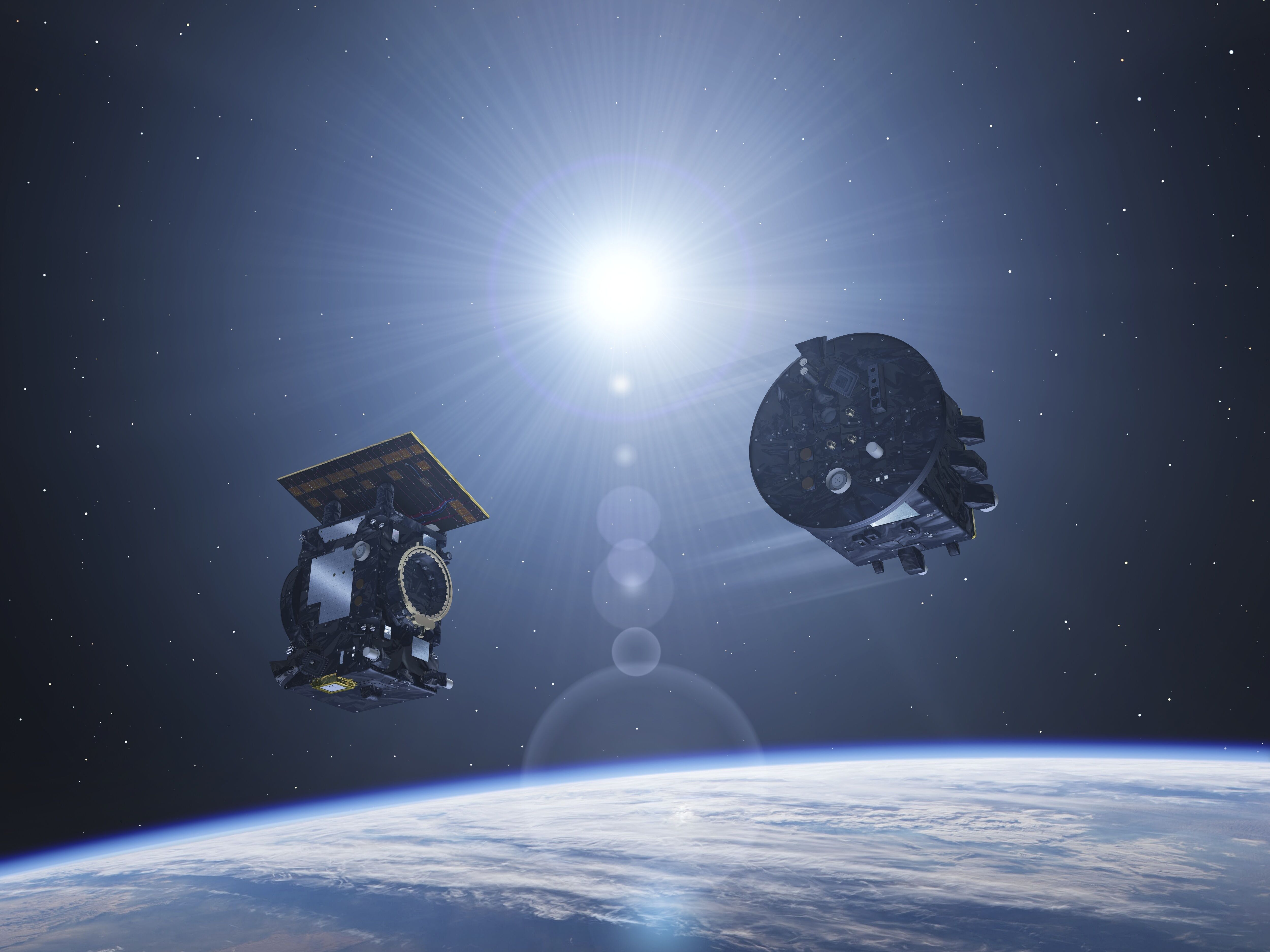
Artist’s impression of the Proba-3 duo satellites. Credit: ESA-P. Carril.
The lifespan of satellite missions can vary greatly, from a few years to decades. This depends mainly on their objective, but also on the orbit in which they are situated, and how precisely they are placed into orbit by the launcher. Normally, an initial duration is planned for each mission, which can then be extended if the ESA member states wish to do so, there is a budget for it and the satellite is still in good condition. An extension thus provides additional scientific value and maximises the return on investment.
This is also the case for Proba-3. This mission was launched on 5 December 2024 with the aim of creating artificial solar eclipses using two satellites. This allows them to study the solar corona, which is otherwise only briefly visible during natural solar eclipses.
‘Since the start of operations, the satellite constellation has already delivered a large amount of high-quality data,’ says Ronald Van der Linden, Director of the Royal Observatory of Belgium. ‘The unique formation is working exceptionally well. This allows us to study the lower layers of the solar corona in great detail, something that was previously impossible. Now that the satellites will be operational for longer, we can continue these important studies. Among other things, this helps us to better understand the Sun’s activity and to predict solar storms and streams of fast solar wind. In this way, we can better protect terrestrial technologies, our space infrastructure and astronauts from the dangerous consequences of these phenomena.’
Belgium’s key role
Belgium plays a central role in this space mission, with a contribution of approximately 66 million euros out of a total budget of 166 million euros, funded via the Federal Public Service for Science Policy (BELSPO) through Belgium’s contribution to ESA. The chairman of BELSPO, Arnaud Vajda, is pleased: ‘The two satellites have proven their robustness. Earlier this year, we briefly lost contact, but this was restored and operations were able to resume in full. The extension of the mission demonstrates that this feat of technology is worth continuing to develop. It confirms the success of this ambitious mission and Belgium’s strong position within European space activities.’
The extension is funded through ESA’s science programme, a mandatory programme run by the agency, and therefore does not require any new investment from our country.
The STCE leads the scientific operation of the coronagraph, which is the mission’s core task. Other instruments have also been installed on the satellites, such as 3DEES, in which the Royal Belgian Institute for Space Aeronomy is involved. This instrument measures high-energy particles around the Earth to better understand radiation in space. Thanks to this knowledge, we can better protect space infrastructure such as satellites, but also astronauts, especially if they were to travel to the Moon or eventually to Mars.