UPDATED - For older posts, please scroll down
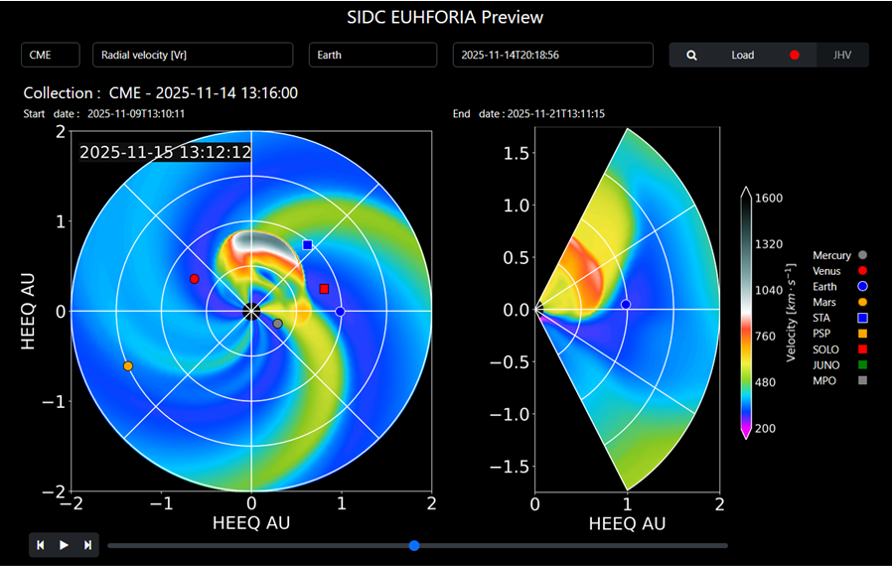
UPDATE 15 November 2025 at 20:30UTC - From the SIDC PRESTO earlier today: "A halo coronal mass ejection (CME) was observed in SOHO/LASCO coronagraph data. It was associated with the X4 flare (SIDC Flare 6063) that peaked at 08:30 UTC on 14 Nov 2025 from SIDC Sunspot Group 687 (NOAA AR 4274). The plane-of-sky speed in SOHO/LASCO is about 1500 km/s, while STEREO-A indicates about 1300 km/s. A 3D reconstruction gives a true speed of roughly 1650 to 1700 km/s. The apex is slightly offset from the Sun-Earth line, so a direct impact is unlikely, but a flank encounter remains possible. EUHFORIA modeling (see screenshot underneath) indicates a glancing blow early on 16 November with at most a weak to moderate shock or compression, and geomagnetic activity up to active or minor storm levels depending on the interplanetary magnetic field orientation within the CME."
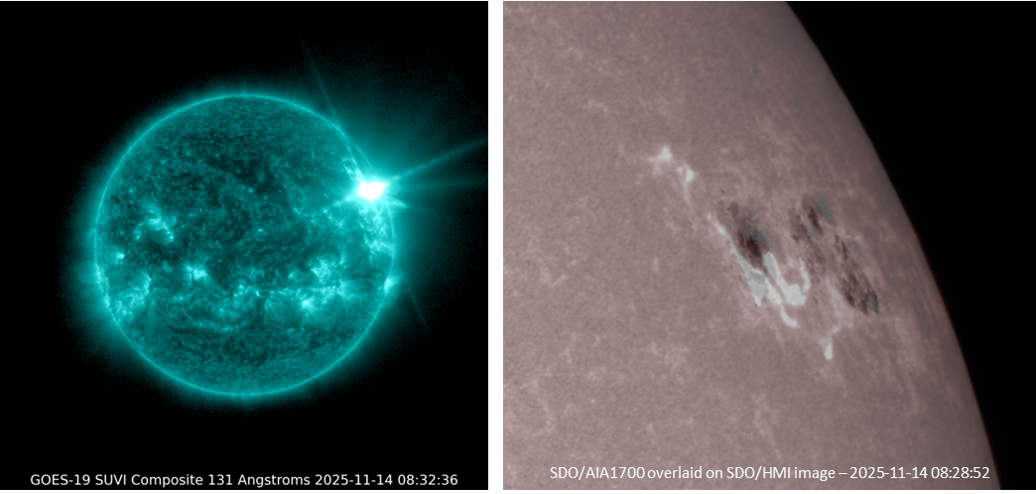
Original 14 November 2025 at 11:30UTC - After two days of relative quiet, SIDC Sunspot Group 687 (NOAA active region (AR) 4274) produced its fifth (!) X-class flare. The X4.0 flare peaked at 08:30 UTC and lasted 56 minutes, nearly a long duration event. The flare can be seen in the extreme ultraviolet (EUV) image taken by GOES/SUVI 131 (underneath left). The source location of the flare's most intense phase was again to the south-east of the trailing main big sunspot. This can be seen in the image underneath right where an EUV image by SDO/AIA 1700 is overlaid onto a white light image.
Only a weak proton event seems to be associated with this eruption (GOES), the fluxes with high-energetic protons (100+ and 500+ MeV) staying mostly at backgound levels.
Radio bursts were detected by the radio astronomy station at Humain (HuRAS), recording Type II and Type III radio bursts (see the STCE SWx Classification page) , as shown in the radio spectrogram underneath with the horizontal axis representing time and the vertical axis representing frequency (lowest frequencies on top). The top chart represents the evolution of the soft x-ray flux as recorded by GOES. A zoom on the 25-75 MHz band between 08:15 and 09:00 UTC is provided by the HuRas/SPADE instrument.
The intensity of the radio bursts was very pronounced over the entire radio band (NOAA/USAF). However, the intensity was (much) weaker at most frequencies than compared to the X5 event of 11 November. Hence, this radio burst is not expected to have disturbed radio/radar communications and applications at these frequencies.
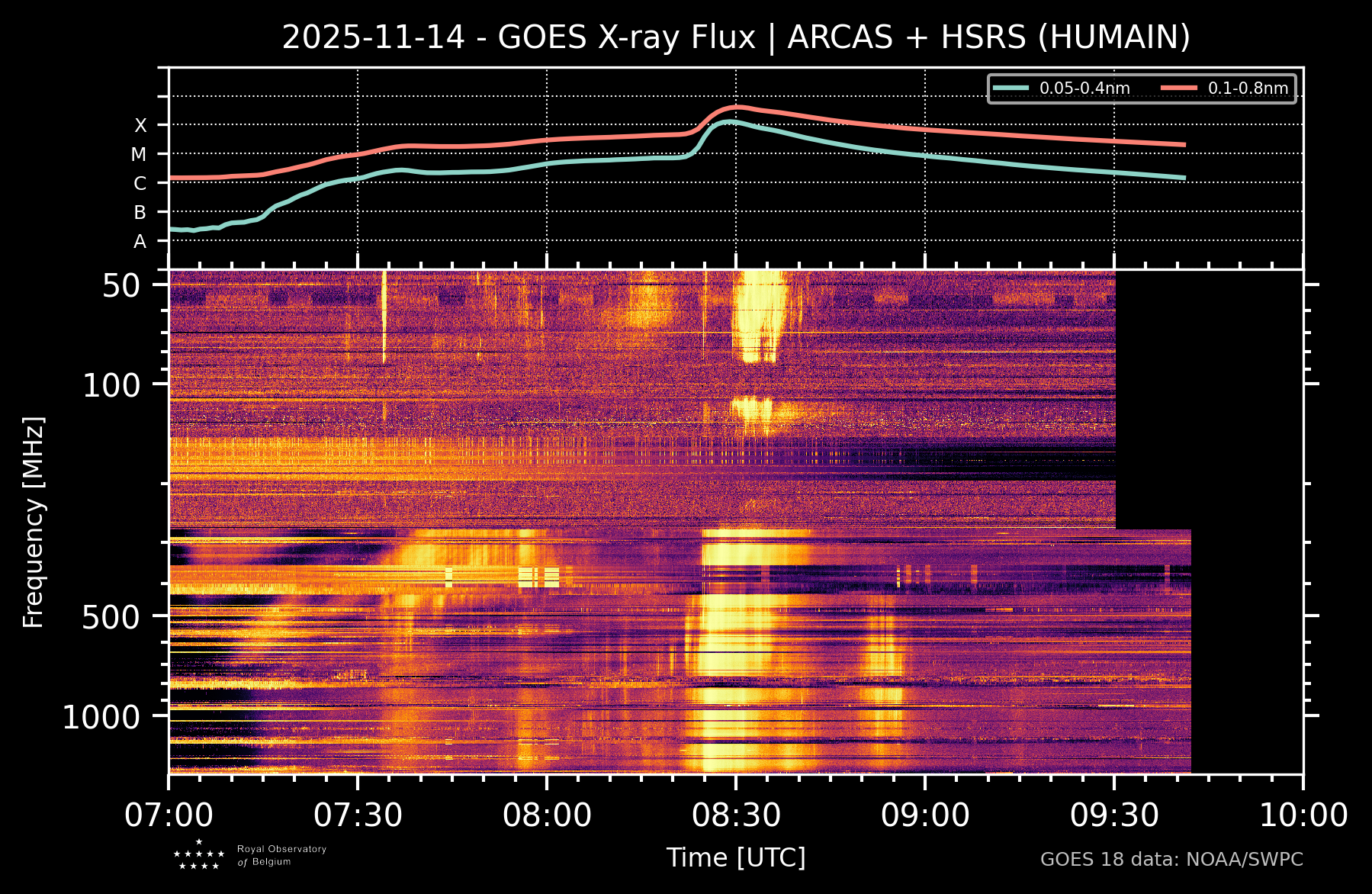
Analysis of the radio bursts seems to indicate that a coronal mass ejection (CME) may have been associated with this flare. Standing-by coronagraphic imagery and further analysis by the SIDC SWx forecaster. In view of the location of the source region on the solar disk, it is expected that the bulk of any CME associated with the X4 eruption will be directed away from the Earth. At most a glancing blow is expected (to be confirmed, and arrival time to be determined), and the resulting geomagnetic storm will be much weaker than the severe storm of 12 November. Hence, currently, no aurora over Belgium are expected from this solar storm over the coming days.
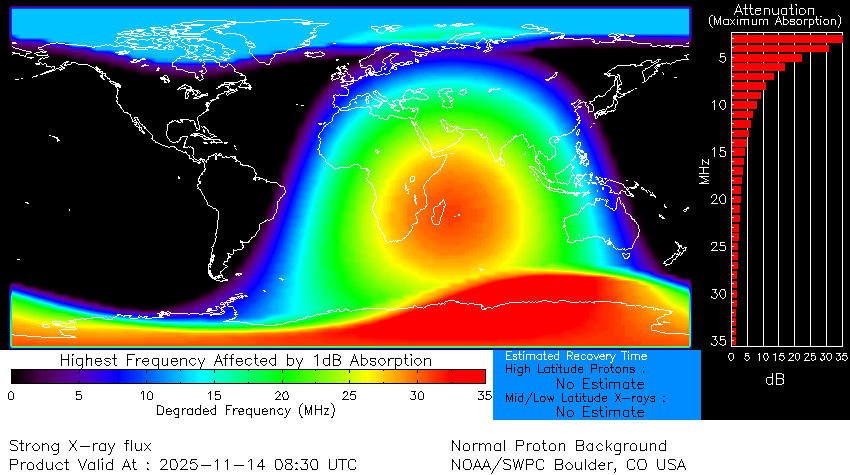
The X-class flare itself affected the lower frequency portion of the High Frequency communication band (HF Com ; 3 - 30 MHz) on the dayside of the Earth, mainly over the middle and southern portion of Africa, Madagascar, and the western portion of the Indian Ocean. An advisory to civil aviation has been issued (PECASUS). The ongoing proton event moderately affects the HF communications over the polar regions, in particular over Antarctica. The effects of the X4 flare on HF Com can be seen in the D-RAP (NOAA/SWPC) map underneath. the HF Com disturbances over Antarctic are still due to the lingering effects of the previous proton event.