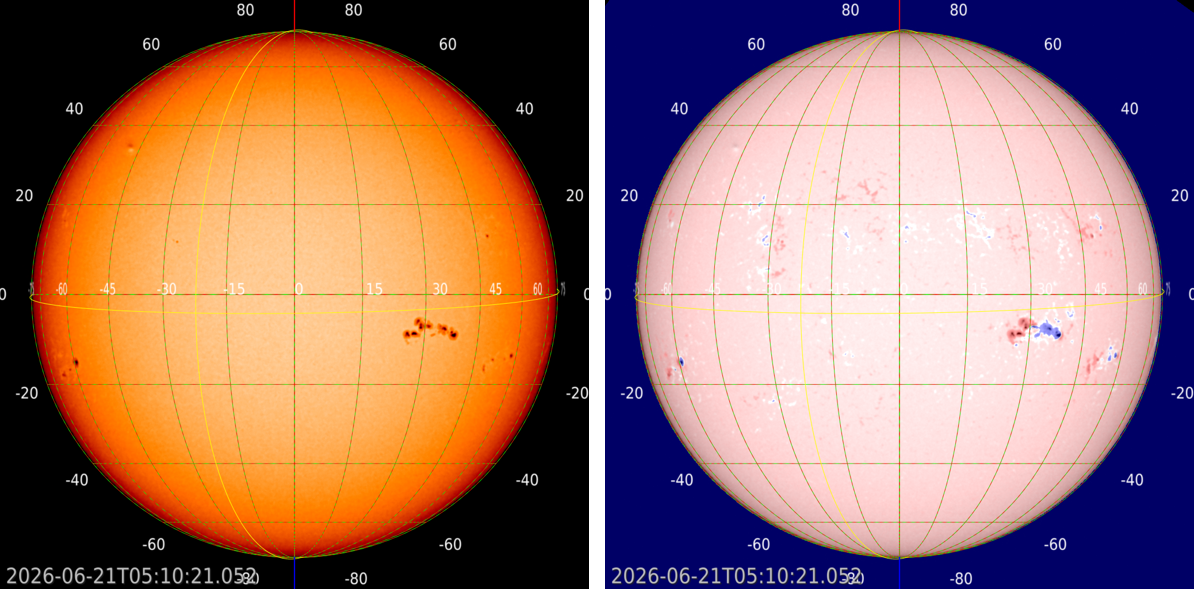
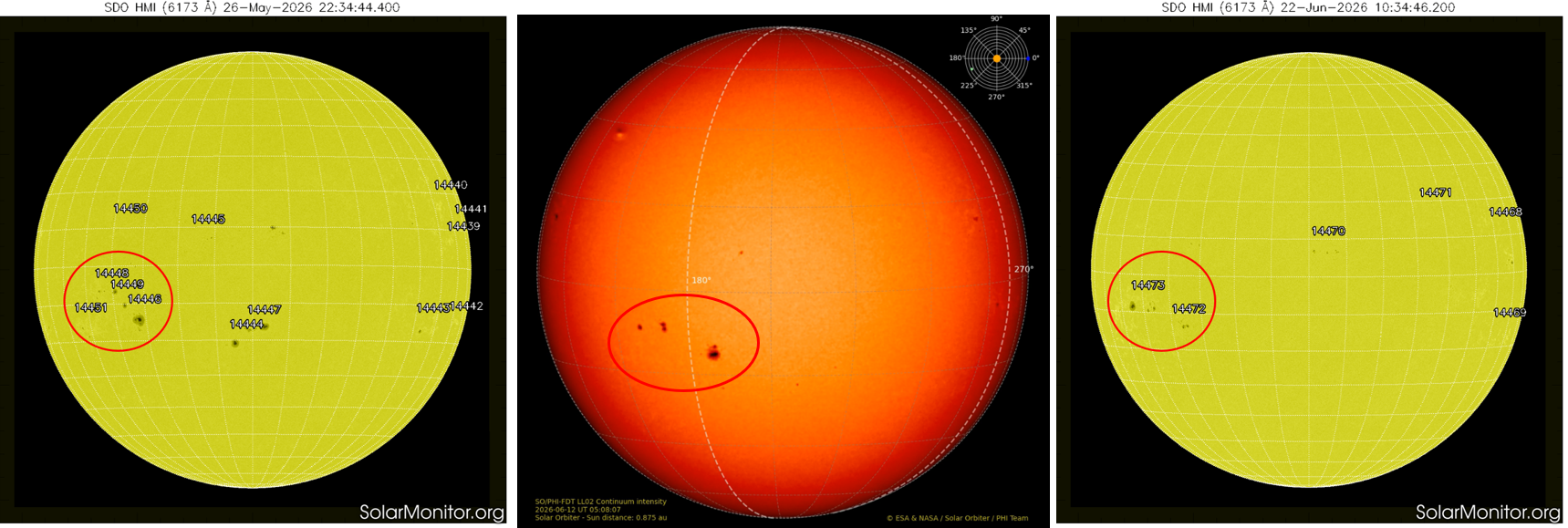
A nest of several active regions has returned on the solar disk, after its 2-week passage on the Sun's far side, as seen from Earth. This group of active regions was discussed in this STCE newsitem. As can be seen in the white light imagery underneath, the annotated SDO/HMI images on the left (26 May) and on the right (22 June) show the group of sunspot regions one solar rotation apart. The middle image was obtained by the Polarimetric and Helioseismic Imager (PHI) on board of Solar Orbiter on 12 June, when the sunspot nest was directly on the far side as seen from Earth (indicated by the 180° meridian).
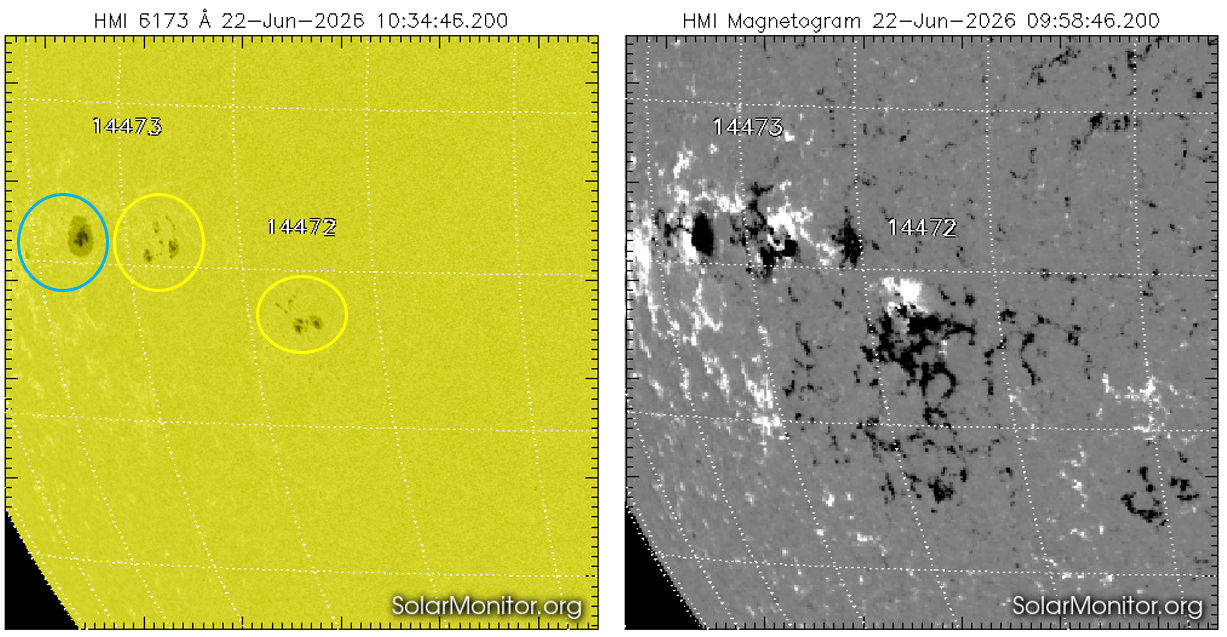
Both groups were in the decaying phase of their life, and -according to the PHI imagery- the trailing portion of the second group gave way to the development of a new active region. By the time they rounded the Sun's east limb as seen from Earth, the leading spot of this new region had become the largest spot in the nest. As could be expected, the main (leading) sunspots of all 3 regions have the same magnetic polarity (black, "negative"). This can be seen in the annotated SDO/HMI imagery underneath, with the old active regions in yellow circles and the new region in blue.
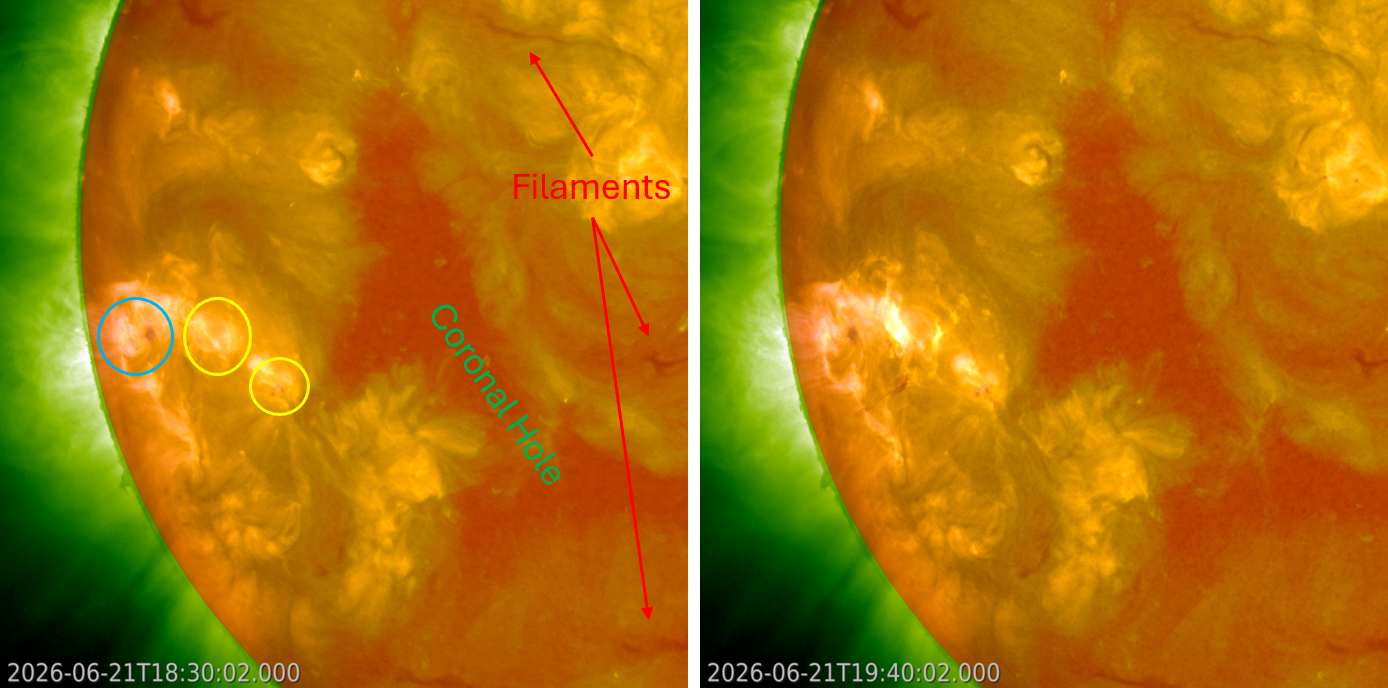
Unlike a solar rotation ago, this time, the sunspot regions were not afraid to show what they were capable of. "Old" region NOAA 14472 and the "new" region produced an M1 flare each on 20 June. The strongest flares were produced by "old" region NOAA 14473: An M2 flare early on 21 June, and an M6 flare around 19:30 UTC on the same day. The annotated images underneath combine H-alpha images (red portion of the solar spectrum, showing the lower, "cooler" solar atmosphere) from the GONG network with extreme ultraviolet images from SDO/AIA 211 (showing the "corona", or the Sun's multimillion-degree hot upper atmosphere). This combination allows in a single image a view on the largest sunspots, filaments, flares and coronal holes. The image on the right shows the M6 flare in NOAA 14473, and on the left the outlook an hour before the eruption.
Meanwhile, a new active region is ready to rotate over the Sun's east limb, probably from 23 June onwards. This is a brand-new sunspot region that developed about a week ago on the Sun's far side, and is now a big and complex sunspot group as shown in the PHI imagery underneath (left: white light ; right: magnetogram). Hence, it is perfectly possible that the flare activity remains enhanced over the next few days.