Solar eruptions are usually characterized by significant enhancements in soft x-rays and extreme ultraviolet. Occasionally, these eruptions are also accompanied by strong emissions at radio frequencies. These Solar Radio Bursts (SRBs) may manifest themselves over the entire radio frequency range, i.e. from the ionospheric cut-off frequency around 15 MHz to several GHz. Hence, strong SRBs may affect technologies such as radar and communication devices operating at these frequencies. Examples are numerous: from the recent radio communication incident on 14 December 2023 (SPECTRUM News ; NOAA/SWPC) over the disturbance of the Swedish air traffic control radar on 4 November 2015 (Marqué et al. 2018) to the interference with GNSS receivers (Global Navigation Satellite Systems such as GPC and Galileo) on 6 December 2006 (Cerruti et al. 2008). Note these impacts concern dayside locations only.

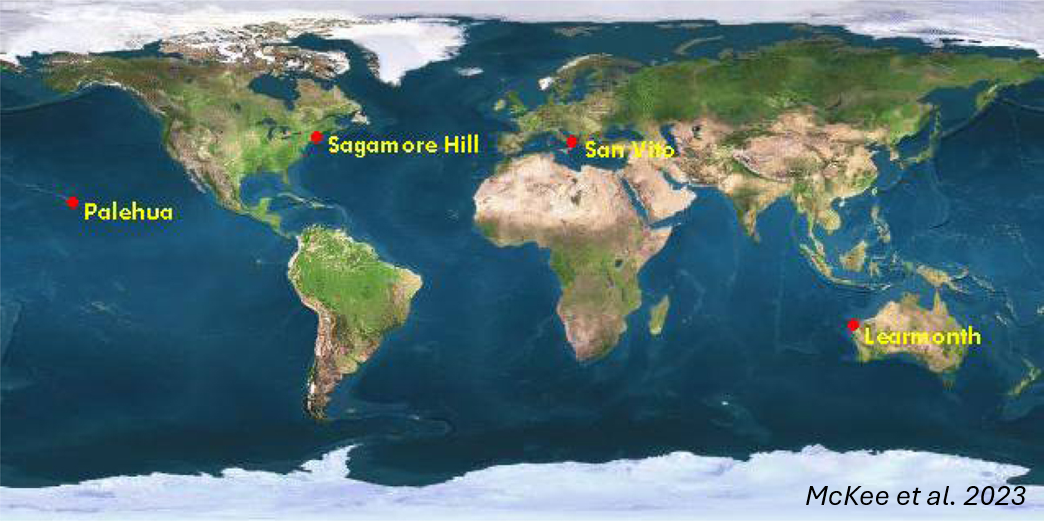
The aforementioned examples obviously require strong intensities at the affected frequencies, meaning that this kind of disturbances do not happen too often. This begs the question: how often? NOAA/SWPC maintains a list of solar radio bursts in their daily "Solar and Geophysical Event Reports" whose archive can be found in their "warehouse". The listings are based on observations of the solar radio flux density at eight frequencies (245; 410; 610; 1415; 2695; 4995; 8800; and 15400 MHz) reported by the United States Air Force (USAF) Radio Solar Telescope Network (RSTN). This network is composed of 4 stations, globally distributed: Learmonth (Australia), San Vito (Italy), Palehua (Hawaii, USA), and Sagamore Hill (Massachusetts, USA) - see e.g. McKee et al. (2023). Though this data set may be incomplete -Nita et al. (2002) has suggested up to 50% of bursts on some frequencies are missing- and has its limitations, it certainly provides a good "first idea" (Giersch et al. 2017).
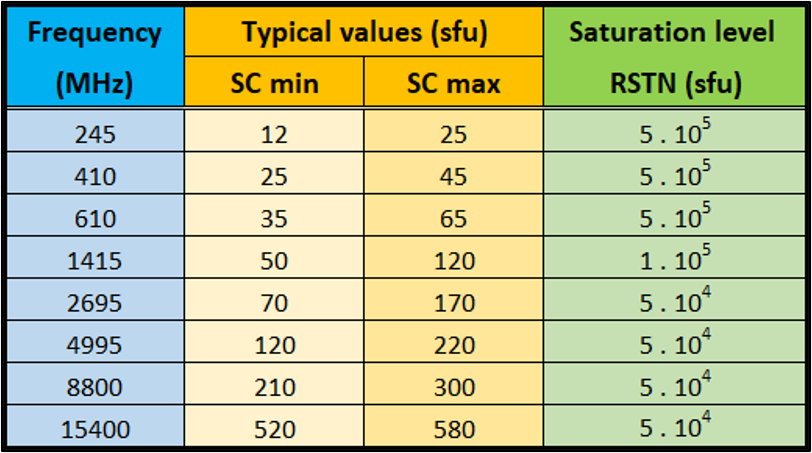
The table underneath provides for each frequency a typical value for solar cycle minimum and solar cycle maximum, as well as the values at which the RSTN radiometer saturates. The typical values for solar cycle minimum and maximum were calculated from the Learmonth observations (one of the RSTN stations) for the minimum and maximum year of the last 3 solar cycles (SC23 to 25; NCEI). For the saturation values, these are nominal values that can vary by more than 50% depending on calibration (maintenance alignments, non-linearity,...). Any bursts reported near these maximum values are thus questionable because of the possibility that the radiometer was saturated and thus the event's magnitude may have been significantly above the reported value (Giersch et al. 2017). The SRB intensities can then be checked against other (non-RSTN) stations, such as the Owens Valley Solar Array (OVSA), Nobeyama, the Humain Solar Radioastronomy Station (HSRS), or stations of the e-Callisto network.
The bursts derived from the daily NOAA reports cover the period of 1996-2025, so a bit more than 2.5 solar cycles. Only bursts with an intensity of at least 5000 sfu (solar flux unit, 1 sfu = 10-22 W m-2 Hz-1) were selected, regardless of the frequency. This value comes from the intensity that SRBs must have (measured at a frequency of 1415 MHz) to affect GNSS applications. There has been some dispute over the exact level of solar flux that causes an effect on GNSS equipment. Often quoted values are 40.000 sfu (Klobuchar et al., 1999), around 10.000 sfu (Cerruti et al. 2006), 4000-12.000 sfu (Chen et al. 2005), and 1800 sfu (Yue et al. 2018). For practical reasons, it was decided to settle on a value of 5000 sfu, with the option that -if so required- this limit can be lowered for some frequencies in a future effort. Plenty of factors play indeed a role: from the solar zenith angle over the technicalities of the measurement devices to the sensitivity of the technology affected (see Giersch et al. 2017 for an overview of the limitations of the NOAA/RSTN reportings). The related graphs at the STCE's Solar Cycle Tracking page are not corrected for any of these, with only a few obvious errors eliminated. The graphs only show one burst per day (the most intense), as very occasionally during episodes of significant solar activity, several strong SRBs may occur at the same frequency in a single day. Such occurrences are rare and affect most often the 245 MHz and 410 MHz frequencies. Note also that during a solar eruption not all radio frequencies are affected as strongly, and that the difference in intensity between the frequencies may be considerable.
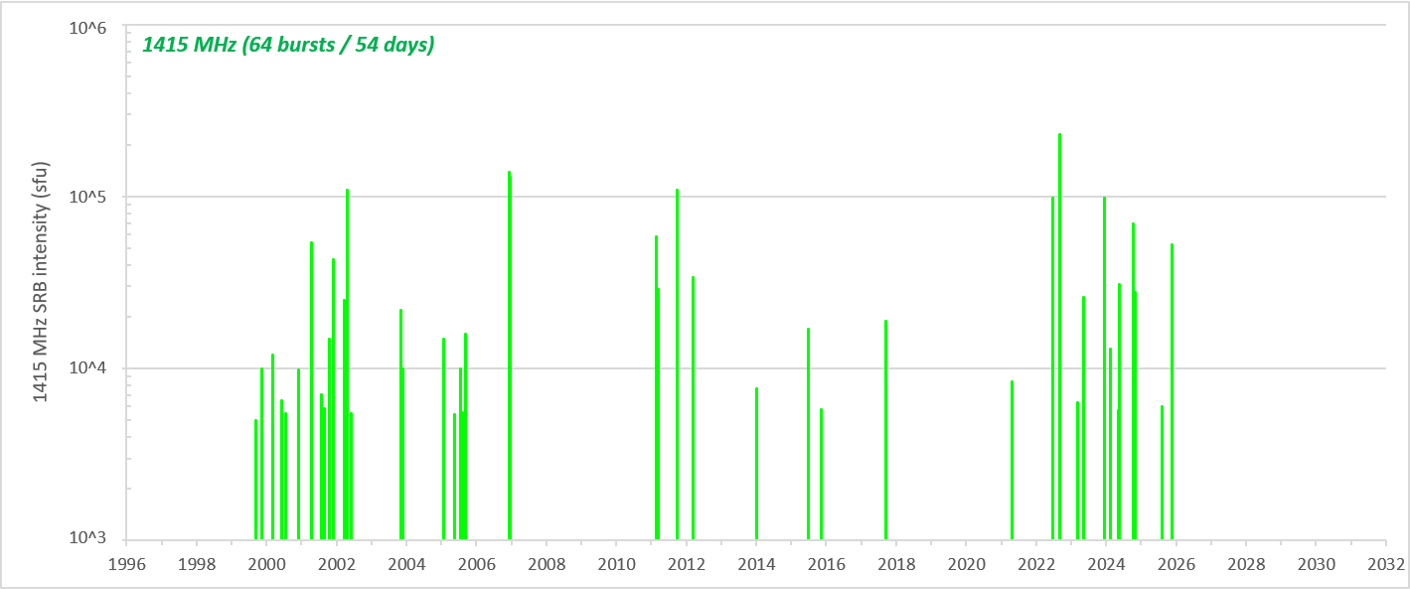
These graphs have now been added to the STCE's Solar Cycle Tracking page. The aim is to have them actualized once a year, during the first update. The graph underneath is an example for the frequency of 1415 MHz, with a total of 64 bursts (larger than 5000 sfu) recorded on 54 different days during the 30-year period, and only the most intense burst for that day displayed.