A compilation of the most memorable space weather moments of 2025 can be found underneath. Using the versatile Space Weather JHelioviewer (SWHV - https://swhv.oma.be/user_manual/) software, a ***MOVIE*** was created (available on YouTube ) containing one or more clips of each event. Usually, images from SDO, GOES/SUVI, STEREO, and SOHO have been used, occasionally supplemented with imagery from Solar Orbiter, PROBA2/SWAP, ROB/USET and the GONG/H-alpha network.
As this chronological list concerns mostly punctual events on the Sun, it does not contain clips from other noteworthy events in 2025 such as e.g. the fly-by of Comet ATLAS, Solar Orbiter's first full view of the solar poles, Proba-3's first image of the solar corona, SOHO's 30th anniversary, and the grounding of half of the Airbus fleet following an incident due to a Single Event Upset induced by a highly energetic particle. Also, for a concise overview of space weather events and their impacts so far this solar cycle, please refer to the STCE's SC25 tracking page.
Happy viewing!
Event 1: Early February - A flock of sunspot groups and numerous CMEs
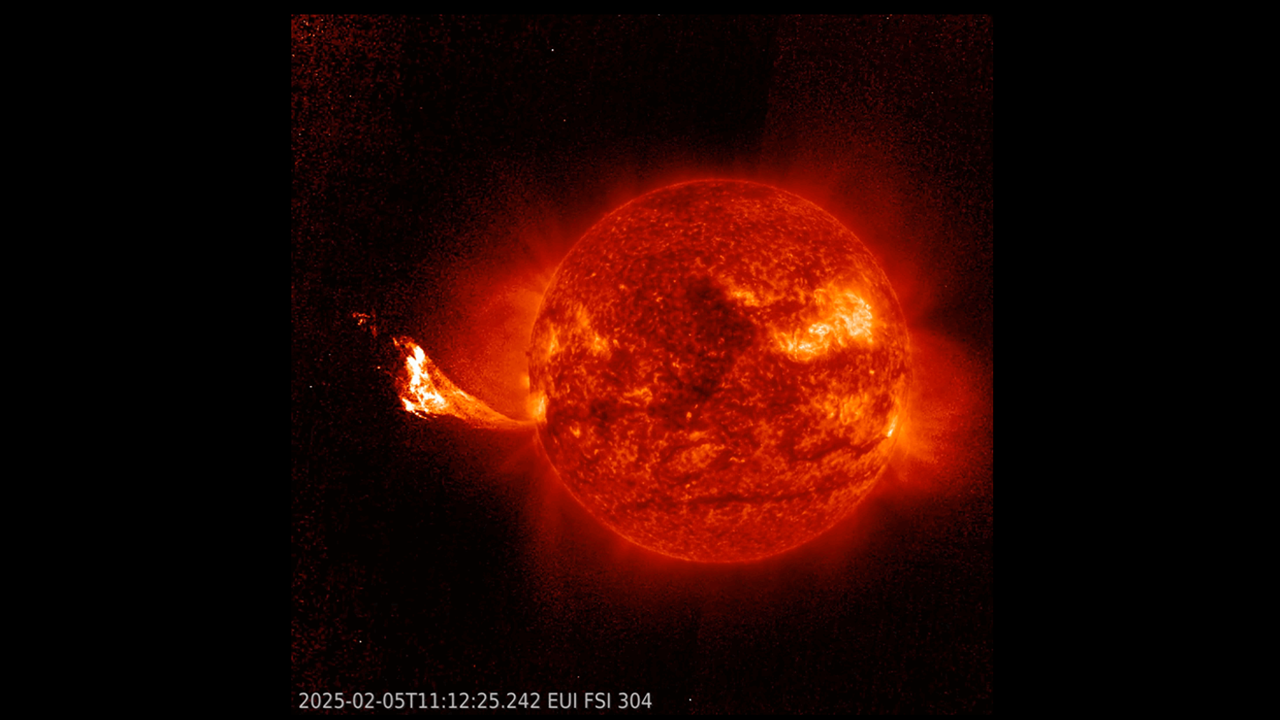
Late January, a nest of closely spaced sunspot groups started its transit over the solar disk. Dozens of sunspots of varying sizes were squeezed together in an area of about 12 by 20 degrees, with even more developing close-by. It drove the monthly sunspot number for February to 155.7, the highest of the entire year. The sunspot nest was an important source of coronal mass ejections (CMEs) during this period. Other sources contributing to this eruptive activity were other sunspot regions, filament eruptions, active regions near the solar limb or originating from the Sun's farside. On 5 February, the EUI telescopes on board Solar Orbiter recorded a jet-like eruption that -at its maximum height- towered over 700.000 km above the solar limb. That is close to twice the Earth-Moon distance!
Ref: STCE newsitems of 3 February and 18 February
Event 2: 24-25 February - Major filament eruption and CME
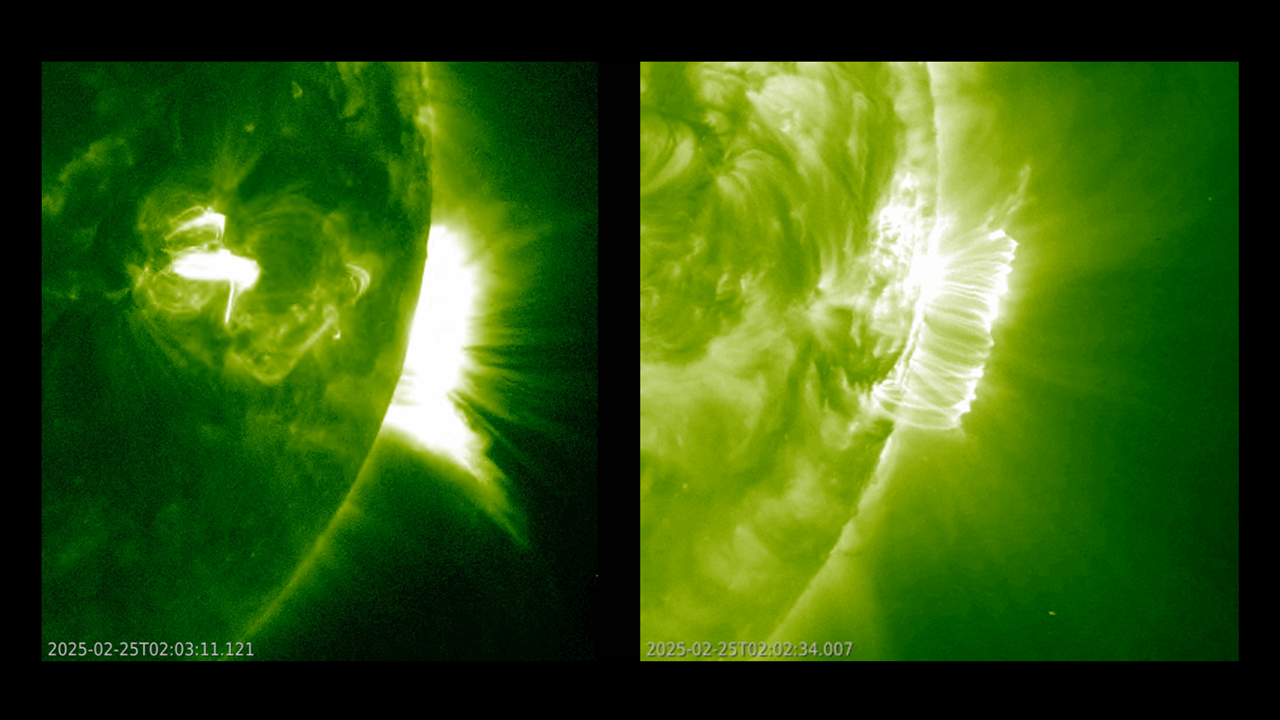
Late on 24 February, a filament erupted while it had already rotated over the Sun's west limb. Yet, it was still associated with a long-duration M3.9 flare. Features such as post-eruption coronal loops and supra-arcade downflows ("SADs" ) could be seen. The eruption was also associated with a minor proton event and a solid and fast partial halo coronal mass ejection (CME). This CME was obviously not directed to Earth in view of the location of the source (behind the solar limb). It had a high speed near 1100 km/s.
Ref: STCE newsitem of 4 March
Event 3: March-December - Large, recurring coronal hole
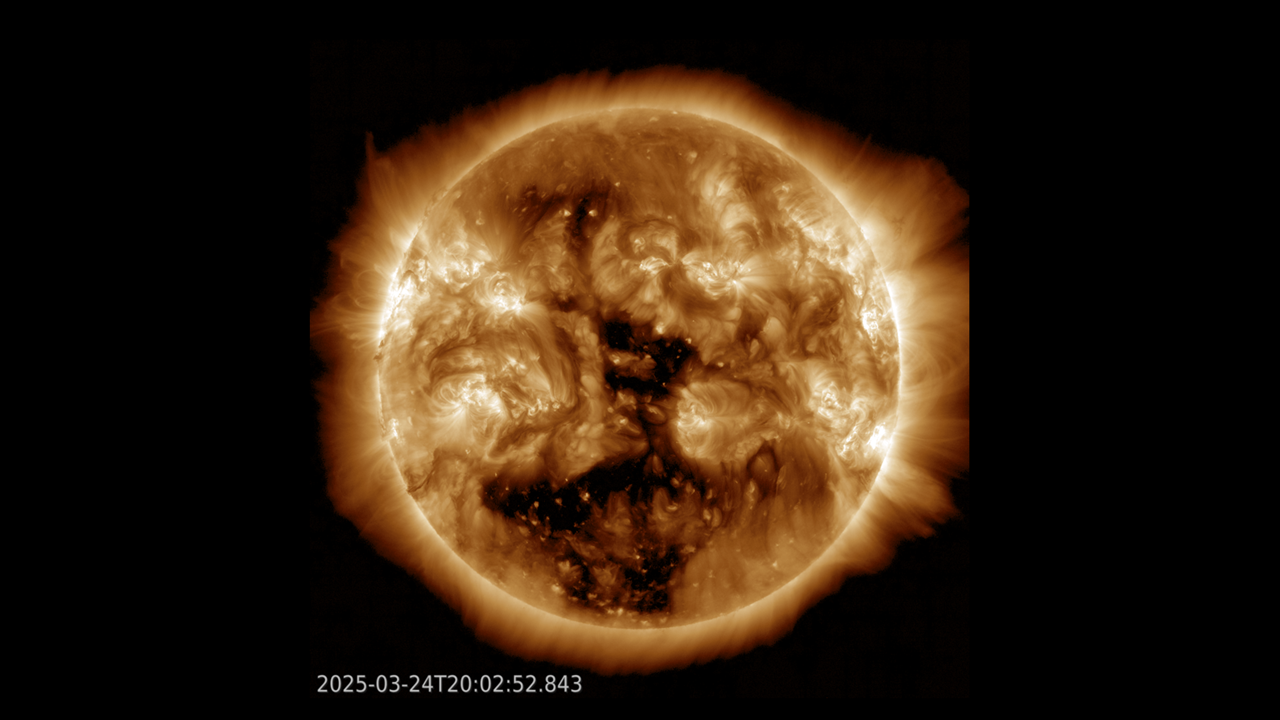
A large, positive polarity coronal hole dominated the outlook of the corona (the Sun's hot outer atmosphere) during each consecutive rotation, and this throughout the entire year! It was largest during its January to April transits, reaching 800 times the total surface area of the Earth (SIDC/SolarMap). The associated high speed streams drove the fluence of energetic electrons (> 2 MeV) in geostationary orbit to high levels early October. These were the highest of the entire year and even affected GOES proton measurements. These highly energetic electrons pose a threat to the electronics on board satellites.
Ref: STCE newsitems of 1 April, 23 April, and 6 October
Event 4: 12-13 April - Filament eruptions combine for a severe geomagnetic storm
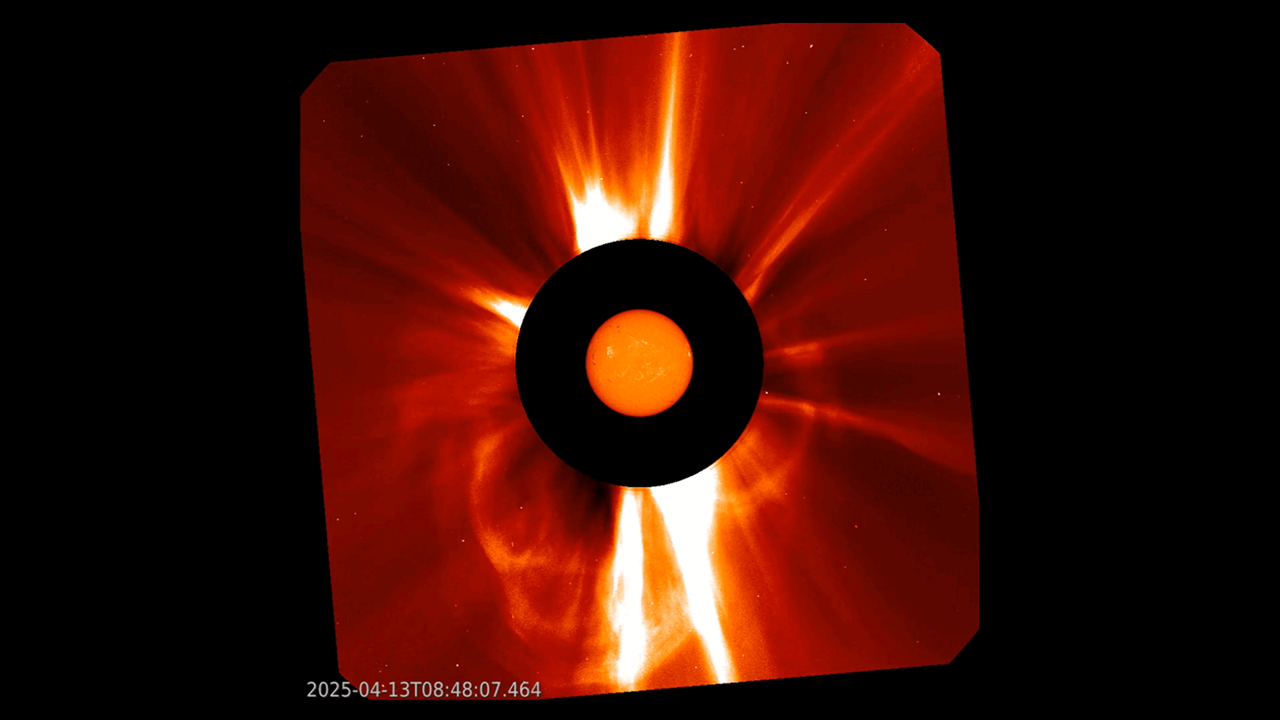
The CMEs related to two filament eruptions late on 12 and early on 13 April combined forces to create a severe geomagnetic storm (Kp = 8-) on 15-16 April. This was the second of only 4 days during which severe geomagnetic storm conditions were reached, the other 3 being 1 January, 1 June and 12 November.
Ref: STCE newsitem of 14 April and STCE newsletter of 25 April
Event 5: 4 April-7 June - Large sunspot group
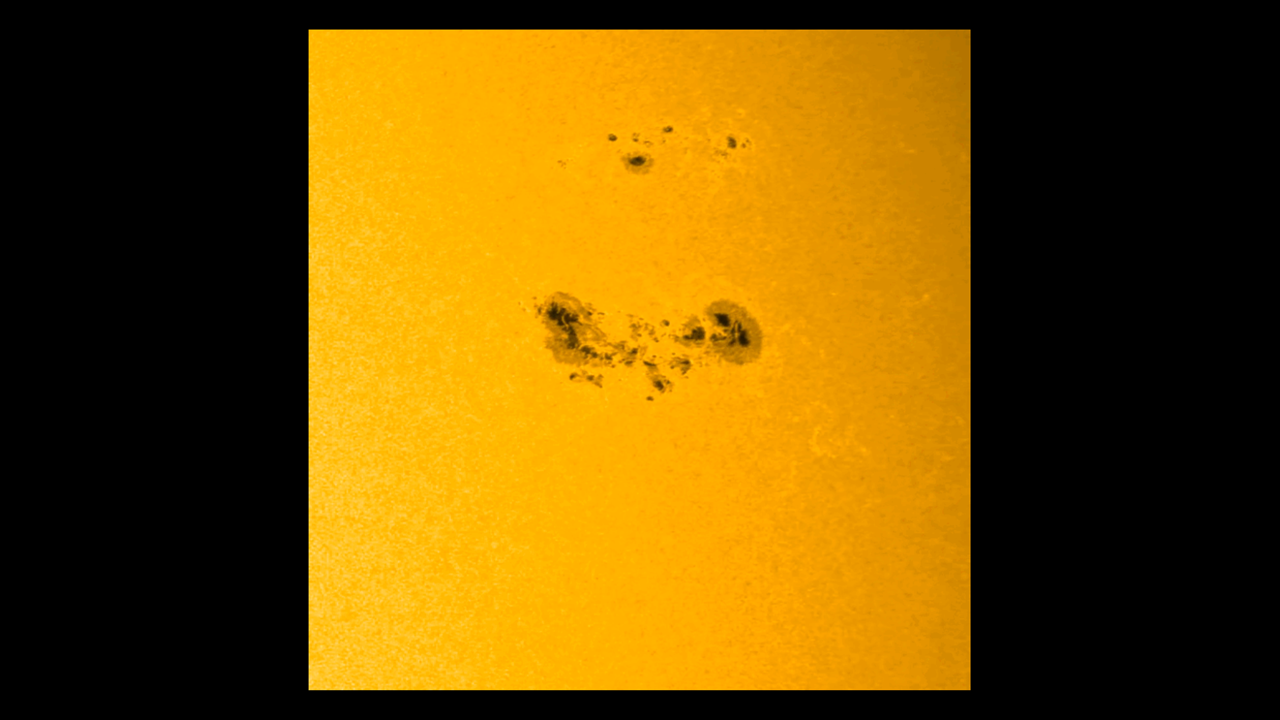
A large sunspot group started to develop on 4 April and was visible for 3 consectuive solar rotations. It was last seen on 7 June while rounding the west solar limb. Known as respectively NOAA 4055, NOAA 4079 and NOAA 4100 (SIDC sunspot group 469), the group reached its largest size during its second solar transit. At that time, its sunspot area was 9 times the total surface area of the Earth, and -using eclipse glasses- the region was visible with the naked eye. NOAA 4079 would eventully become the second-largest sunspot group of the year. Over its 65-day lifespan, the group produced nearly 3 dozen of M-class flares.
Ref: STCE newsitems of 14 April and 7 May
Event 6: 12-14 May - Spectacular filament eruption

Late on 12 May, a filament with a length of twice the Earth-Moon distance (!) erupted from the Sun's northern hemisphere. The eruption looked very complex, but using imagery from both GOES and STEREO-A (preceding Earth by 36°), it turned out that the large front side filament eruption was accompanied by an almost simultaneous eruption of a filament on the Sun's far side along the same line-of-sight.
Ref: STCE newsitem of 19 May
Event 7: 30-31 May - Powerful long-duration M8 flare
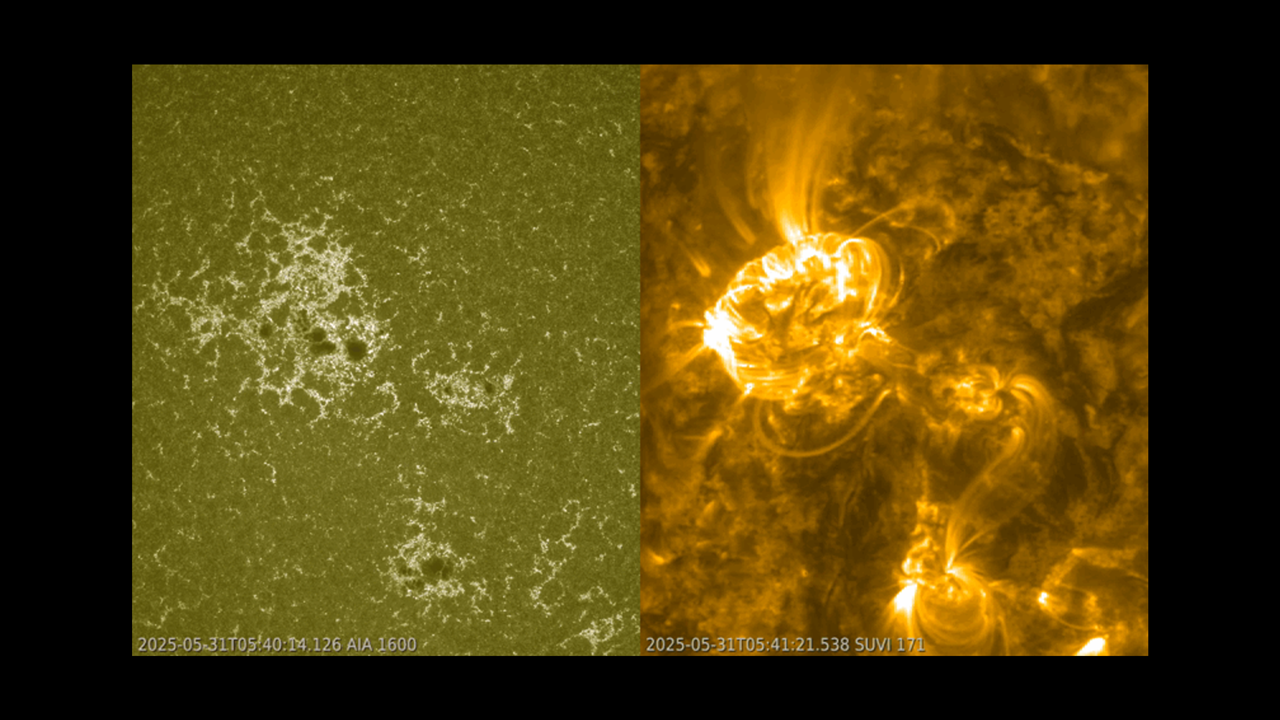
NOAA 4100 was already the third appearance of the original active region NOAA 4055 (SIDC sunspot group 469) and decaying, when ultimately it produced a long duration (2 hours!) M8.1 flare peaking shortly after midnight on 31 May. The associated halo CME had a speed of over 1500 km/s and battered the earth environment already 29 hours later, resulting in a severe geomagnetic storm (Kp = 8-). The speed with which this interplanetary CME passed would eventually top 1100 km/s, which is unusually high. The greater than 10 MeV proton flux reached moderate levels (666 pfu) peaking near the time of the ICME arrival (a so-called "ESP event", as it results from the acceleration of charged particles by a fast, usually ICME-driven shock in interplanetary space - see this STCE newsitem). Except for a single interval late on 1 June, the geomagnetic storm lasted for 66 consecutive hours (Kp = 5- or higher), with solar wind parameters suggesting 2 or 3 CMEs might have been involved. The solid CME also provided additional shielding against the cosmic rays, with the Oulu neutron monitor registering a drop of 18% in the neutron flux. This was the strongest "Forbush decrease" so far this solar cycle!
Ref: STCE newsitem of 31 May-1 June ; STCE SC25 Tracking page (cosmic rays)
Event 8: 14-15 July - More impressive filament eruptions
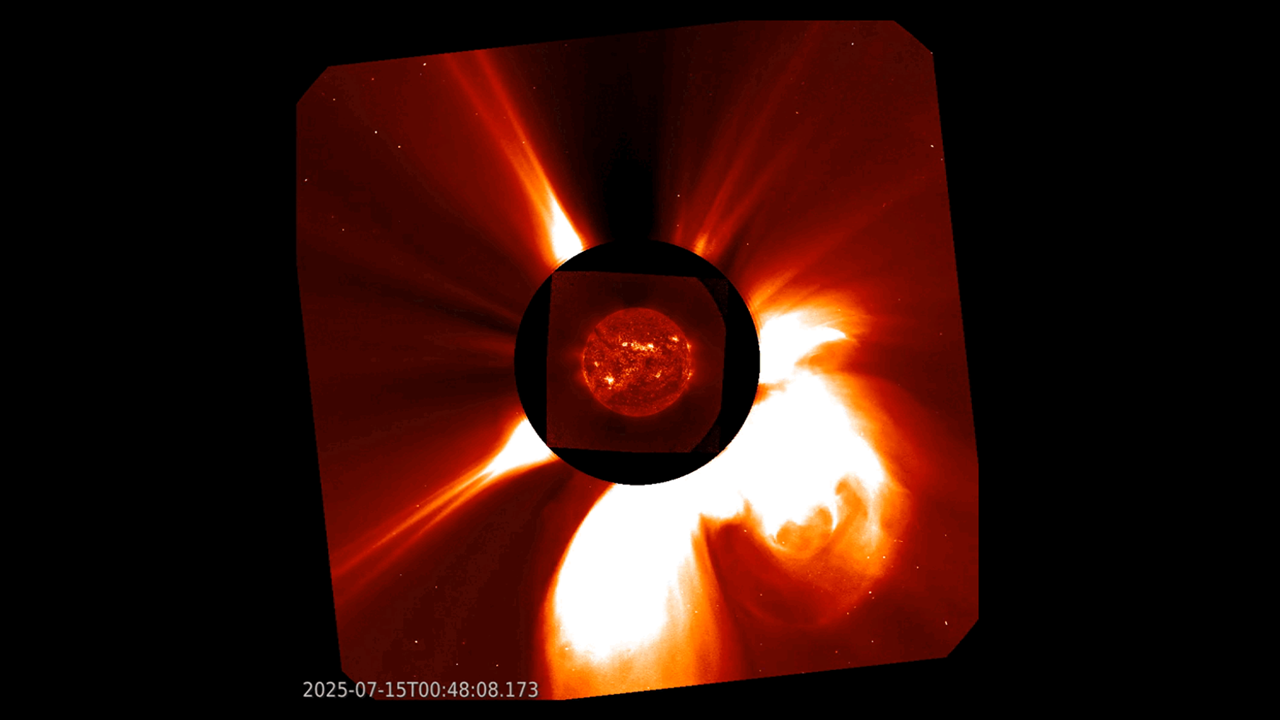
Two spectacular eruptions took place mid-July, with a prominence eruption near the Sun's southwest limb on 14 July, followed by a filament eruption from the northeast solar quadrant a day later. The length of the parallel ribbons in the second eruption is at least 350.000 km -about the distance between the Earth and the Moon-. The feature is often dubbed a "canyon-of-fire". The associated CMEs had plane-of-the-sky speeds around 400-500 km/s and were not directed to Earth.
Ref: STCE newsitem of 22 July
Event 9: 10-11 August - NOAA 4168 produces M2 flare
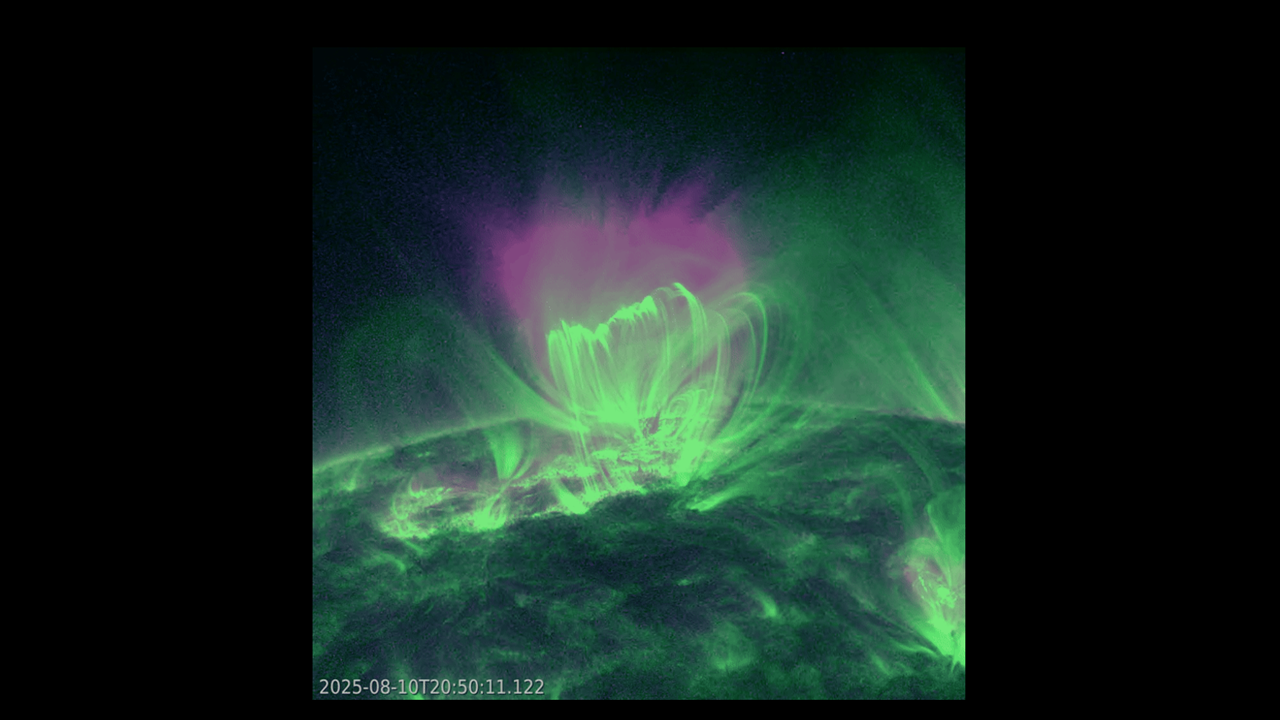
NOAA 4168 was a small but complex sunspot group that started to develop on 2 August, just south of decaying NOAA 4165. Due to its complex magnetic structure, NOAA 4168 quickly became a very flare-active region, producing 17 M-class ("medium") flares during its transit. Probably the nicest M-class eruption from NOAA 4168 took place on 10 August. At that time, the active region was already close to the Sun's west limb, and so the eruption could be nicely seen in profile. The M2.2 flare peaked at 15:07UTC. The post-flare coronal loops reached a height of nearly 200.000 km, that's half the Earth-Moon distance. Also the supra-arcade downflows ("SADs") were very prominent.
Ref: STCE newsitem of 18 August
Event 10: 20 August - Solar prominences choose for the vastness of interplanetary space
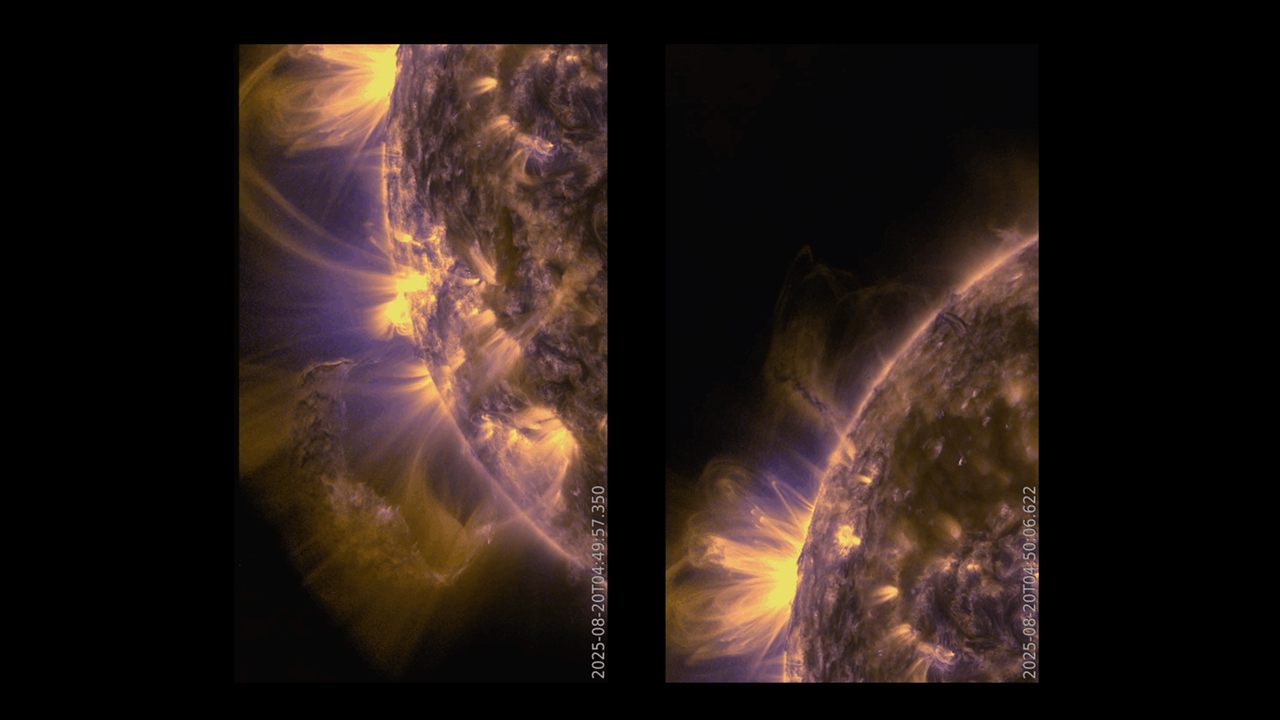
Two solid prominences located near respectively the southeast and northeast solar limb erupted early on 20 August. The associated CMEs were not earth-directed. The views are spectacular both at "cold" temperatures (about 80.000 degrees) and hot temperatures near and above 1 million degrees.
Ref: STCE newsitem of 2 September
Event 11: 21 August - Powerful farside event
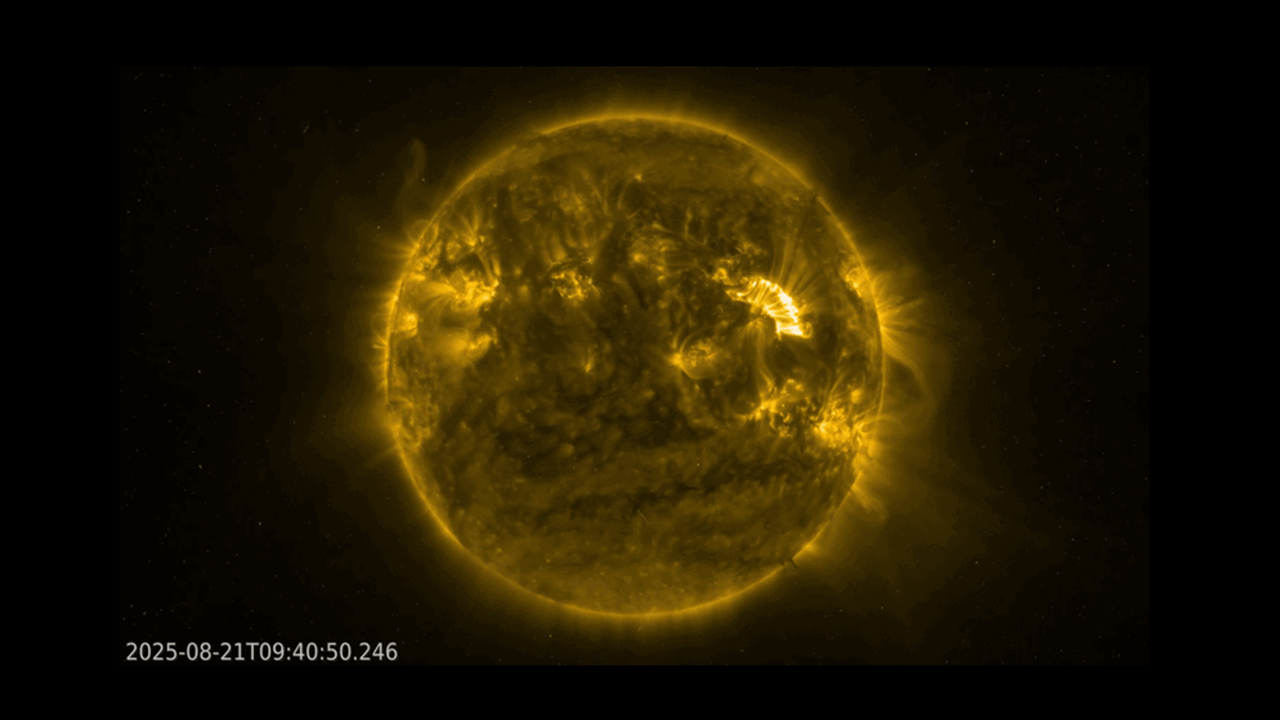
Out of nowhere, a powerful full halo CME appeared on 21 August, with a speed ranging between 1200 and 1600 km/s. As there were no important active regions on the earth-facing solar disk, it was quickly determined that this CME had to originate from the Sun's farside. Fortunately, instruments on board Solar Orbiter (EUI, STIX) were monitoring the Sun's farside at that time. They linked the eruption to an active region about 3 days behind the Sun's east limb (as seen from Earth), and a proxied flare intensity of X1.4. Amazingly, the greater than 10 MeV proton flux gradually started to increase a day later and would eventually reach 13 pfu (proton flux units). Though this is only a minor proton event, it's still a formidable achievement for a farside eruption. The region would rotate onto the earth-facing solar hemisphere early on 25 August as NOAA 4199 (SIDC sunspot group 617) and would still produce some M-class flares during its transit.
Ref: STCE newsitem of 2 September
Event 12: 11 September - Recurring coronal hole
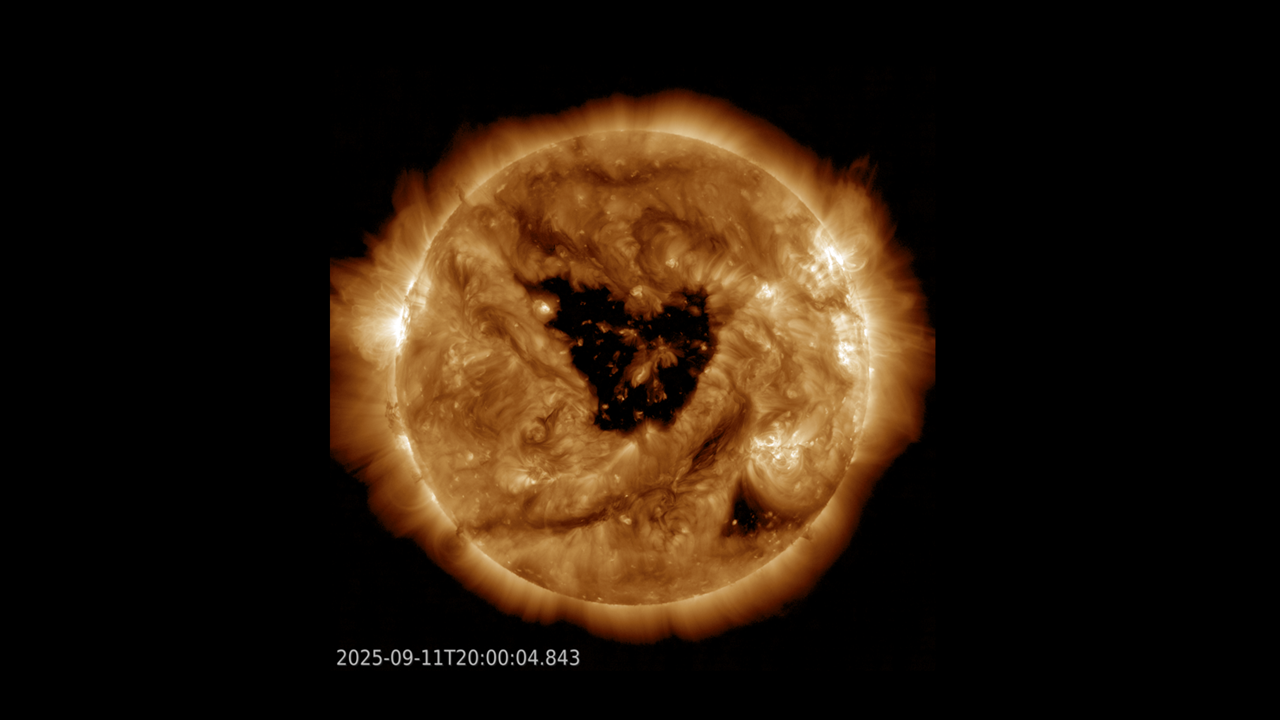
A large, negative polarity coronal hole dominated the outlook of the corona between April and December 2025. It was largest during its June and September transits, reaching 260 times the total surface area of the Earth (SIDC/SolarMap). The associated high speed stream reached a maximum speed of 800 km/s and drove the fluence of energetic electrons (> 2 MeV) in geostationary orbit to high levels on 20 and 21 July.
Ref: STCE newsitems of 16 September
Event 13: 21 October - Another powerful farside event

NOAA 4246 (SIDC sunspot group 639) started to develop on 10 October into a large and complex active region. It was the source of 27 M-class flares during its transit over the solar disk from 10 to 19 October, making it the most prolific M-class flare generator of 2025. Then, out of nowhere, a powerful full halo CME appeared on 21 October, with a speed around 1350 km/s. STEREO-A imagery indicated the location to be NOAA 4246 which at that time was transiting the Sun's farside. Based on these EUV images, the intensity of the flare was proxied to be X1.1 (Chertok et al. 2015). There was a small enhancement in the greater than 10 MeV proton flux, but the flux remained well below the alert threshold.
Ref: STCE newsitem of 20 October and STCE Newsletter of 29 October
Event 14: 9-14 November - NOAA 4274: five X-class flares, a severe geomagnetic storm and an intense GLE
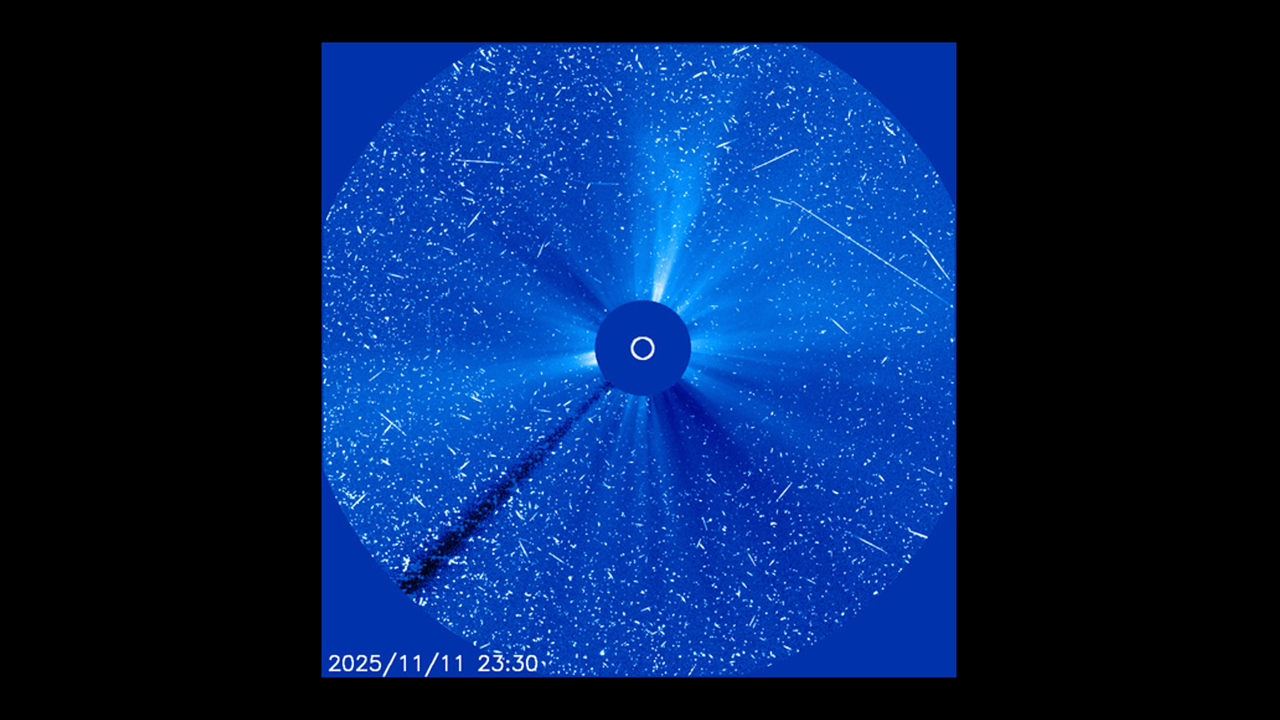
Active region NOAA 4274 (SIDC sunspot group 687) was the return of the flare-productive NOAA 4246. The region now also produced X-class flares, continuing a habit it had picked up during its farside transit. The earth-directed CMEs associated with the X-class flares on 9 and 10 November would eventually result in a severe geomagnetic storm on 12 November (Kp = 9-). This was the most intense geomagnetic storm of 2025, with distinctly red aurora visible as far south as Florida and Texas in the United States, and Catalonia (Spain), Austria and Switzerland in Europe. Solar wind speed (990 km/s) and the intensity of the north-south component of the interplanetary magnetic field (Bz ; -53 nT) would reach values more extreme than during the May 2024 storm, but did not last as long. The X5.1 flare of 11 November was the strongest in 2025, and the arrival of its associated CME would prolong the ongoing geomagnetic storm into 13 November. The flare events were also associated with very strong radio emission, in particular at 410 MHz and 610 MHz (9 and 10 November) and at 1415 MHz (GNSS frequencies; 11 November).
The greater than 10 MeV proton flux would reach 1460 pfu (a strong event) but was mainly driven by the arrival of successive interplanetary CMEs (so-called "ESP events", as they result from the acceleration of charged particles by a fast, usually ICME-driven shock in interplanetary space - see this STCE newsitem). Nonethless, a ground level enhancement (GLE) was associated with the X5.1 flare. This was the largest of the 5 GLEs recorded so far this solar cycle, with the greater than 500 MeV proton flux, i.e. the driver behind these enhancements, being a factor 7 to 10 larger than those from the previous GLEs. The resulting percentage increase in neutron counts was up to 75%-150% at some locations, compared to only about 10% for the GLE on 11 May 2024. We have to go back until 13 December 2006 to find a GLE of similar intensity.
Ref: STCE newsitems of 9-10 November, 11 November, 12-13 November, 14-15 November, and 20 November
Event 15: 1-8 December - Several strong and flare-active sunspot regions
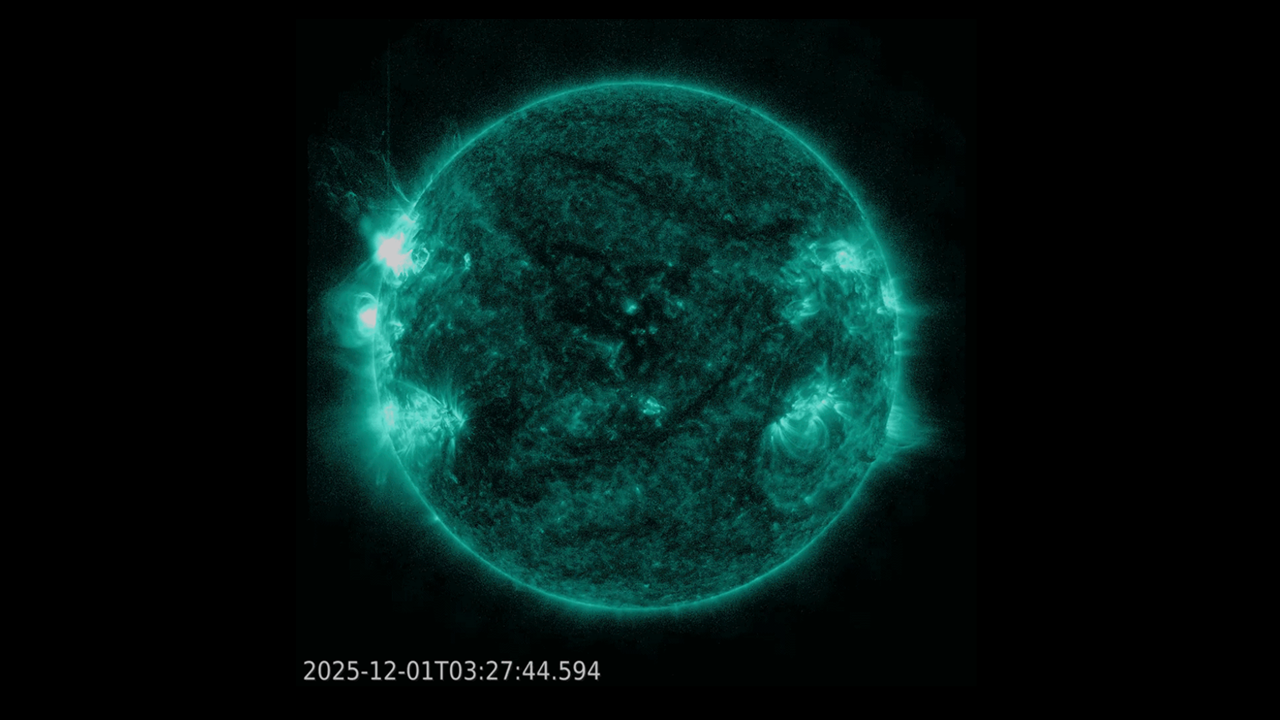
An impressive chain of very large sunspot groups appears in the southern solar hemisphere. NOAA 4294 (the middle group) would become the largest sunspot group of 2025, with a sunspot area about 9 times the total area of the Earth. Together with NOAA 4296 (the group to the east or "left") they would be visible with the protected naked eye (eclipse glasses). The much smaller NOAA 4298 (to the west or "right") would become the source of an X1.1 flare on 8 December. Meanwhile, NOAA 4299 -the return of NOAA 4274- would produce an X1.9 flare on 1 December, and an M8.1 flare on 6 December. Clearly, solar cycle 25 has no intention to already quiet down...
Ref: STCE newsitems of 1 December and 8 December