December 5, 2024 - exactly 1 year ago, the duo satellite Proba-3 left Earth to head to space. The telescope ASPIICS, whose task is to make perfect total solar eclipses from space, was onboard. The launch went flawless.
December 5, 2025 - exactly 1 year later, ASPIICS has already delivered a wealth of amazing pictures of the solar atmosphere close to its surface, a treasure box for solar scientists.
A peek in the treasure box

This is a white-light image of the solar corona taken by ASPIICS on September 9, 2025. The corona has a shape typical for a maximum solar activity cycle, with streamers visible all around the solar limb. A Coronal Mass Ejection is seen propagating towards the west (right in the image).
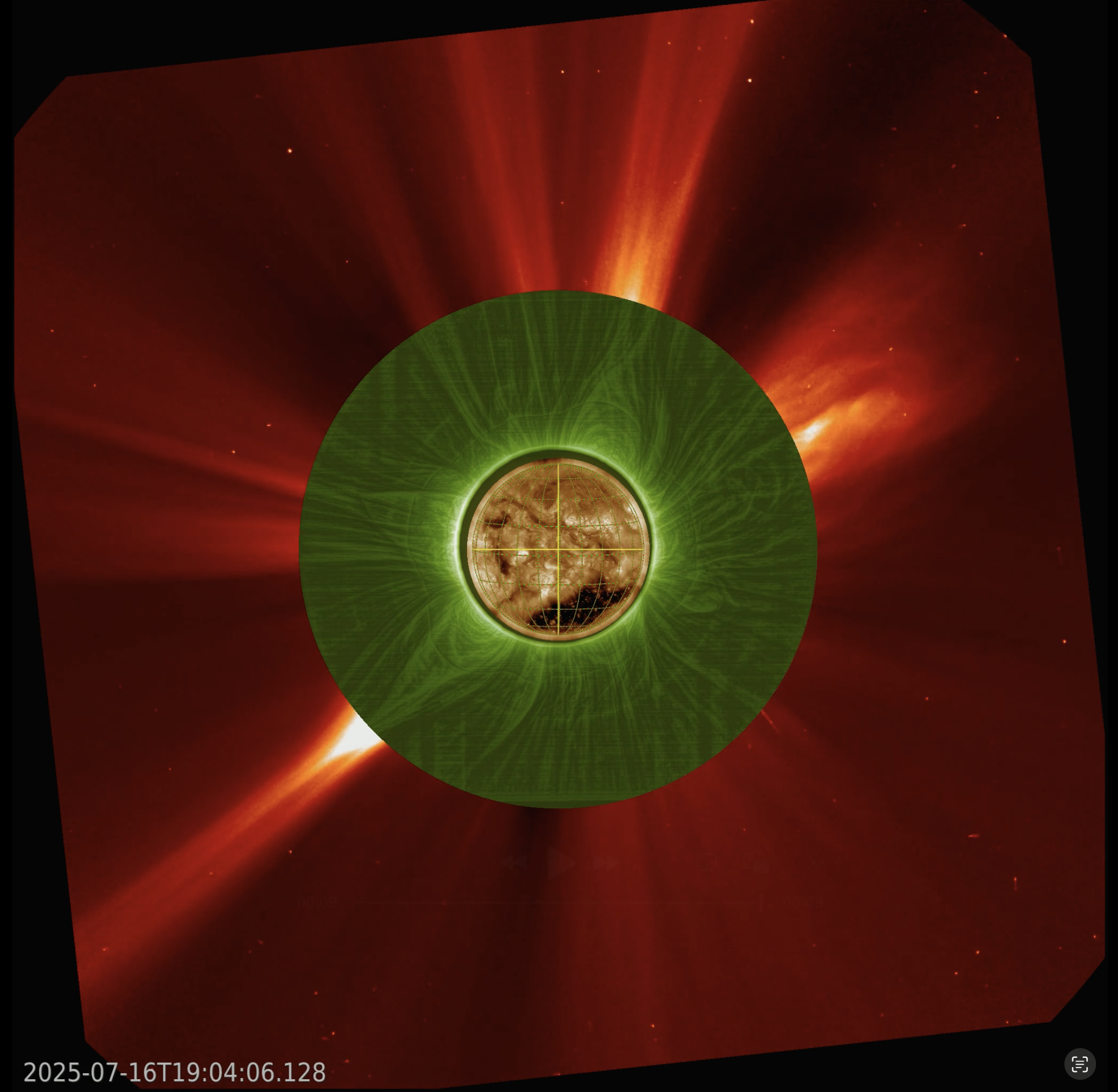
Click on the image to get the movie. This is the Sun and the solar atmosphere on July 16, 2025. The green images are more detailed compared to the red images. A Coronal Mass Ejection is seen propagating towards the west (right in the image). The middle EUV image is taken by SDO/AIA. The green white-light image is taken by ASPIICS, the red white-light image is from SOHO/LASCO. All images show the Sun and the solar atmosphere on July 16, 2025.
Reactions from a few people of the Belgian ASPIICS team
Laurent Dolla, Science Planner - one can never get bored.
ASPIICS is really a cutting-edge instrument, for which I plan the observations. Our images are ‘clean’ and of exceptional good quality. It was a surprise that the instrument achieves this even with “normal” exposure times. We can now see features that were never seen before because they clearly stand out from the background. For us, solar scientists, this is very exciting. When I wake up in the middle of the night, it’s not uncommon that I start working. With ASPIICS, one can never get bored.
Andrei Zhukov, Principal Investigator - being on the forefront of solar physics.
I joined the Proba-3 team already in 2009. Now, after launch and commissioning, I can finally do what I love to do: science. We make total solar eclipses, almost as on an assembly line, which feels for me as being a kid on a science playground toying with unprecedented images. In June 2025, I witnessed the first huge prominence eruption with ASPIICS. We could already see it in our images before they were even cleaned! I’m looking forward to presenting the science results at the annual meeting of the American Geophysical Union in December 2025.
Zoe Zontou, Instrument Operator - this is the coolest job ever
It is so cool that we make total solar eclipses from space and I’m an operator of this instrument! I come from a totally different background than solar physics, so I was thrilled when I joined the team in May 2025. The day that we showed the first official science image to the public was really exciting. I already learned so many things about the solar atmosphere. ASPIICS showed me that I will never stop asking questions and never stop learning. I love it and look forward to meeting even more interesting people and discovering more on solar physics and our Sun!
Andreas, Instrument Operator - bitten by the heliophysics bug
I plan and write commands for the telescope, but I also do surveillance of the newly arrived data. This means that I’m one of the first taking a glimpse at the images! I’m really on the front line to see things which were never seen before. The commanding of ASPIICS can in theory be done a bit beforehand, but in the early phases of the mission I was sometimes at the Mission Operations Center in Redu where I had to take immediate action and call to remote ground stations. Together we had to command the satellites and ASPIICS in real-time. Since my PhD, I have had big dreams. Now, it is amazing to be part of this passionate researchers community and figure out important open questions on the Sun.
More on https://www.sidc.be/proba-3/