The STCE's SC25 Tracking page has been updated to reflect the latest evolution of some critical space weather parameters for the ongoing solar cycle 25 (SC25). It covers various aspects of space weather, from sunspot numbers over geomagnetic indices all the way to cosmic rays. The multiple graphs allow for a comparison with previous solar cycles at similar stages in their evolution.
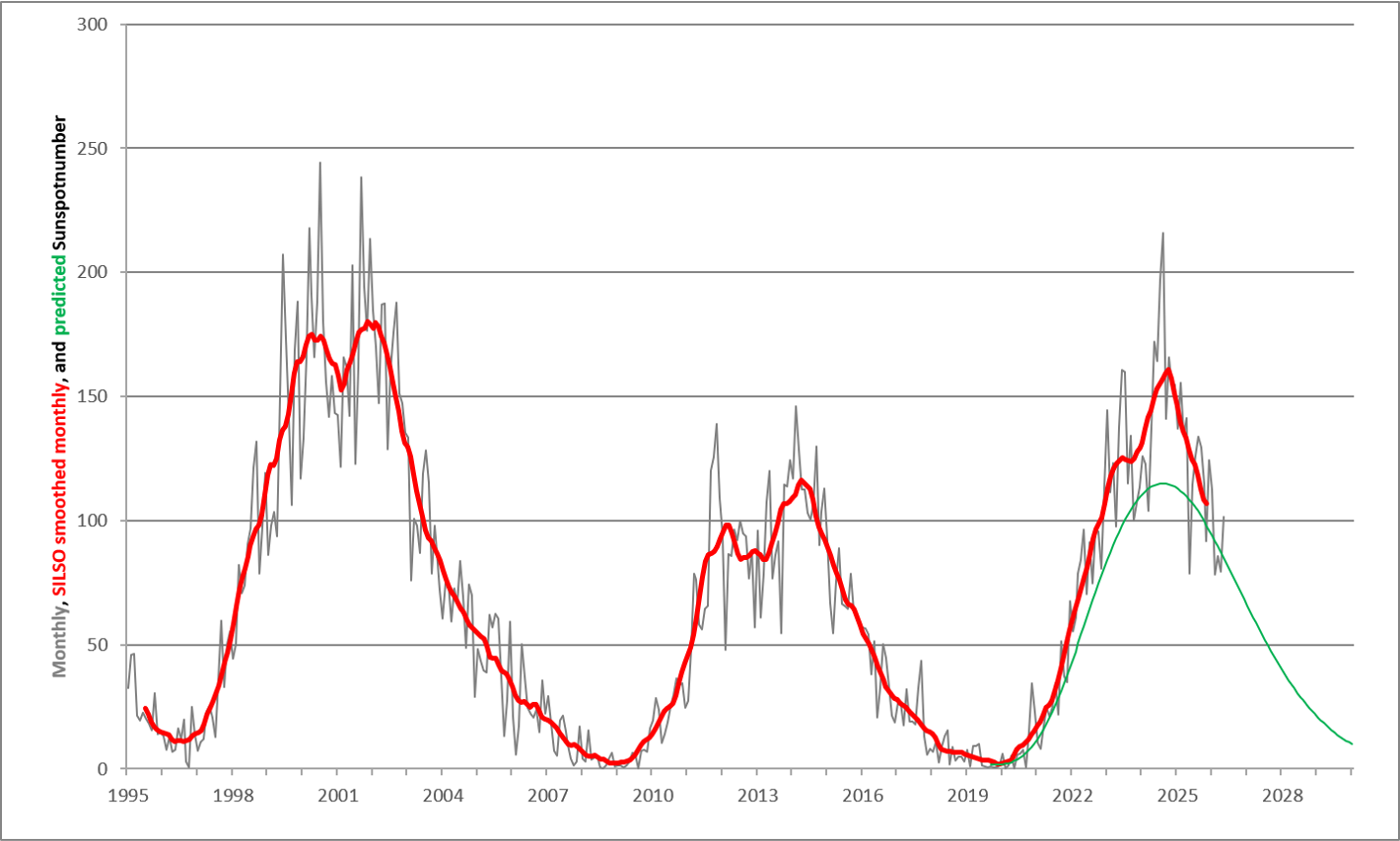
The graph below shows the monthly and SILSO smoothed monthly sunspot number (SIDC/SILSO) from around the start of SC23 up to the current SC25. The prediction for the ongoing solar cycle 25, which started in December 2019, is displayed in green. Following the maximum of the smoothed monthly sunspot number in October 2024, the overall solar activity has been gradually declining. Over the last 3 months, i.e. from from March till May 2026, there were still a few X-class flares. Of note is that the ongoing solar cycle has now already more than 2000 M- and X-class flares. For comparison: the previous solar cycle totaled only 1200 such flares over its entire duration! With still 4 to 5 years to go until the next solar minimum, the 2457 M- and X-class flares from SC23 are on the target list as well!
Many other parameters such as the sunspot area and the 10.7cm solar radio flux are following the sunspot number's declining trend. In contrast, some other parameters are exhibiting an overall increase. Examples are the interplanetary A index ("Ap" - see the STCE SWx classification page) which reflects the level of disturbance of the geomagnetic field, and the neutron count, which reflects the amount of cosmic rays and solar energetic particles that reach the earth environment.
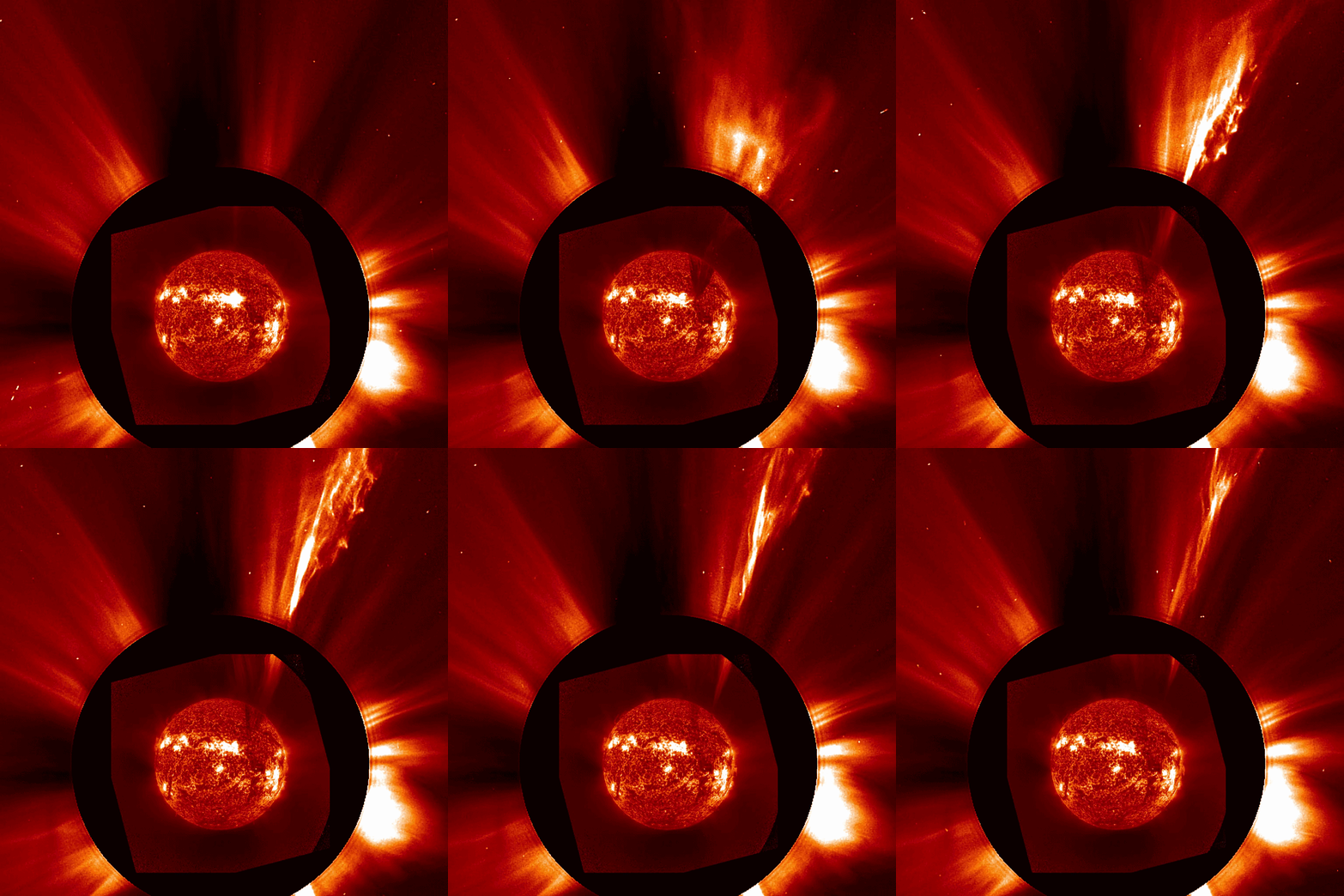
The imagery underneath is a combination of an extreme ultraviolet image (GOES/SUVI 304) of a solar eruption on 3 June and the associated coronal mass ejection in white light (SOHO/LASCO C2).