An interesting paper has been published recently by one of the observers of the SILSO network. ‘An independent assessment of the International Sunspot Number since 1996' by Peter Meadows. SILSO is the World Data Centre for the International Sunspot Number and takes care of the production, validation, distribution and preservation of this index of solar activity. This index goes back to the early 1600!
Laure Lefevre, Director of the WDC-SILSO: 'This is actually a great paper written by one of our own observers supporting our evidence.'
Figure 1 (from the paper) shows the comparison between the International Sunspot Number and different solar indices.
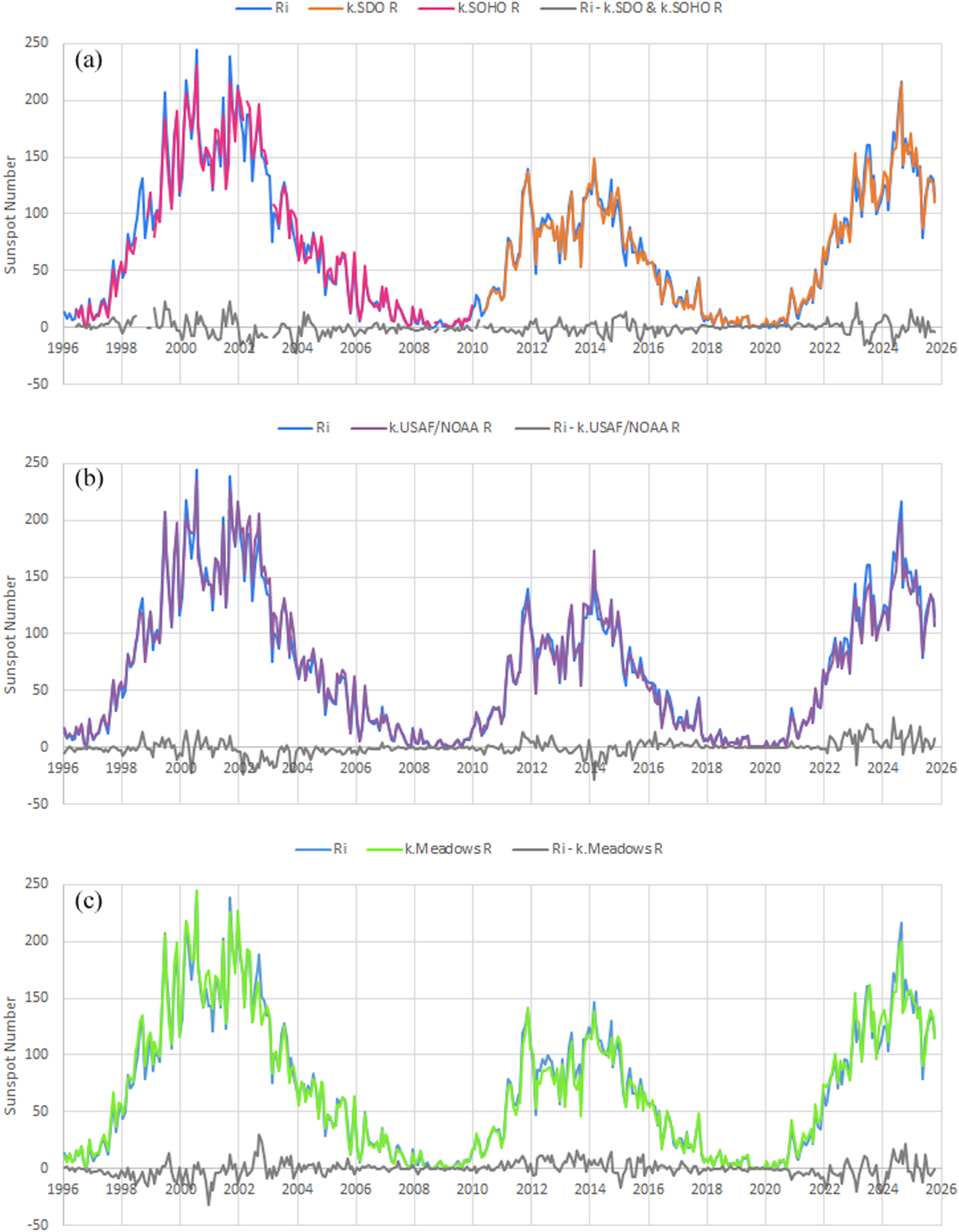
Monthly International Sunspot Number Ri compared with (a) SOHO/MDI and SDO/HMI image derived sunspot number, (b) USAF/NOAA SRS sunspot number and (c) the author's own sunspot number. Differences are also shown.
The findings of this paper (cf. Figure 1) “support the overall consistency and reliability of the International Sunspot Number. They also highlight the value of space-based white-light observations for sunspot number derivation, as they are unaffected by atmospheric seeing and provide a stable reference for long-term solar activity monitoring. Independent cross-checks of this kind remain vital for maintaining confidence in the datasets that underpin solar-terrestrial and space-weather research."
Laure Lefevre: 'The independent cross-checks are indeed what we should focus on. Space-based observations to derive the Sunspot Number have been tested: they give similar results but different - as any proxy does - and the differences need to be characterized. So they are interesting for comparison.'
From this it is clear that space-based data should not replace ground based data into the computation of the International Sunspot Number just yet. Not until we have had the time to fully characterize the relationship between the two.
Laure Lefevre continues: 'in the SILSO network, we mainly gather information from projection methods, drawings or eye-based observations. CCD observations are not commonly used so as to keep the homogeneity of this historical series. This paper is a good introduction for what is to come, since we are preparing a systematic study assessing the stability of SN since the recalibration in 2015.’
The paper: https://iopscience.iop.org/article/10.3847/2515-5172/ae1cbb