Message in a rock
On March 8, several stations from the BRAMS network observed the meteor that became instantaneously famous. From 18:55 CET, people started to post on social media pictures and movies of a bright, exploding meteor. The meteor survived its trip through the atmosphere and touched ground becoming officially a meteorite. A meteorite is in a sense a message in a rock from space. It is literally a fossil from the time that our solar system was born.
BRAMS, Belgian RAdio Meteor Stations
BRAMS can 'see' meteors on their trip through the earth's atmosphere, regardless the weather, day and night. The key is that the meteor material becomes so hot that it evaporates into an electrically charged gas or a plasma.
Hervé Lamy, BRAMS project leader, explains: "Meteors can be detected not only with optical cameras but also using radio techniques. One such method, called forward scatter, relies on a ground-based receiver tuned to a distant radio transmitter. When a meteoroid enters the atmosphere, it produces an ionized trail capable of reflecting radio waves. For a brief moment, the reflected signal becomes detectable. This is known as a meteor echo. By recording these echoes, scientists can count meteors, study their properties, and even remotely measure temperature and wind speeds in the upper atmosphere at altitudes of 80 - 100 km. The BRAMS network continuously monitors meteor activity using a dedicated transmitter and more than 50 receiving stations across Belgium and neighbouring countries. Meteors are relevant for space weather because they modify the upper atmosphere, for example by contributing to persistent metallic layers or high-altitude clouds. They also represent a potential hazard to the growing number of satellites in orbit."
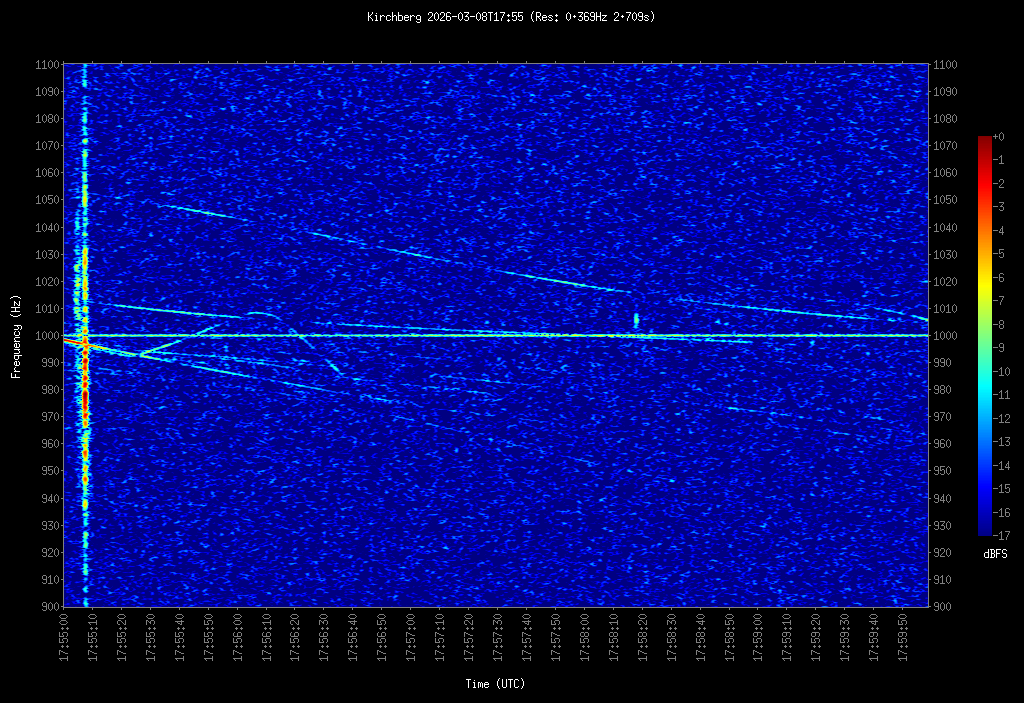
This is a spectrogram showing which frequencies are being reflected as function of time. The horizontal line at 1000 Hz is the frequency of the beacon BRAMS transmitting antenna. The receiving antenna is located in Kirchberg, Luxembourg. When nothing passes or when no echoes are detected, the spectrogram is dark blue. Echo's are indicated by other colours. Red indicate the most intense echoes. The echo of the March 8 fireball is seen as a nearly vertical line just before 17:55:10 UTC. It spans the whole frequency range from 900 to 1100 Hz and colours nicely red. This meteor clearly pops out of the spectrogram!

BRAMS (https://brams.aeronomie.be) is led by BIRA-IASB and supported by the