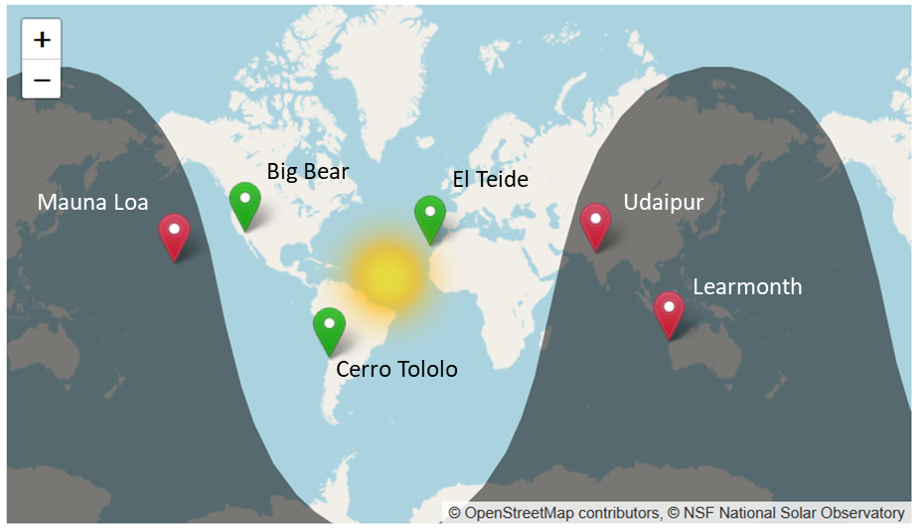
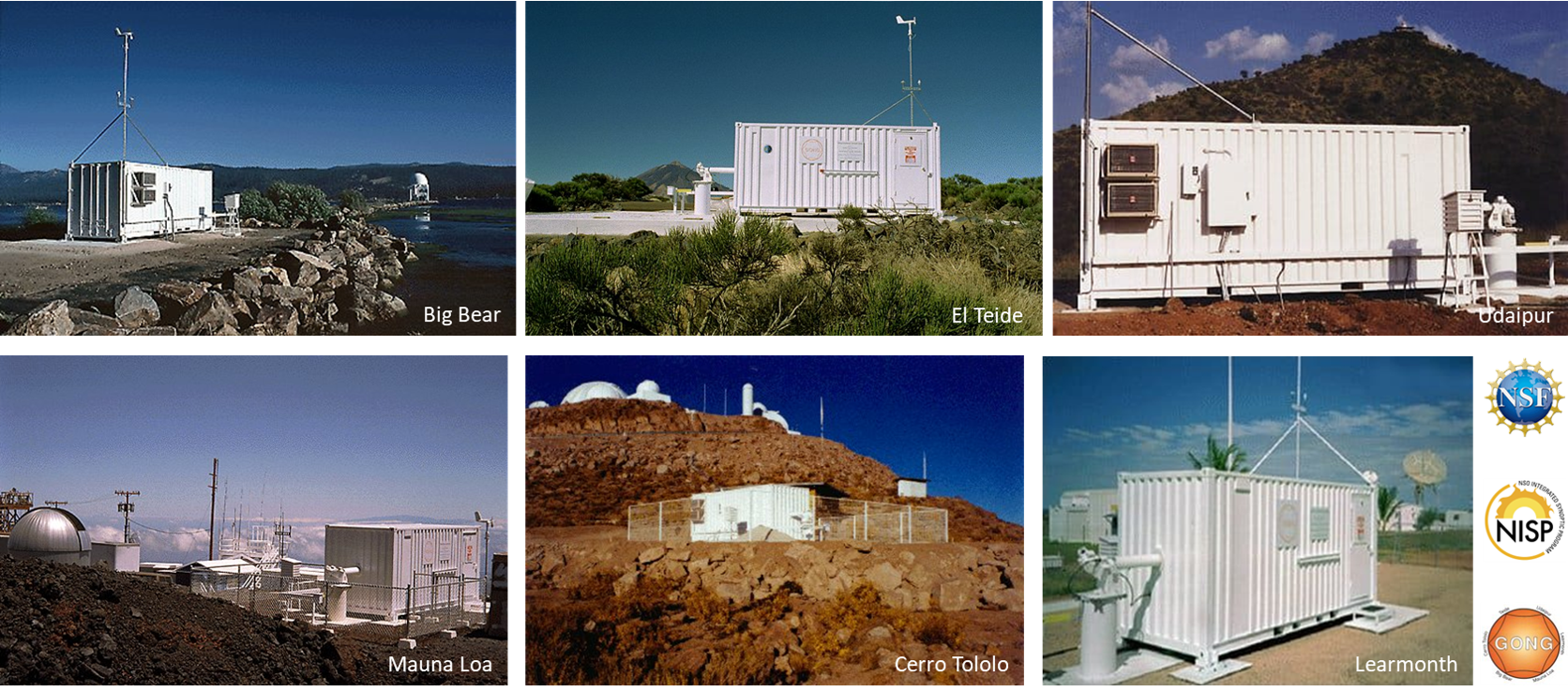
A recent review article authored by Jain et al. (2026 - https://doi.org/10.1007/s11207-026-02639-9 ) highlighted the instruments and achievements of the Global Oscillation Network Group (GONG). This network exists for 30 years now, and still provides continuous, high-quality helioseismic and magnetic data, significantly advancing solar physics and space weather research. The project was originally proposed in the mid-1980s, but due to the time required for the site location of the observing stations and the development of the instruments, GONG started its observations in 1995. It consists of 6 sites about equally distributed across longitudes to minimize diurnal gaps. The stations are located in El Teide (Spain), Cerro Tololo (Chile), Big Bear (USA), Mauna Loa (USA, Hawaii), Learmonth (Australia), and Udaipur (India). The Mauna Loa site has been temporarily shut down following the volcanic eruption in 2022. GONG maintains a high duty cycle of about 86% with overlapping observations for redundancy.
GONG's instruments have been designed for high sensitivity, stability, and continuous operation, with major upgrades performed over the 3 decades. These upgrades also increased the data volume, improved the image quality, and enabled real-time data transmission. The instruments are housed in a shipping container (see composition underneath). The main telescope has a 7-cm aperture, and a nifty filter system allows observations in white light, in H-alpha (656.28 nm; since 2011) and also provide magnetograms.
GONG's primary goal and main contribution has been in the area of the helioseismology, such as the differential rotation, the solar interior, the solar dynamo, the meridional flows,... Also the hemispheric and latitudinal asymmetries, as well as understanding sub-surface flows near active regions are prominent fields of study. Helioseismology is a branch of solar research that is very similar to seismology on Earth, where by studying the waves induced by earthquakes, scientists get an idea on the Earth's interior. Indeed, by carefully "listening" to the up and down movements all over the solar surface, helioseismologists get a pretty good idea on the specifics of the solar interior. The 86-page article by Jain et al. (2026) provides an extensive discussion of the GONG contributions into this field of research.
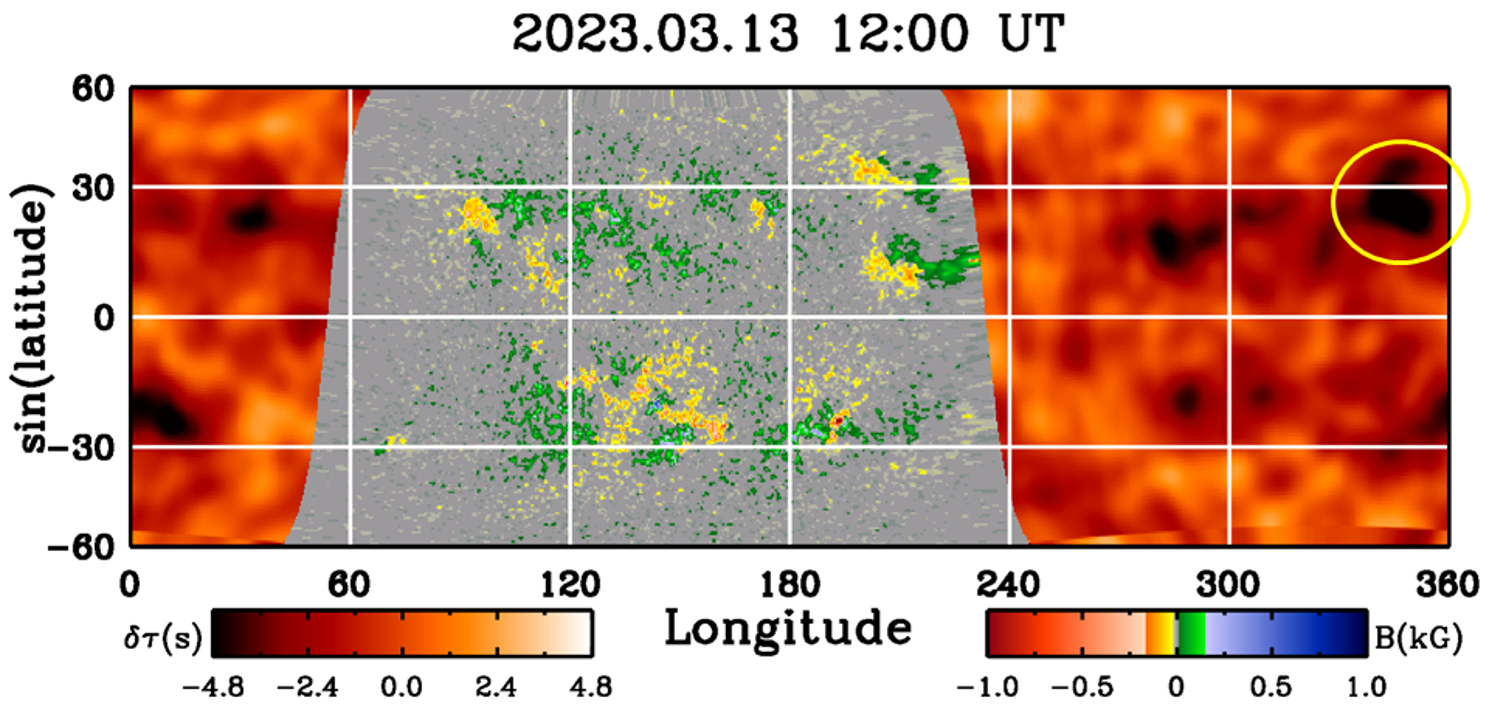
GONG strongly supports the space weather domain as well. By studying the related acoustic waves that are travelling through the solar interior, researchers can virtually "see" any rather big, active region that may be present on the Sun's farside (as seen from Earth; see an example above from this STCE newsitem). Applying advanced helioseismic techniques, synoptic maps now include the Sun's farside thus aiding in active region detection and space weather forecasting. Incorporating these farside active regions improves space weather prediction accuracy, especially for solar wind and flare forecasts. These maps remain an essential back-up for images by the Solar Orbiter and STEREO-A when these satellites are not observing the (entire) Sun's farside.
GONG magnetograms, initially designed for helioseismology, are now vital for space weather monitoring and modeling. Synoptic maps constructed from GONG data are prime input for models such as the Potential-Field Source-Surface (PFSS; STCE newsitem) model, which in turn are then used to study the solar corona and forecast the solar wind with models such as WSA-ENLIL and EUHFORIA. These magnetograms also reveal the evolution of the global magnetic field over the solar cycle, including streamer belts and coronal holes.
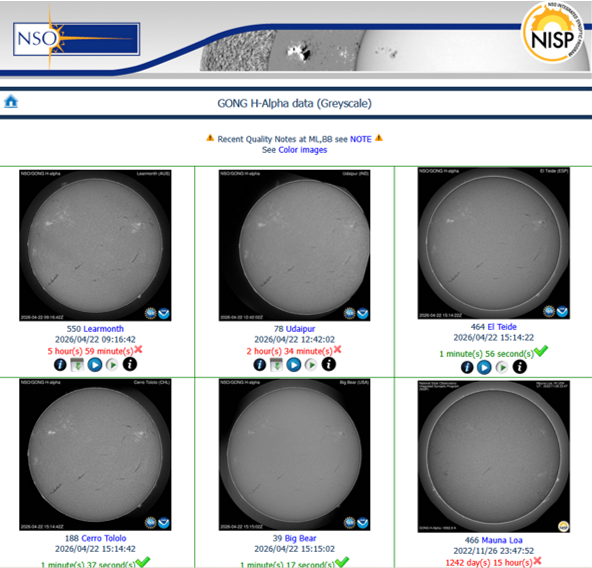
GONG intensity images and H-alpha observations support solar activity monitoring and research. Intensity images added in 2006 show sunspots, pores, and plages, though the small pores are still missing. Daily intensity images now support total and solar spectral irradiance data records, improving irradiance models. The H-alpha observations started in 2010, providing essential, near real-time data for space weather forecasts (see image above). GONG H-alpha data are also a valuable help in the study of filament magnetic fields, their eruptions, and other specific features such as magnetic chirality. Filament oscillations detected via GONG aid in early eruption signatures and magnetic diagnostics.
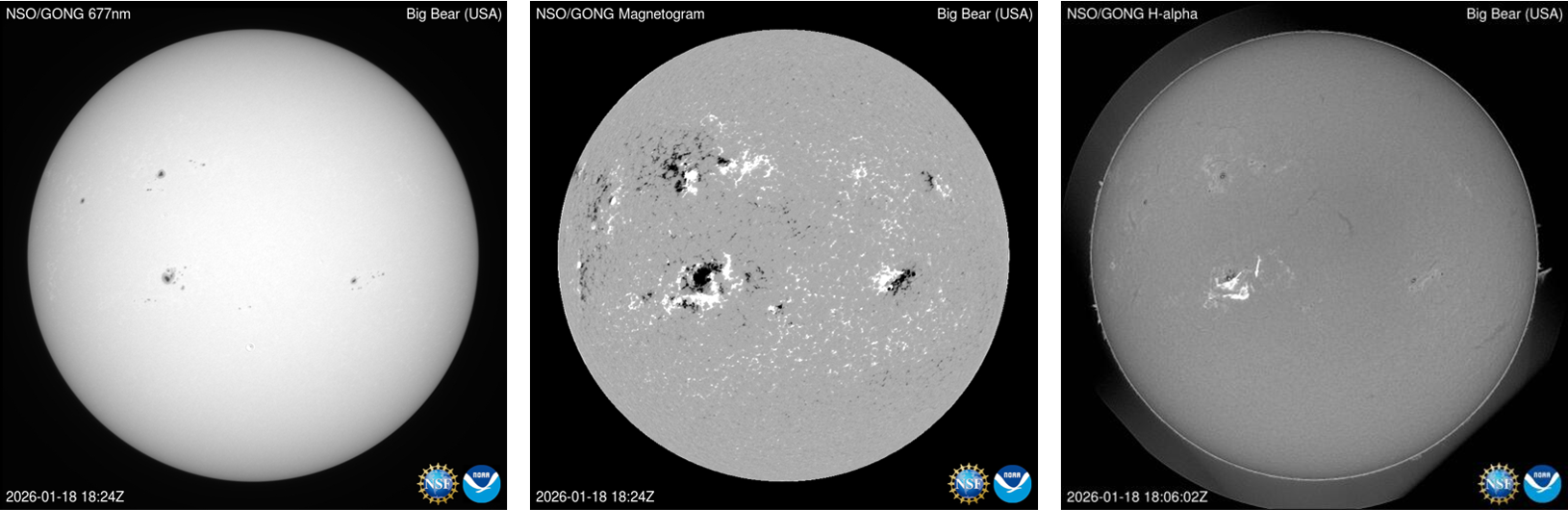
GONG full-disk imagery of the Sun in white light, magnetogram and in H-alpha near the time of the X1 flare on 18 January 2026 (STCE newsitem).
It is clear that during its 30-year existence, GONG has made significant contributions in the fields of helioseismology, the solar magnetic field, and by supporting operational space weather services. Following the "GONG Classic" (1995) and the GONG+ upgrade (2001), it will probably not come as a surprise that another upgrade -the next-generation GONG ("ngGONG")- has already been approved in 2025. The completion of the final design is expected for 2029, and will then be followed by an estimated five-year period for construction and deployment. To ensure a smooth transition, GONG operations will be maintained until ngGONG is fully operational, with an appropriate overlap period. This network is expected to provide continuous measurements for helioseismic probing of the solar interior, solar activity, surface velocity fields, and magnetic-field evolution over two solar magnetic cycles - spanning more than 44 years.
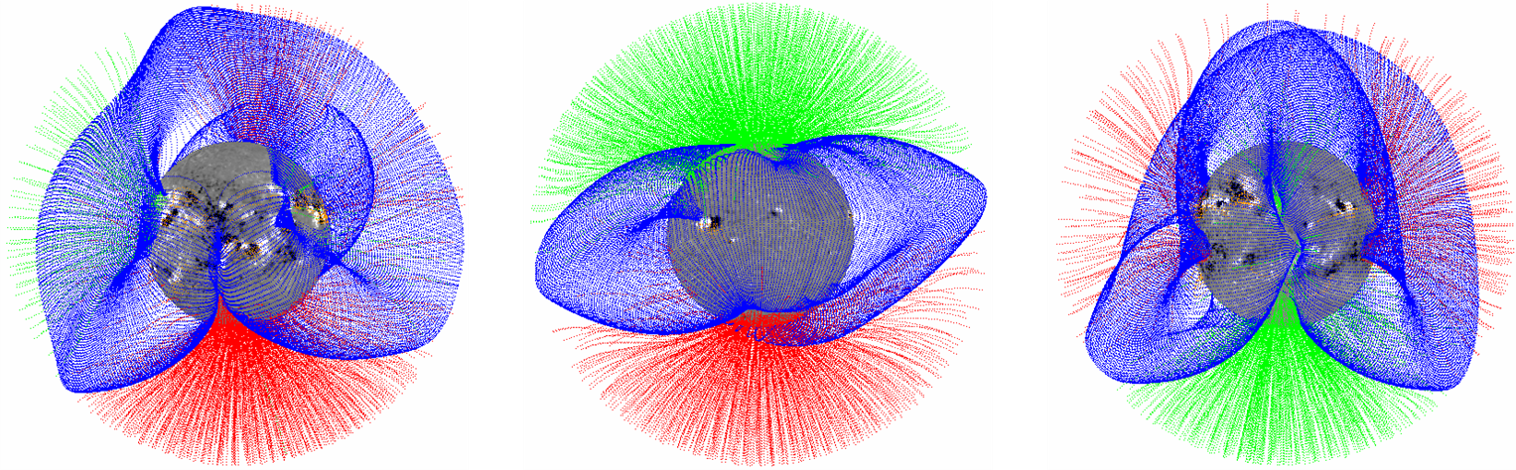
The image above shows the line-of-sight field plot (PFSS model) as deduced from GONG magnetograms for 22 April 2015 (about a year after the previous solar cycle maximum), 2018 (solar cycle minimum), and 2026 (about a year and a half after the current solar cycle maximum in 2024). Note the reversal of the magnetic polarities at the Sun's poles.
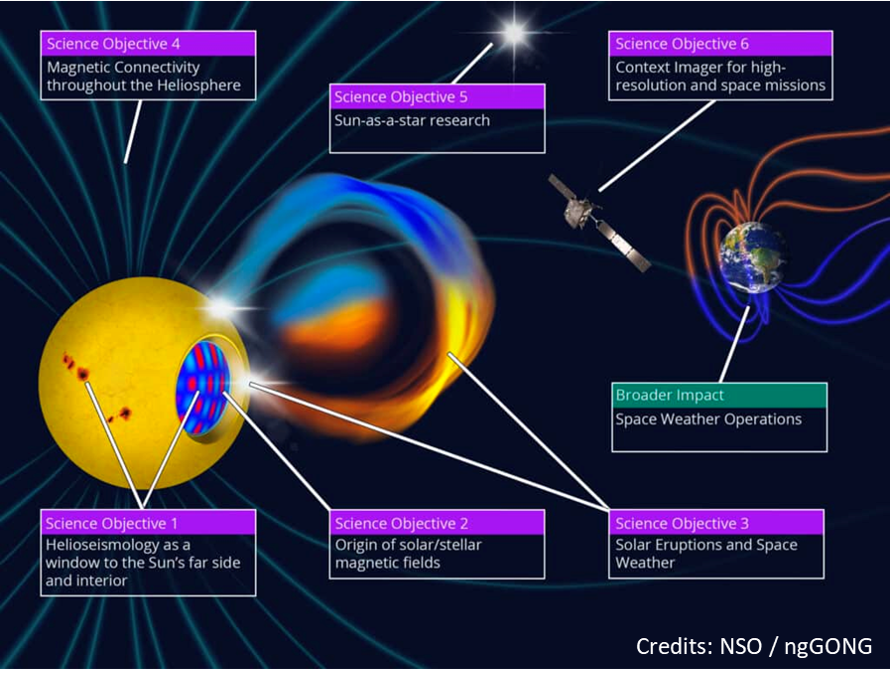
The new network will feature significantly larger aperture telescopes (0.5 m for ngGONG compared to 0.07 m for GONG), while retaining GONG's modular design and utilizing the same site locations. Building on GONG's capabilities, ngGONG will also incorporate instruments for vectormagnetic-field and Doppler-velocity measurements at multiple heights within the solar atmosphere. The ngGONG network will be designed to address six principal science goals, as outlined in the sketch underneath (NSO / ngGONG). As part of its broader impacts, ngGONG will continue to support operational space weather forecasting capabilities. The new network will ensure long-term, continuous solar observations vital for scientific and operational needs.