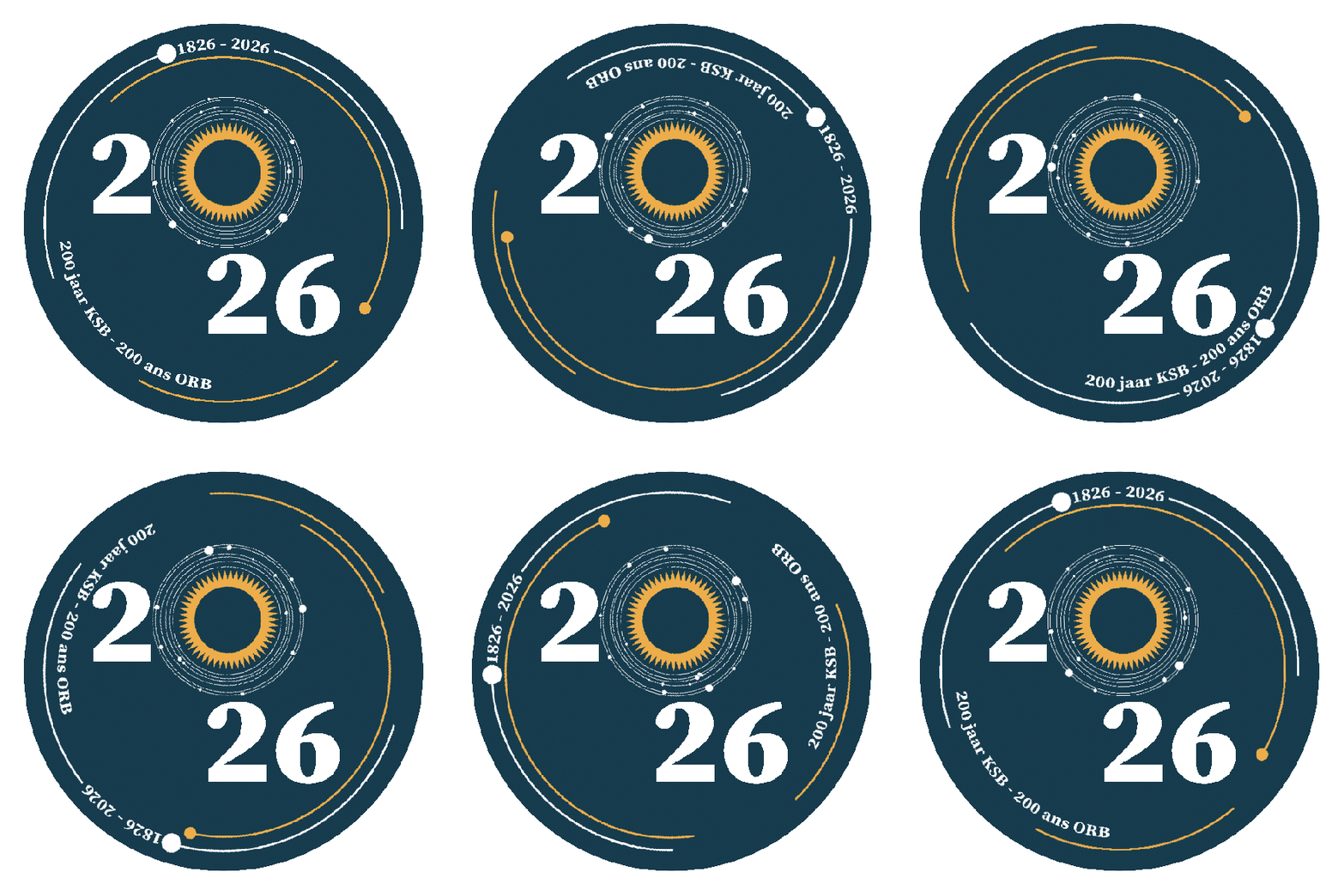
On 18 November 2026, NASA's Voyager 1 spacecraft crossed an extraordinary threshold in human exploration: it became the first human-made object to reach a distance of one light-day from Earth -roughly 25.9 billion kilometers- away. Even traveling at the speed of light, a radio message from Earth now takes 24 hours to reach the probe, and another 24 hours to return. Launched on 5 September 1977 -just sixteen days after its twin, Voyager 2-, Voyager 1 was built to exploit a rare planetary alignment. Called the "Grand Tour" of the outer planets, the Voyager mission basically rewrote our knowledge of planetary science. Voyager 1 flew past Jupiter in 1979 and Saturn in 1980 before heading out of the plane of the planets toward the stars. Attached to its side is the Golden Record (Figure 1), a gold-plated copper phonograph carrying sounds, music, and images of Earth for any extraterrestrial civilization that might one day find it. After completing its planetary tour, Voyager 1 kept going, crossing the heliopause -the outer boundary of the Sun's magnetic and particle bubble- in August 2012 to enter interstellar space (with Voyager 2 following in 2018). Today, nearly half a century after launch, its nuclear power supply loses about 4 watts per year, forcing NASA engineers to steadily power down instruments -most recently the Cosmic Ray Subsystem (CRS) in February 2025 and the Low-Energy Charged Particles (LECP) instrument in April 2026- leaving only its Magnetometer (MAG) and Plasma Wave Subsystem (PWS) active as the probe journeys onward (instruments).
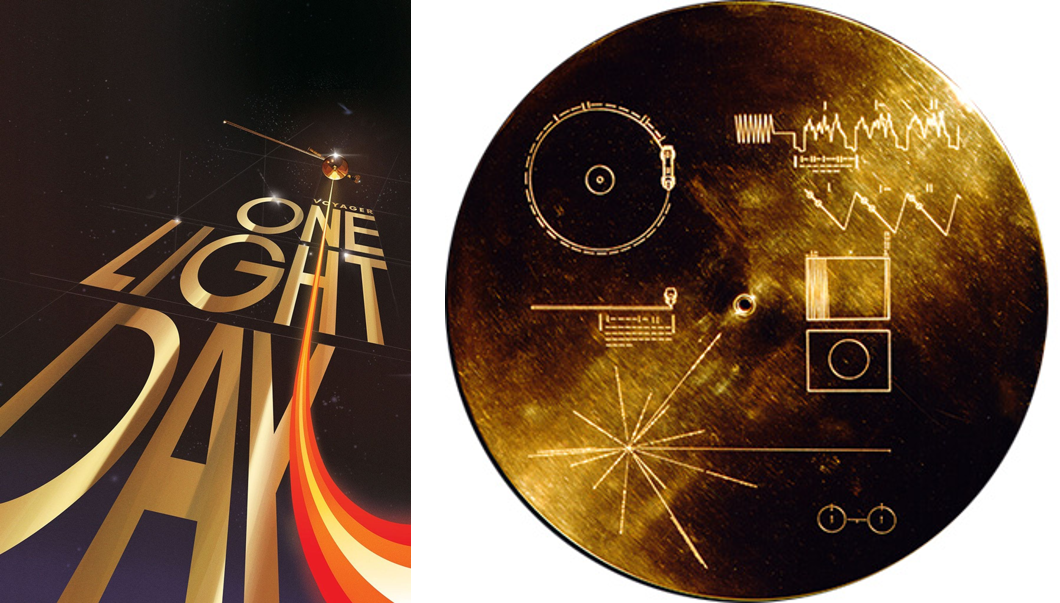
Figure 1: (left) Celebrating Voyager 1 reaching one light-day from Earth. Credit: NASA/JPL-Caltech - (right) The famous Golden Record that accompanies both Voyager spacecraft. Credit: NASA/JPL-Caltech
To understand what Voyager 1 reveals about space weather, it helps to picture our solar system inside a giant magnetic cocoon (Figure 2). Just as Earth's magnetic field carves out a protective cavity called the magnetosphere that shields our atmosphere from the steady stream of charged particles flowing off the Sun (the solar wind), the Sun blows a vast bubble around all the planets called the heliosphere. As shown in NASA's Voyager interstellar mission overview and other heliospheric physics studies (e.g. Richardson 2012), the heliopause acts much like Earth's magnetopause, marking where the outward push of the solar wind balances the inward pressure of the thin gas and magnetic fields between the stars (the interstellar medium).
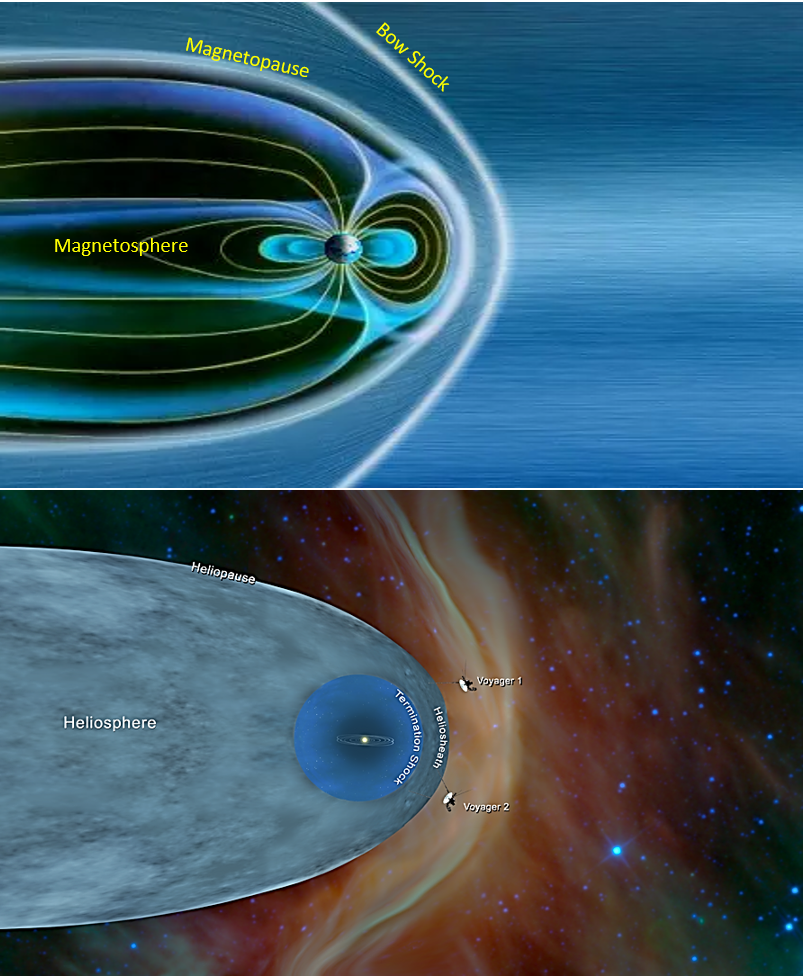
Figure 2: Just as Earth's magnetic field carves out a protective magnetosphere (Top ; Credit: ESA/AOES Medialab ; annotated), the Sun blows a vast magnetic bubble -the heliosphere- around our solar system. Voyager 1 crossed its outer boundary, the heliopause, in August 2012 (followed by Voyager 2 in November 2018), entering interstellar space where the thin gas and magnetic fields between the stars dominate. Credit: NASA/JPL-Caltech
Voyager 1 has no solar telescope to spot sudden flashes of electromagnetic radiation (solar flares). Intuitively, one would also not expect the spacecraft to be able to detect proton storms, due to the radial dilution, i.e. the particle flux drops sharply with increasing distance. However, as the shock associated with a strong coronal mass ejection (CME) plows through the solar wind, it acts like a cosmic snowplow, continuously accelerating local protons and ions to high energies all the way to the edge of the heliosphere (ESP - see this STCE newsitem for more information). These proton storms can be detected as an increase in particles by the Low-Energy Charged Particles (LECP ; shut down in 2026) instrument. Farther away, in the outer solar system, faster CMEs catch up with the slower ones. They pile up into massive, dense shock fronts called Global Merged Interaction Regions (GMIRs ; Burlaga et al. 2016). These merged fronts trap and boost energetic protons, keeping the particle flux high enough for Voyager's Low-Energy Charged Particle (LECP) and Cosmic Ray Subsystem (CRS) instruments to be detected (Figure 3). The passage of CMEs could also be observed by abnormally low proton temperature, sudden jumps in velocity and density (via the Plasma Science Subsystem or "PLS"), and by sudden increases in the magnetic field strength (Magnetometer - MAG). Once the GMIR has passed, the CRS instrument may record a decrease in the amount of cosmic rays, as the vast magnetic structure temporarily shields the spacecraft against these particles (a kind of Forbush decrease - see e.g. this STCE newsitem).
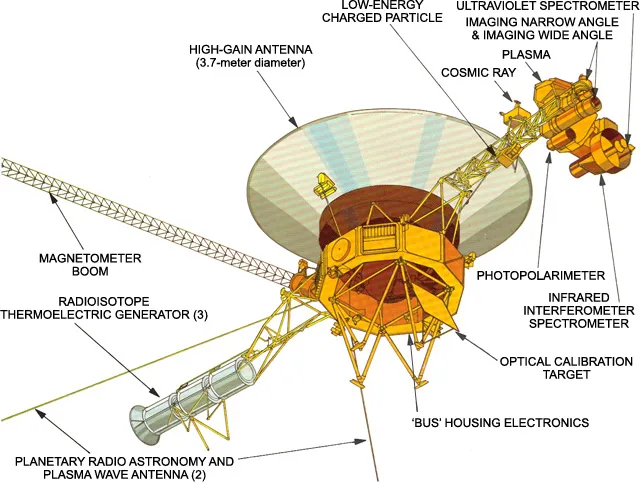
Figure 3: Instrumentation on board the Voyager spacecraft. Credit: NASA/JPL-Caltech
A most amazing effect happens when those giant, shell-like pressure waves - the already mentioned Global Merged Interaction Regions (GMIRs)- slam into the heliopause from the inside. The GMIR then acts like a piston hitting a drumhead (the heliopause): the solar plasma stops at the boundary, but a pressure shock punches right through into interstellar space like a sonic boom, compressing the interstellar magnetic field and strumming the surrounding ionized gas so Voyager 1's magnetometer and plasma wave receiver can "hear" the storm's echo. That "ringing at the front door" could already be heard by Voyager 1 in July 1992, while it was still well-tucked inside the heliosphere. The merged shock waves from the massive May-June 1991 solar storms slammed into the heliopause and triggered the most intense low-frequency (a few kHz) radio outburst ever recorded in our solar system (Gurnett et al. 1993 ; PWS ; Figure 4), giving scientists their first direct measurement of the distance to the edge of the solar bubble.
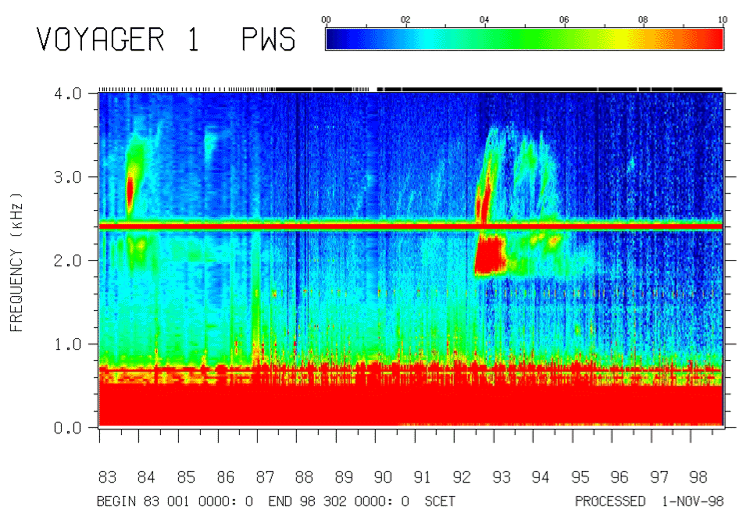
Figure 4: When massive solar eruptions merge into a giant shock wave and slam into the heliopause, they compress the surrounding plasma like a drumhead, triggering bursts of 2-to-3-kilohertz radio waves and electron vibrations. Voyager 1's Plasma Wave Subsystem recorded these "cosmic tsunamis" -such as the famous 1992–1993 outburst triggered by the 1991 solar storms- helping reveal the distance to the edge of the heliosphere and confirming Voyager 1's entry into interstellar space in 2012–2014. Credit: NASA/JPL-Caltech (Dr. Paulett Liewer)
Over nearly five decades, Voyager 1 has served as an outer-solar-system space weather station for several historic solar storms, while also witnessing space weather at work around the giant planets. During its 1979 Jupiter flyby and 1980 Saturn flyby (Figure 5), Voyager 1's ultraviolet spectrometer (UVS) detected auroral emissions on both planets: while Jupiter's auroras are largely powered internally by volcanic gas from its moon Io interacting with its spinning magnetic field, Saturn's auroras respond strongly to gusts in the solar wind. Merged shock waves (GMIR) from the July 2000 "Bastille Day" eruption (Webber et al. 2002 ; STCE newsitem), the October-November 2003 "Halloween" storms (Richardson et al. 2005), as well as from the September 2005 and December 2006 events (Webber et al. 2009) swept past Voyager 1 months after rattling Earth. Even after crossing into interstellar space in 2012, Voyager 1 was struck by three successive interstellar "tsunami" shock waves (GMIR) between 2012 and 2014 -vibrating the surrounding gas at 2 to 3 kilohertz and proving from its high density that the spacecraft had truly left the solar bubble (Gurnett et al. 2013 ; NASA JPL). Remarkably, despite surviving Jupiter's fierce radiation belts and decades of cosmic rays, Voyager 1 has suffered virtually no permanent radiation damage, even when a corrupted memory chip (NASA) scrambled its telemetry in 2023–2024, engineers rescued the 69-kilobyte computer -that's a memory less than a single low-resolution photo on a modern smartphone- from 24 billion kilometers away.
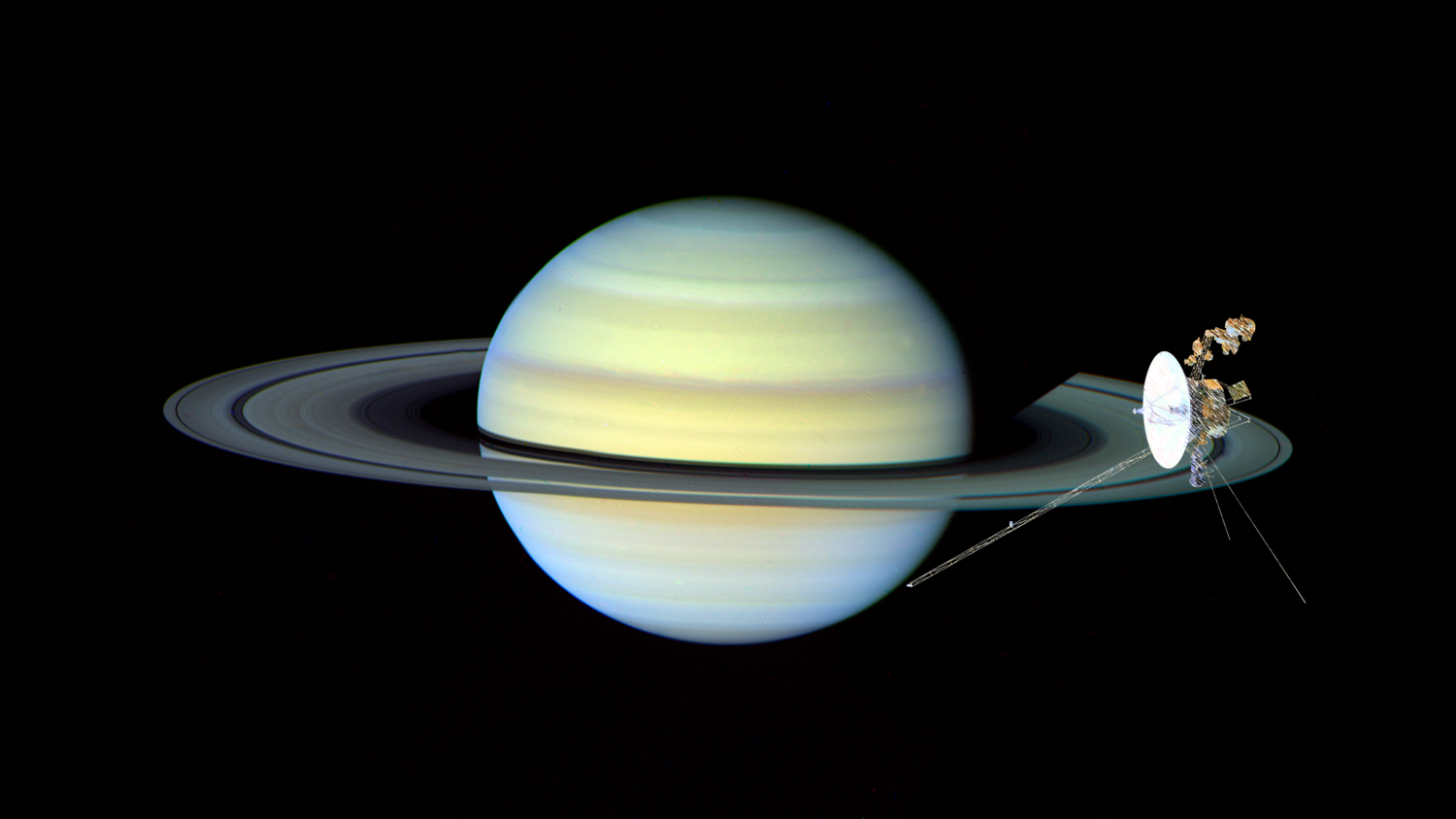
Figure 5: Artist's impression of Voyager 1 en route to its encounter with Saturn. The Saturn image was actually taken by Voyager 1, on 27 October 1980. Credit Saturn image: NASA/JPL-CalTech/Kevin M. Gill
Looking ahead, Voyager 1's remaining magnetometer and plasma wave detector will keep listening for the faint magnetic and plasma ripples of solar storms until dwindling electrical power forces NASA to switch off the final science instruments around the end of this decade or the early 2030s. Recent modeling has indicated that it is unlikely Voyager 1 will be able to record the effects from solar cycle 25 (e.g. the events in May and October 2024), while this is not excluded for its twin (expected for around 2030 - Fraternale et al. 2026). Even then, after its 23-watt transmitter falls silent, Voyager 1 will drift onward for tens of thousands of years as a quiet ambassador from Earth. Before turning off its cameras in February 1990 to conserve power, Voyager 1 looked back one last time from 6 billion kilometers away to capture the iconic "Pale Blue Dot" portrait -a single pixel of Earth suspended in a sunbeam- (Figure 6), reminding us how small and precious our home world is within the vast, stormy ocean of space.
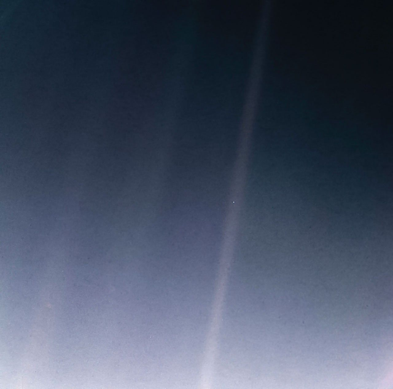
Figure 6: On 14 February 1990, 34 minutes before NASA switched off its cameras forever to conserve power, Voyager 1 turned back from 6 billion kilometers away to capture this iconic portrait of Earth - appearing as a single bluish speck suspended inside a scattered ray of sunlight. Credit: NASA/JPL-Caltech