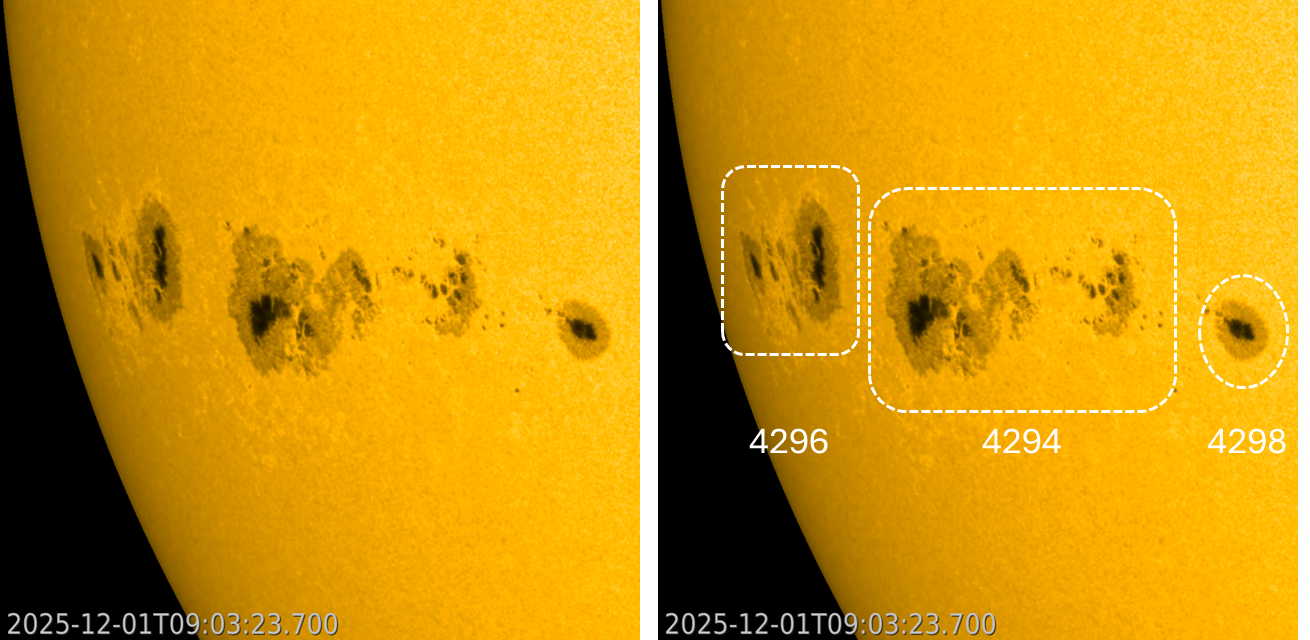
Starting on 28 November, a huge sunspot complex started to transit the southeast solar limb. As it looks right now, it consists of 3 active regions: NOAA 4298, 4294 and 4296, as shown in the annotated SDO/HMI white light image underneath. NOAA 4294 is the largest of the trio, and one of the larger ones of the ongoing solar cycle. It has a sunspot area at least 10 times the total surface area of the Earth, and its length equals 14 Earth diameters. The region was the source of an M5.9 flare late on 28 November, and 5 low-level M-class events on 29 November. The region then became silent, most likely as the previously existing delta structures dissipated. Nonetheless, the region is so large that it still has the potential for a powerful M- or even X-class event.
Then, early on 1 December, GOES registered an X-class event. The X1.9 flare peaked at 02:49 UTC and lasted for 38 minutes. Contrary to expectations, the source was not NOAA 4294, but a smaller yet also complex active region near the northeast limb, later numbered as NOAA 4299. The image underneath shows the region in the white light underneath left, whereas the flare can be seen in the extreme ultraviolet (EUV) image (SDO/AIA 131) underneath right. The blooming and diffraction patterns that can be seen in this image are instrumental (more information is in Note 1 of this STCE newsitem).

The greater than 10 MeV proton event is currently still at background levels (GOES). Radio bursts were recorded over the entire radio band, and were most intense in the VHF (30-300 MHz) and SHF (3-30 GHz) bands (NOAA/USAF). GNSS (Global Navigation satellite Systems, such as GPS and Galileo) frequencies (1200-1500 MHz) and their applications seemed to be little to not affected. The radio astronomy station in Learmonth (Australia) recorded Type II and Type III radio bursts (see the STCE SWx Classification page) between 02:35 and 03:15UTC, as shown in the radio spectrogram underneath with the horizontal axis representing time and the vertical axis representing frequency (highest frequencies on top). The Type II and III radio bursts recorded around 03:30 UTC seem to have been associated with the violent eruption of a nearby filament, as shown in the GONG images underneath.
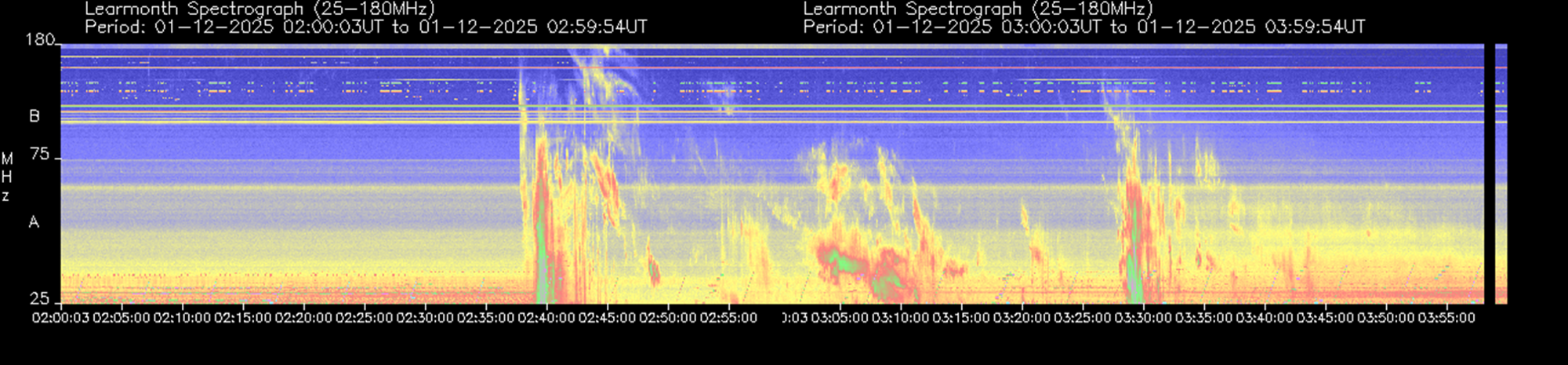

The apparent presence of 2 Type II radio bursts seems to indicate that two coronal mass ejections (CMEs) may have been associated with this flare. Sure enough, coronagraphic imagery from SOHO/LASCO C2 show the strongest CME, i.e. the one related to the X-class flare, starting around 02:48 UTC and directed mainly to the east, as well as a second but weaker CME starting around 03:36 UTC and somewhat more directed to the northeast. The PRESTO alert by the SIDC SWx forecaster mentioned that "... An associated fast partial halo coronal mass ejection (CME) was detected in the LASCO/C2 coronagraph imagery starting at around 03 UTC with an estimated projected velocity of 850 km/s. The CME is directed off the Sun-Earth line and is not expected to have a notable impact on Earth. ..." The second CME is even smaller and is also not expected to have an earth-directed component.

The X-class flare itself affected the lower frequency portion of the High Frequency communication band (HF Com ; 3 - 30 MHz) on the dayside of the Earth, mainly over the Australia, New-Zealand, Southeast Asia, and the bordering portions of the Indian and Pacific Ocean. An advisory to civil aviation has been issued (PECASUS). The effects of the X1 flare on HF Com can be seen in the D-RAP (NOAA/SWPC) map underneath. Further strong flare activity can be expected over the coming days, and as the source regions will gradually move further onto the solar disk, any associated CMEs may gradually become earth-directed.