The strong X1.9 flare of 18 January this year was associated with a severe solar radiation storm (see this STCE news item). The greater than 10 MeV proton flux (labelled "P10" in this news item) reached a maximum of 37.000 pfu (1 pfu = 1 proton flux unit = 1 proton per second, per square cm, and per steradian). This is higher than that of the famous Halloween events in October 2003 (29.500 pfu). We have to go back all the way to 23-24 March 1991 (that's 35 years ago...) to find an even stronger proton event, when P10 reached 43.000 pfu - the strongest observed by GOES satellites in half a century of observations!
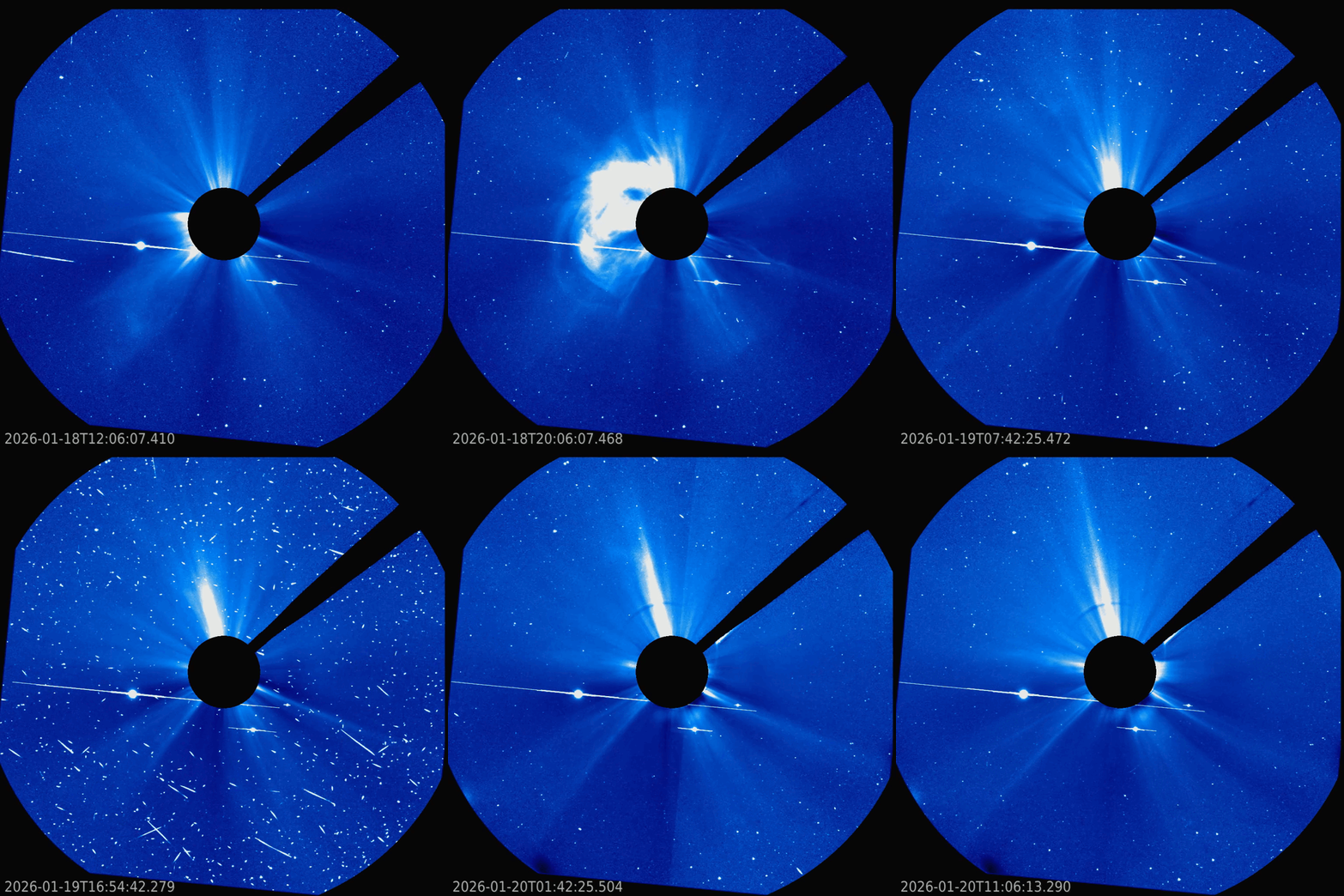
The effect of the large number of protons was quite obvious in the images made by the coronagraphs on board of SOHO. The imagery underneath covers the period from noon on 18 until noon on 20 January. The flare peaked around 18:00UTC, and the magnetic cloud (CME or coronal mass ejection) can already be seen shortly afterwards. The protons generated by the eruption can be "seen" as bright flashing dots in the images as the particles impacted the camera pixels. This "noise" in the images continued its gradual increase during the next day, as the shock of the earth-directed CME continued to accelerate particles which were also registered by the GOES instruments as a further increasing proton flux (P10). As soon as the shock had passed the earth environment (after around 20:00UTC on 19 January), the proton flux quickly fell off, and the noise in the coronagraphic images followed suit. Note that -in general- the CME shock is efficient at accelerating high-energy protons (100 MeV or more) when it is close to the Sun, but as it propagates away, it becomes only efficient at accelerating low-energy particles (P10).
One would expect -from historical events- that such severe proton events go together with hazardous radiation conditions for astronauts and passengers in planes flying over the north pole. The typical space weather examples cited are the Bastille Day event (14-15 July 2000) and the Halloween events, when astronauts had to seek shelter in the inner compartments of the International Space Station, and planes on polar routes were diverted to more southerly flight paths in order to avoid the radiation hazard from these particles. Indeed, when these proton events are accompanied by protons with energies of 500 MeV or more, one can detect secondary particles such as neutrons at the Earth surface. This is called a Ground Level Enhancement (GLE), i.e. an increase in the natural radiation at the surface of the Earth.
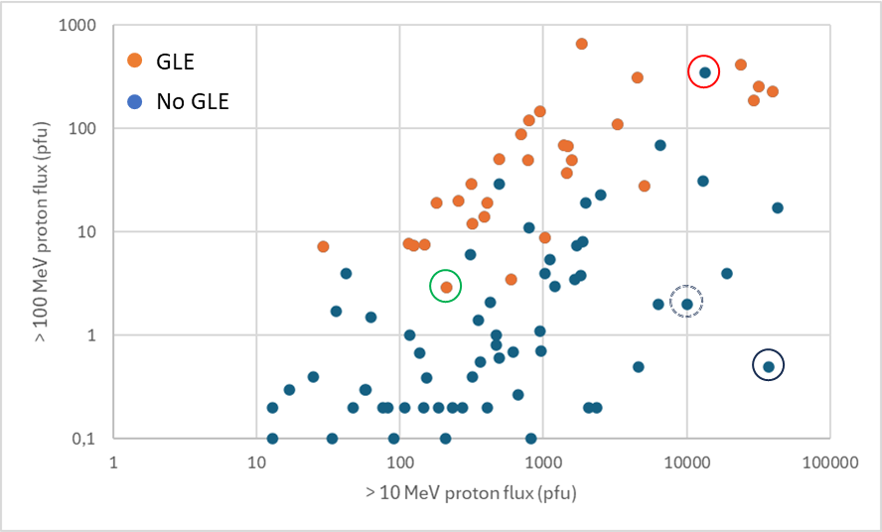
However, this was not so much the case for the January 2026 event, when the protons with energies greater than 100 MeV proton flux (labelled "P100" in this news item) remained near background levels for the entire duration. This can be seen in the plot underneath, covering most of the moderate and stronger proton events from the maximum of solar cycle 22 onwards (data from NOAA/SWPC). The P100 value was chosen, as it is more easily available than fluxes of protons with higher energies. The horizontal axis represents P10, the vertical axis represents P100. For each event, the maximum P10 and P100 values were taken. Note that both of these axes are on a logarithmic scale. If a GLE (Oulu GLE database) was associated with the proton event, then the data point got an orange colour. It's clear that the general relationship holds true: the higher P10, the higher P100 and -if the P100 exceeds about 5 to 10 pfu- usually a GLE follows.
But there are exceptions. The most obvious is the 19 January 2026 event, i.e. the circled dot at the lower right of the plot. Clearly, this sheep is far away from the flock. The reason for this (or at least one of the contributing factors) is the very high speed of the CME, transiting the Sun-Earth distance in barely 25 hours. The shock of this fast CME then drove the P10 to well above the typical values for such an event. These are extraordinary circumstances! Indeed, a moderately strong solar flare (with very low P100) that gets nonetheless accompanied by a very fast CME which in turn drives the P10 to unusually high values: for sure this is something not seen every day. But it happens from time to time, another example being the 20-21 February 1994 event (the blue dot in the dashed circle) where the CME made the Sun-Earth transit in 31 hours. In all these cases, despite the very high P10, radiation hazard for astronauts and for passengers/crew on polar flights was significantly lower than during the Bastille Day or Halloween storms. Of course, the high P10 strongly affected the High Frequency Communication (HF Com ; 3-30 MHz) over the polar cap, which may have been a reason to divert the planes away from the poles anyway.
The plot underneath also shows some proton events with a very high P100, without resulting in a GLE. This is in part because a high P100 does not necessarily mean that there is also a sufficient number of high-energy particles (500 or more MeV) necessary to cause a GLE. This certainly explains a few proton events that have a P100 around 10 pfu but that eventually did not result in a GLE. Even then, there still remain some true anomalies. For example, during the 9 November 2000 event (red circled dot), the P100 reached a staggering 347 pfu. It was found that for this event, also the greater than 700 MeV proton flux was strongly enhanced. Yet, no GLE was observed! Another anomaly is the 6 May 1998 event (green circled orange dot), where no enhancement in the greater than 700 MeV proton flux was observed, yet the proton event still managed to produce a GLE. Studies such as by Thakur et al. (2016) have suggested that a series of factors such as the phase of the solar cycle, the height of the CME-shock formation, ... may all have combined into the materialization of these anomalies.