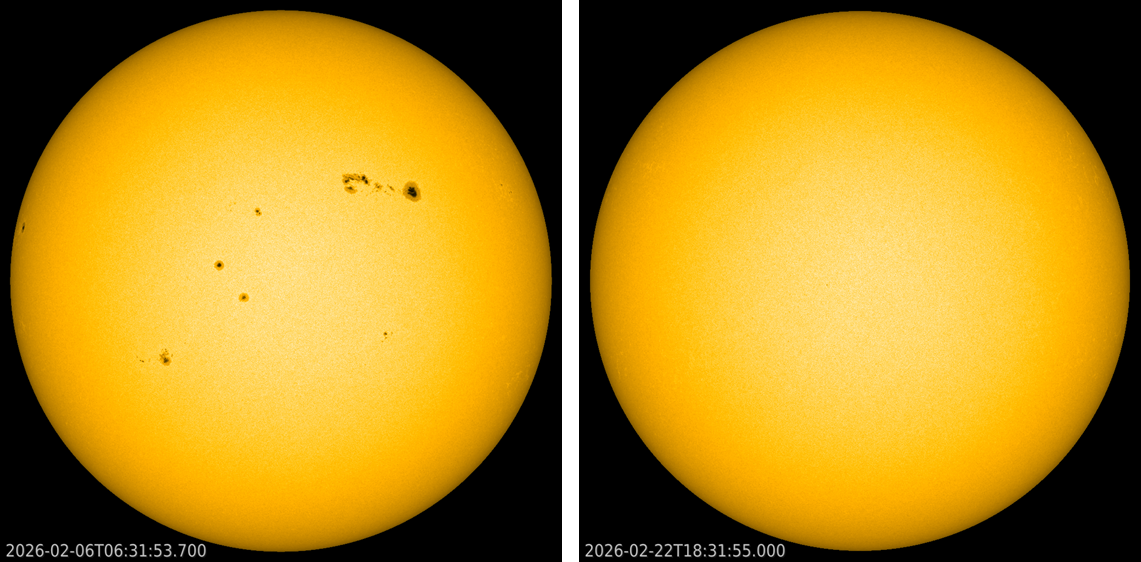
Over the last few weeks, the Sun showed solar observers two different faces. Early February, various sunspot groups were visible including the large active region NOAA 4366 (SIDC Sunspot Group 784). Two weeks later, the Sun was nearly devoid of any sunspots, in particular on 22, 23 and 24 February. This can be seen in the SDO/HMI images underneath, taken on 6 and 22 February.
SILSO, short for "Sunspot Index and Long-term Solar Observations", is the World Data Center for the production, preservation and dissemination of the international sunspot number. The sunspot number is calculated as 10 times the number of sunspot groups to which then the total of individual sunspots is added. SILSO bases these numbers on a worldwide network of more than 80 observers. Every year, this parameter is used in hundreds of research papers on solar physics, climate change, and several space weather and space climate related topics.
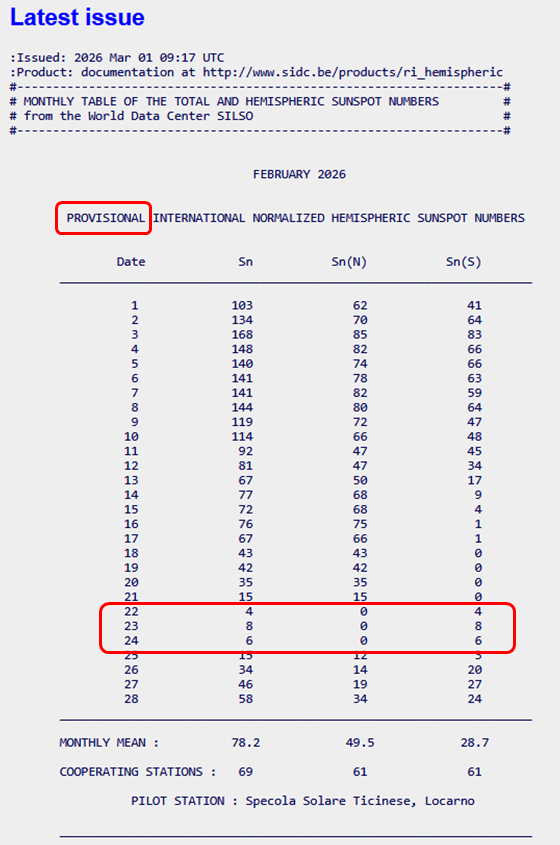
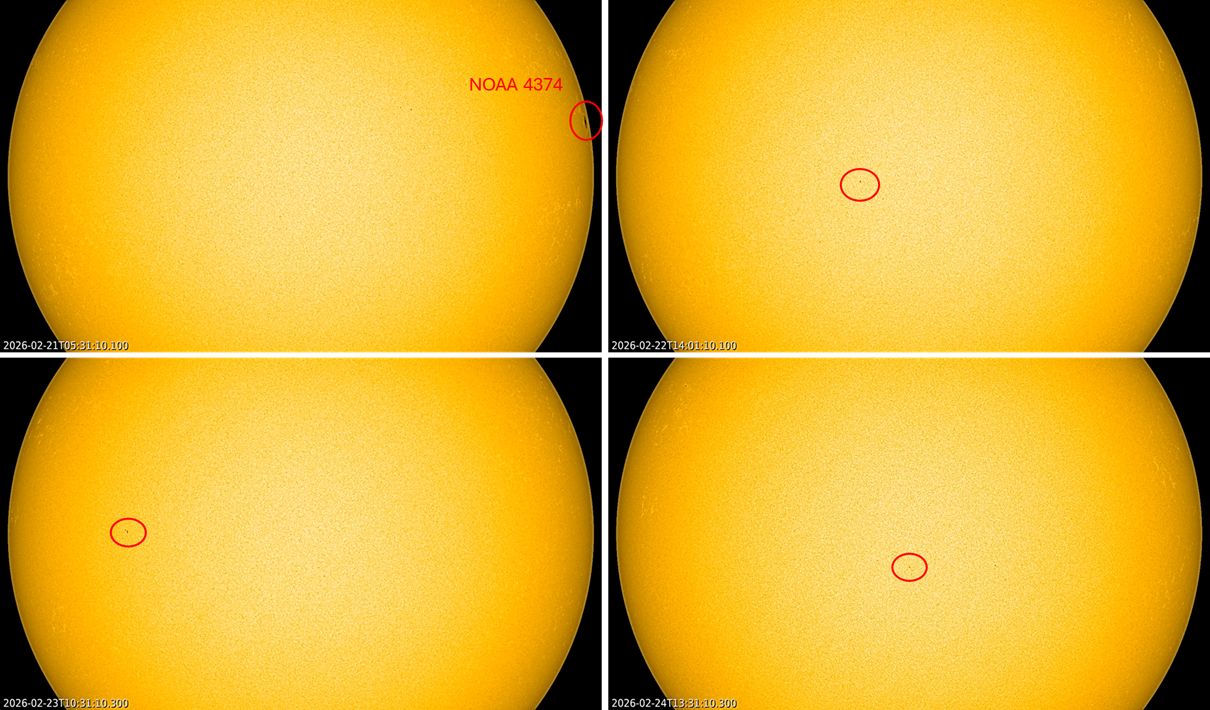
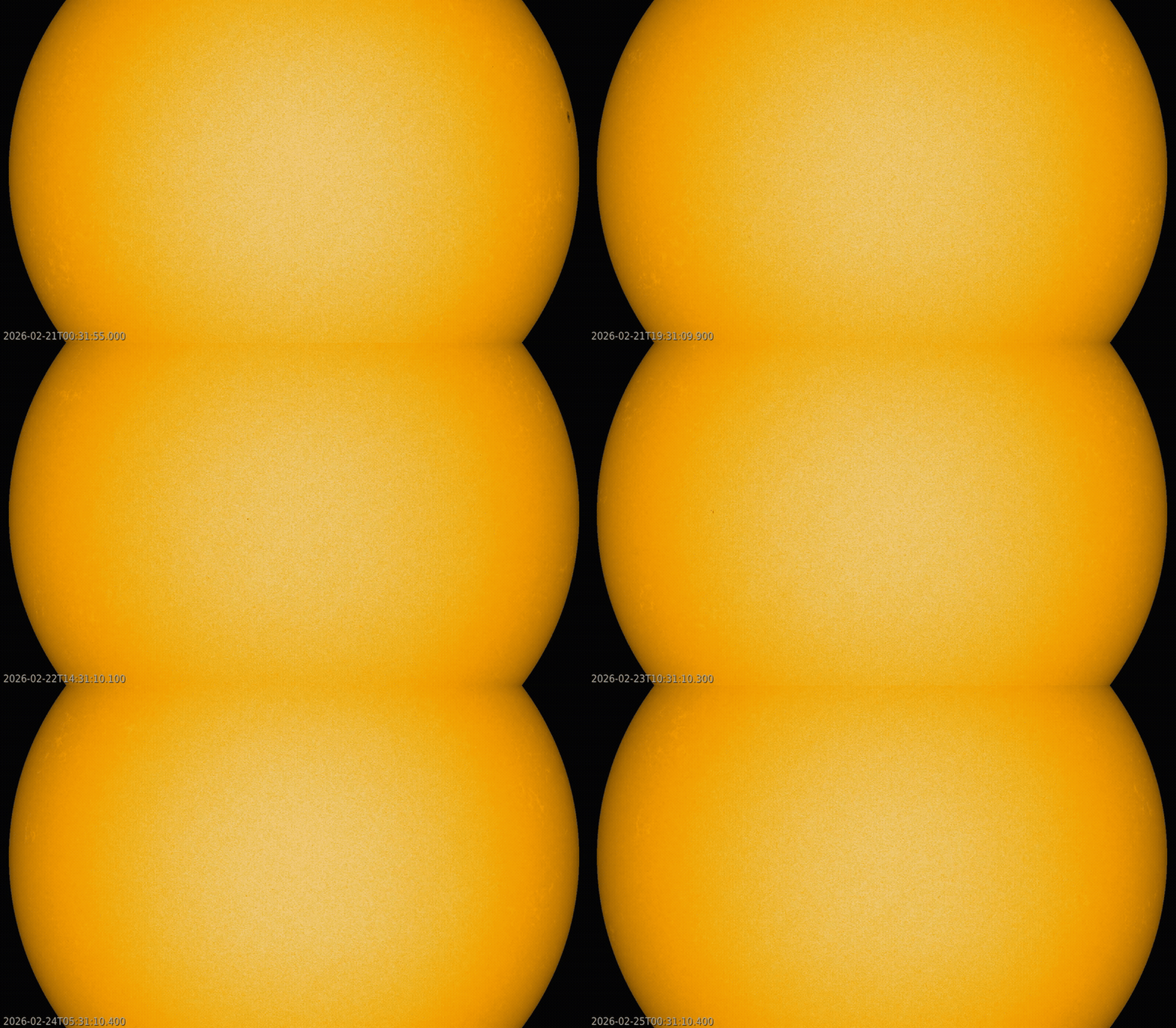
In its most recent monthly compilation of the provisional international sunspot numbers, SILSO reports for 22, 23 and 24 February daily sunspot numbers of respectively 4, 8, and 6 - as highlighted on the annotated report above. At first, these values may sound impossible, as the lowest sunspot number that an individual observer can have is -aside 0 of course- 11 (1 sunspot group with 1 sunspot). However, one should not forget that there's also a correction factor for each observer accounting for various influences such as the diameter of the telescope. Specola Solare Ticinese in Locarno serves as the reference station. Also, the daily sunspot number is the average of the observers that submitted reports for that day. It's no surprise then that during days with only few and very small sunspots popping in and out of existence, the sunspot number for that day ends up somewhere between 0 and 11. This can indeed be seen in white light images underneath where some tiny sunspots appear just for a few hours before already disappearing again. Small sunspots were indeed visible for a few hours during each of the 3 days (annotated image), but is was a close call.
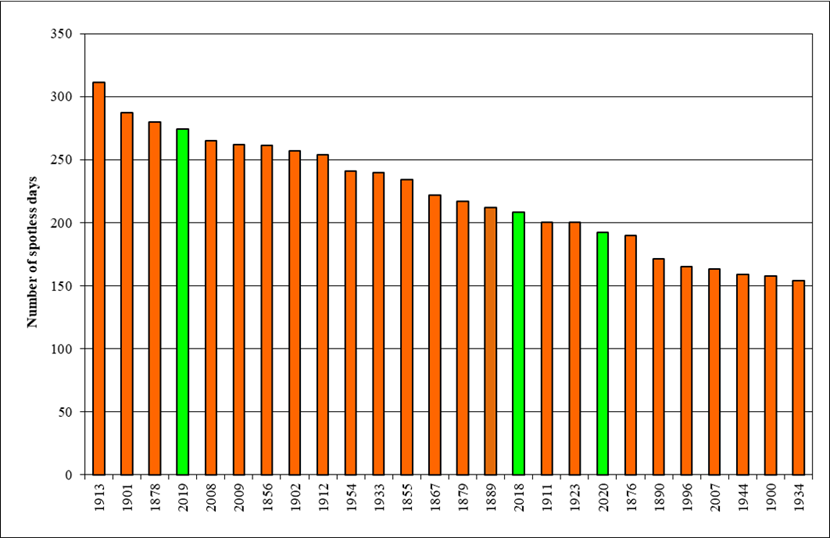
A spotless day is a day with no sunspots, equivalent to a daily sunspot number of 0. The last spotless day dates already back to 11 December 2021 (SILSO). It marked the 848th and last day with a spotless solar disk during the transition from the previous solar cycle 24 to the current solar cycle 25. Though there are a few exceptions, the number of spotless days may give a first rough idea on the strength of the upcoming solar cycle: a weakly to moderately active cycle (many spotless days), or a moderate to strong solar cycle (only few spotless days). It also gives an idea on the evolution of the cosmic ray intensity, i.e. the higher the number of spotless days, the higher the flux of cosmic rays as measured by neutron monitors on the Earth's surface (SC25 Tracking page). SILSO has a Spotless Days page to follow this transition. It will be activated for the next solar cycle transition around the 10th spotless day, most likely in 2027. The chart below shows the 25 years with the highest number of spotless days since 1849.