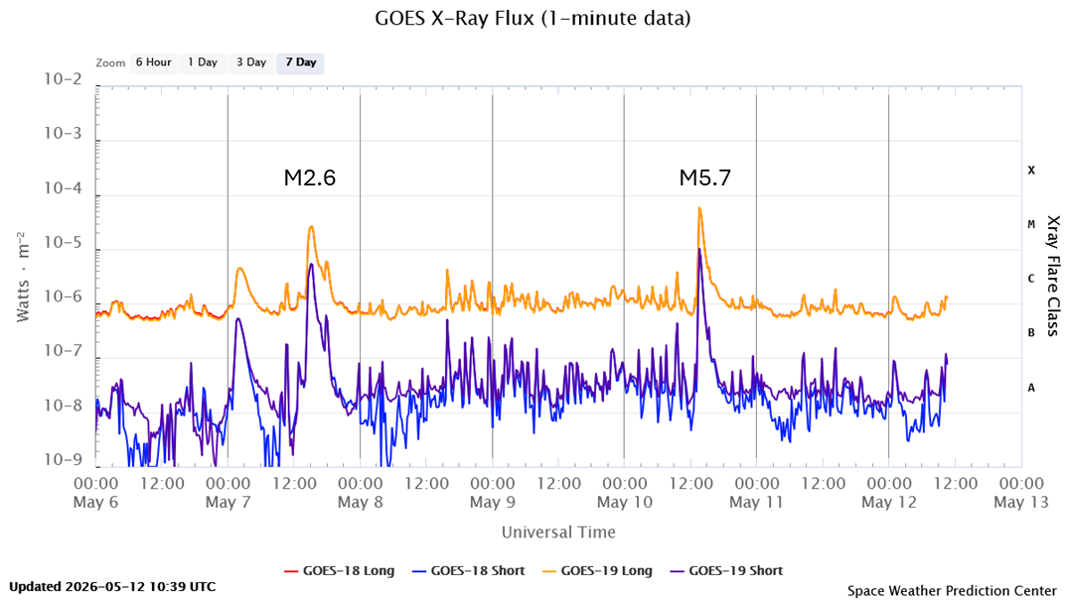
Flare activity was fairly calm last week, with only 2 M-class flares recorded: An M2.6 on 7 May (15:14 UTC), and an M5.7 (13:39 UTC) on 10 May (flare classification). The flares are indicated on the plot underneath showing the solar emission in soft x-rays as observed by the GOES from 6 to 13 May.
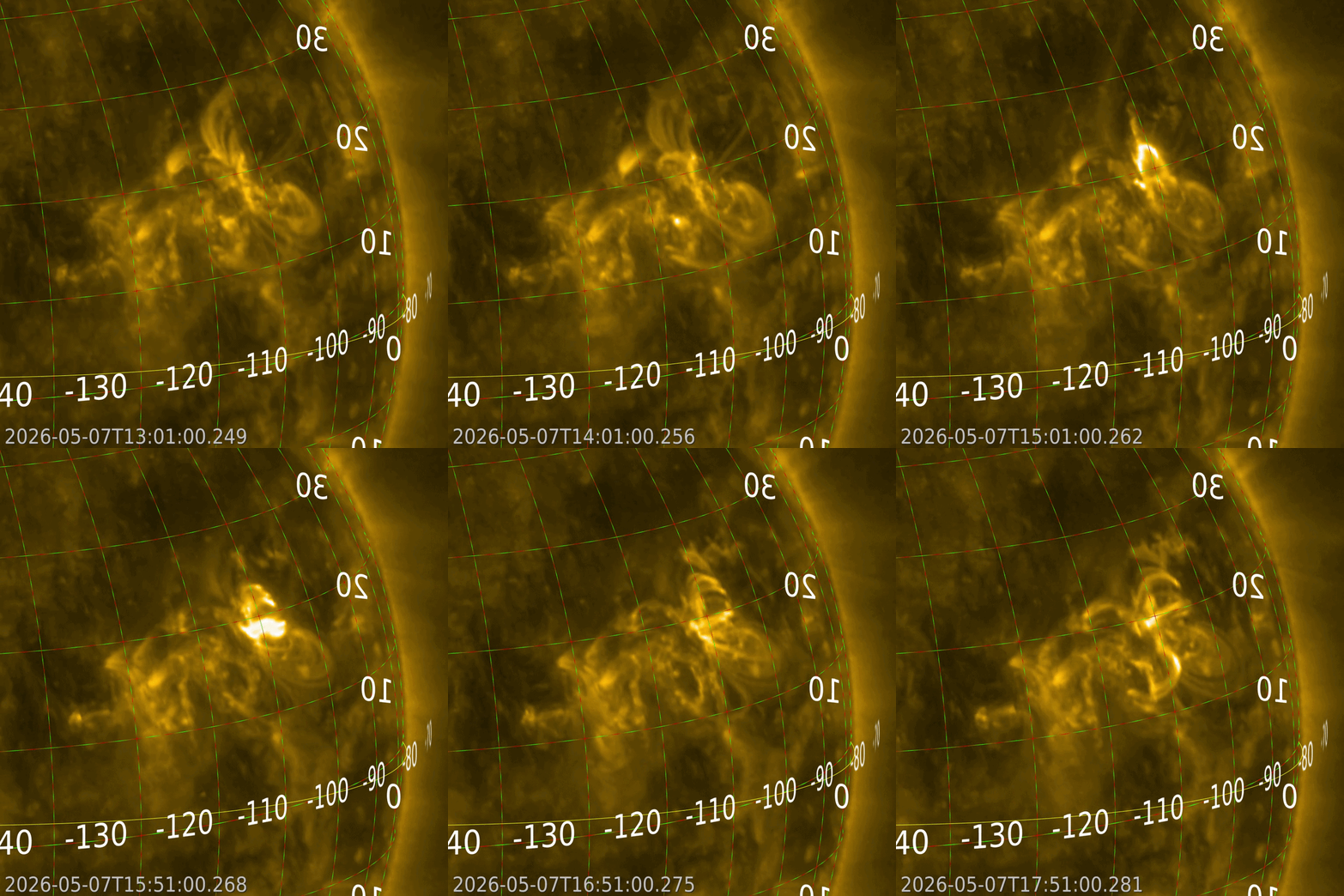
The second flare was clearly located in SIDC region 825 (NOAA 4436), while the first M-class flare took place from a region just behind the northeast limb. It was assumed this flare had the same source region. This was confirmed by imagery from Solar Orbiter's EUI (Extreme Ultraviolet Imager) as shown underneath. It shows zoomed-in imagery by EUI/FSI 174 (Full Sun Imager, at temperatures around 1 million degrees) around the time the flare was recorded by GOES (Earth). At that time, Solar Orbiter was observing the Sun's farside -again: as seen from Earth- and so had a good view on anything that happened over the Sun's east limb. From these observations, it became clear that NOAA 4436 was indeed the source region of the M2 flare, and that the region was still about 10 degrees behind the east limb. In the FSI imagery, the east limb as seen from Earth corresponds to the "-100" meridian (labeling issue due to line-of-sight effect). Obviously, the source region got its NOAA number only once it had turned onto the earth-facing side of the Sun.
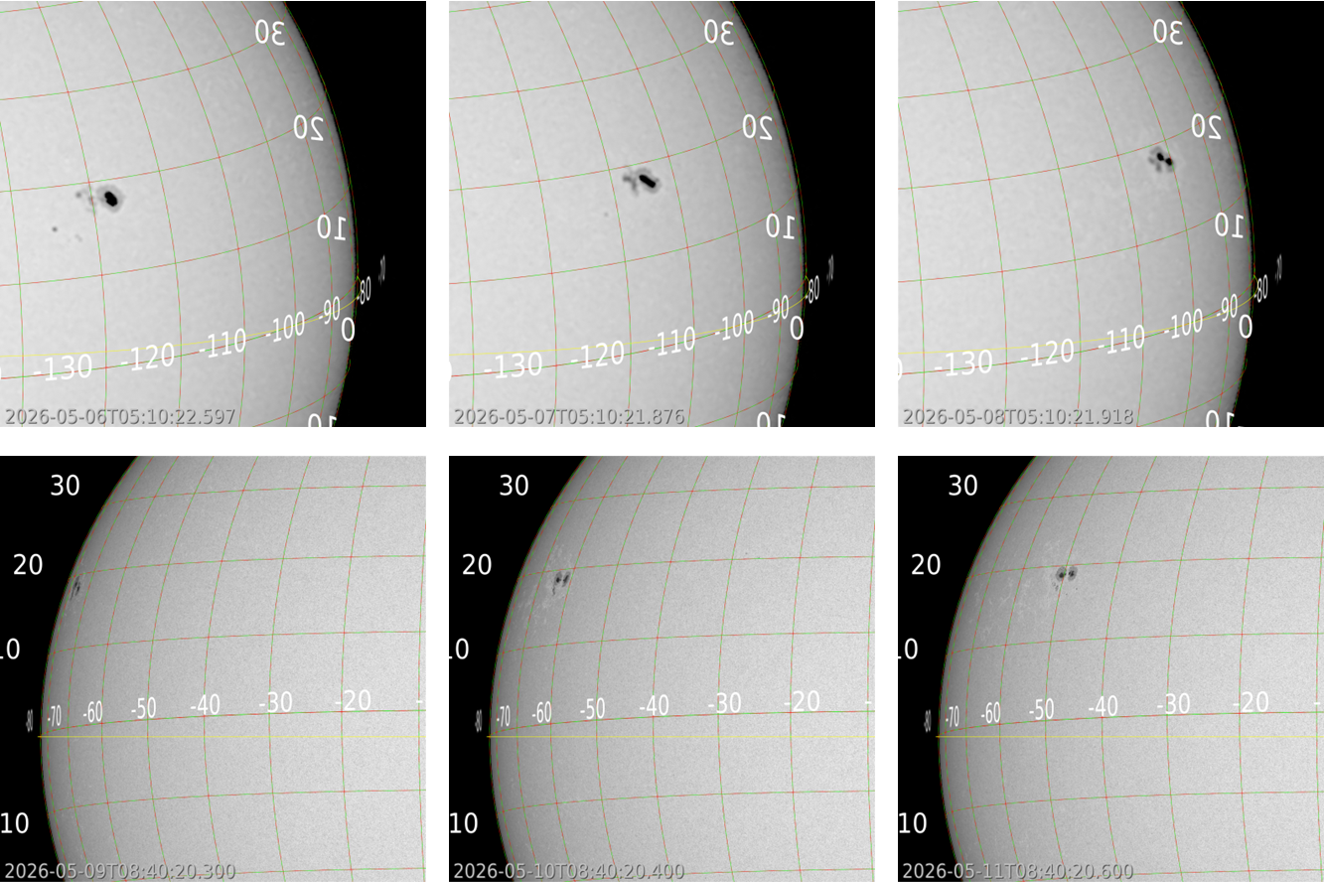
White-light images obtained by the Solar Orbiter's PHI instrument (Polarimetric and Helioseismic Imager) also show that this was actually a new region emerging on the Sun's farside, about 5 degrees north and 15 degrees west of old NOAA 4419 (clip). So, NOAA 4436 is not the return of NOAA 4419, the latter can actually be seen disappearing. The PHI images also show how the big main, leading spot of NOAA 4436 actually splits in two around 7 May. It's no surprise then that for solar observers from Earth, who had their first view of this region only a day later, this split main spot initially looked like a bipolar region. In the compilation underneath, which covers pictures of the active region from 6 to 11 May, the top row images are made with the PHI instrument (solar farside), whereas the bottom row images were obtained by SDO/HMI. Needless to say, and quite obvious once you know how NOAA 4436 came to be: the two, nearly touching each other, main spots in the SDO images of 10 and 11 May have the same magnetic polarity.
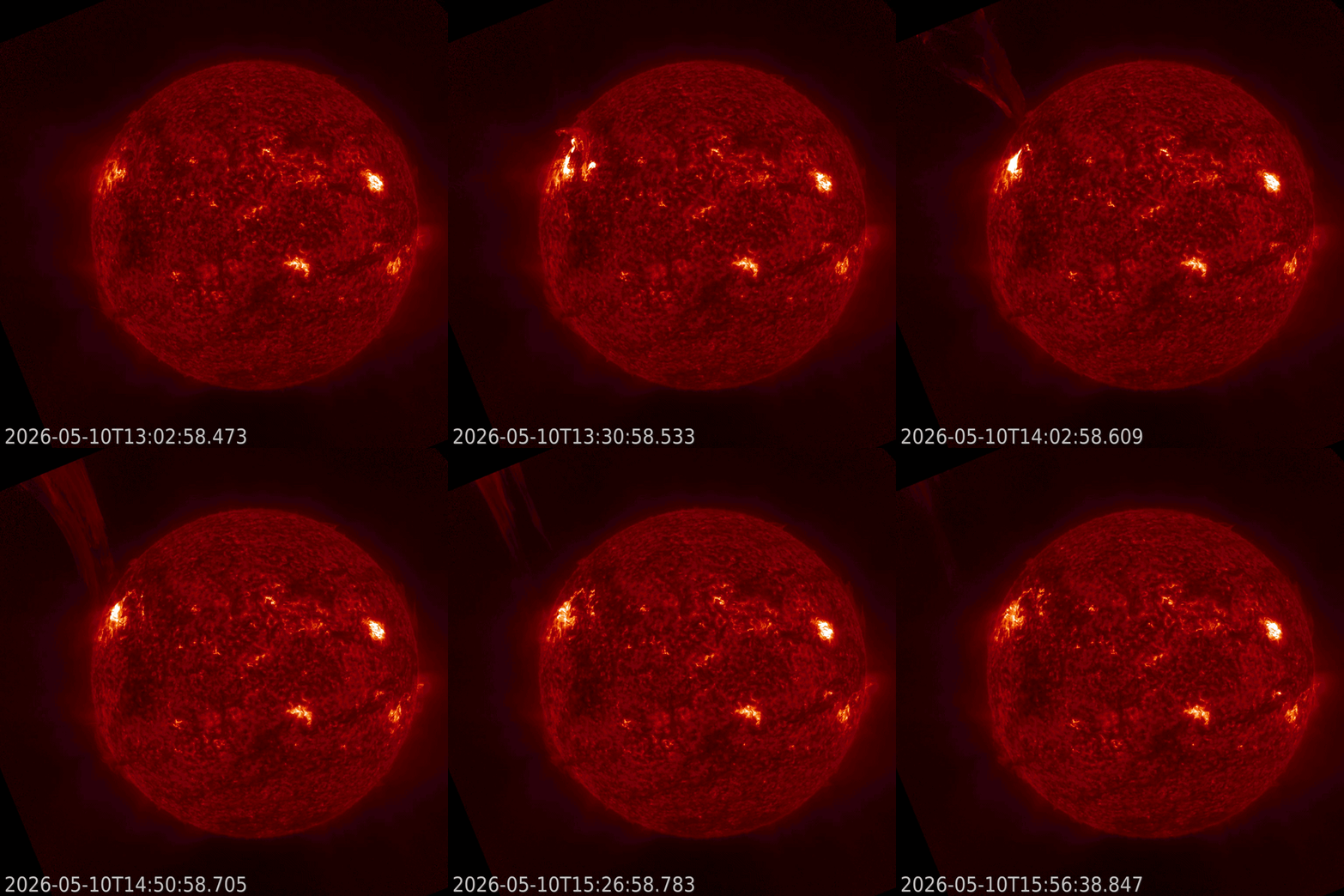
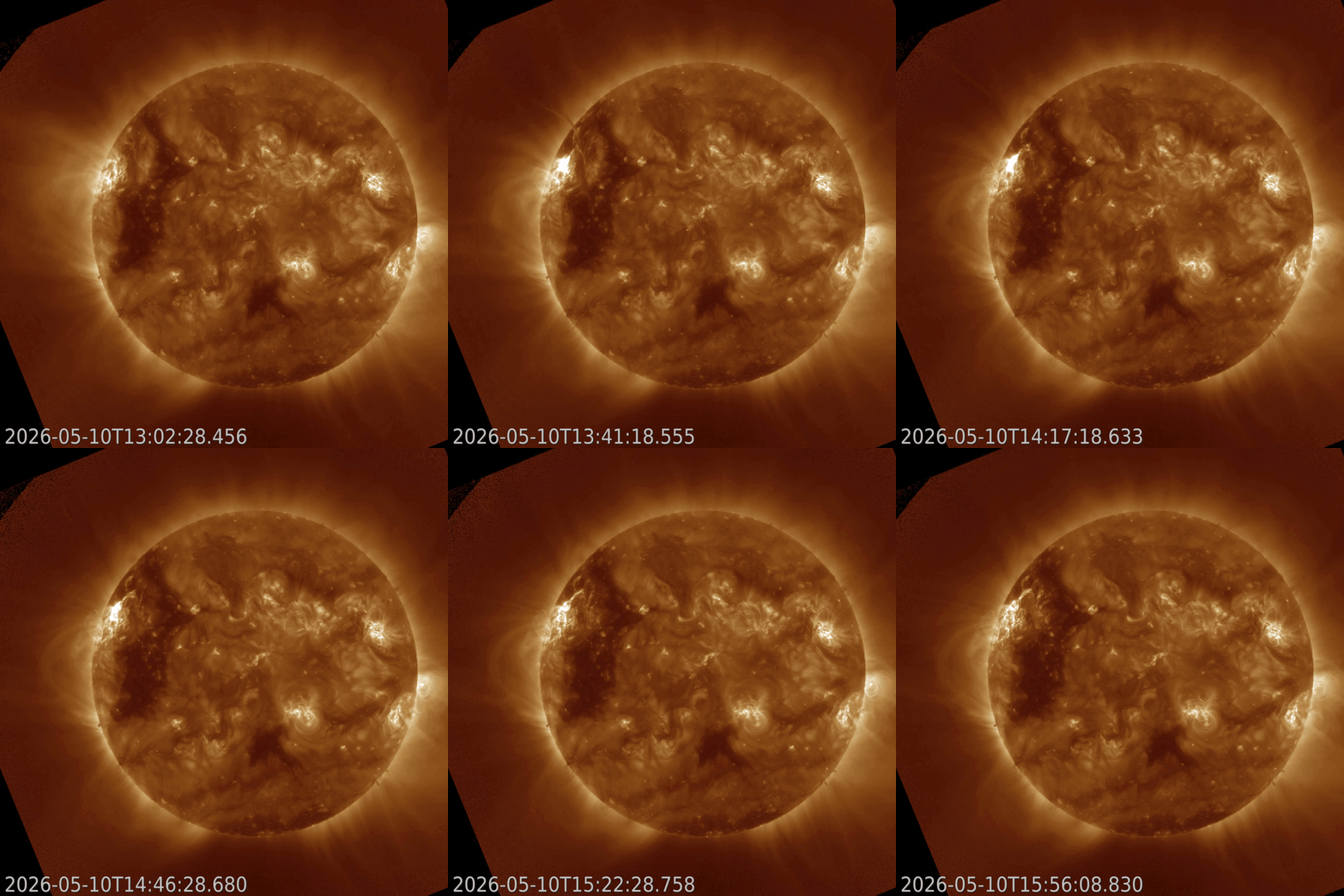
As the M2.6 flare took place while the source region was still behind the solar limb, one could expect that the actual intensity of the eruption was a lot higher, because a portion of the flare site was hidden by the solar disk. So, it's a good thing that Solar Orbiter also has an instrument with which the x-ray intensity can be proxied. According to its STIX instrument (Spectrometer and Telescope for Imaging X-rays), the proxied intensity of the flare was M3.1, with the uncertainty ranging from M1.8 to M5.6. That is indeed somewhat higher, but not that much and certainly not of the X-class level. A few days later, the M5.7 flare occurred just behind the west limb as seen from Solar Orbiter, so STIX had an almost unhampered view of the eruption. In this case, the proxied intensity was M4.4, with an uncertainty range from M2.5 to M8.1. The images underneath show the M5.7 eruption as observed with GOES/SUVI instrument, showing the eruption at temperatures of around 80.000 degrees (left ; 30.4 nm) and around 1.2 million degrees (right ; 19.5 nm).
 |
 |
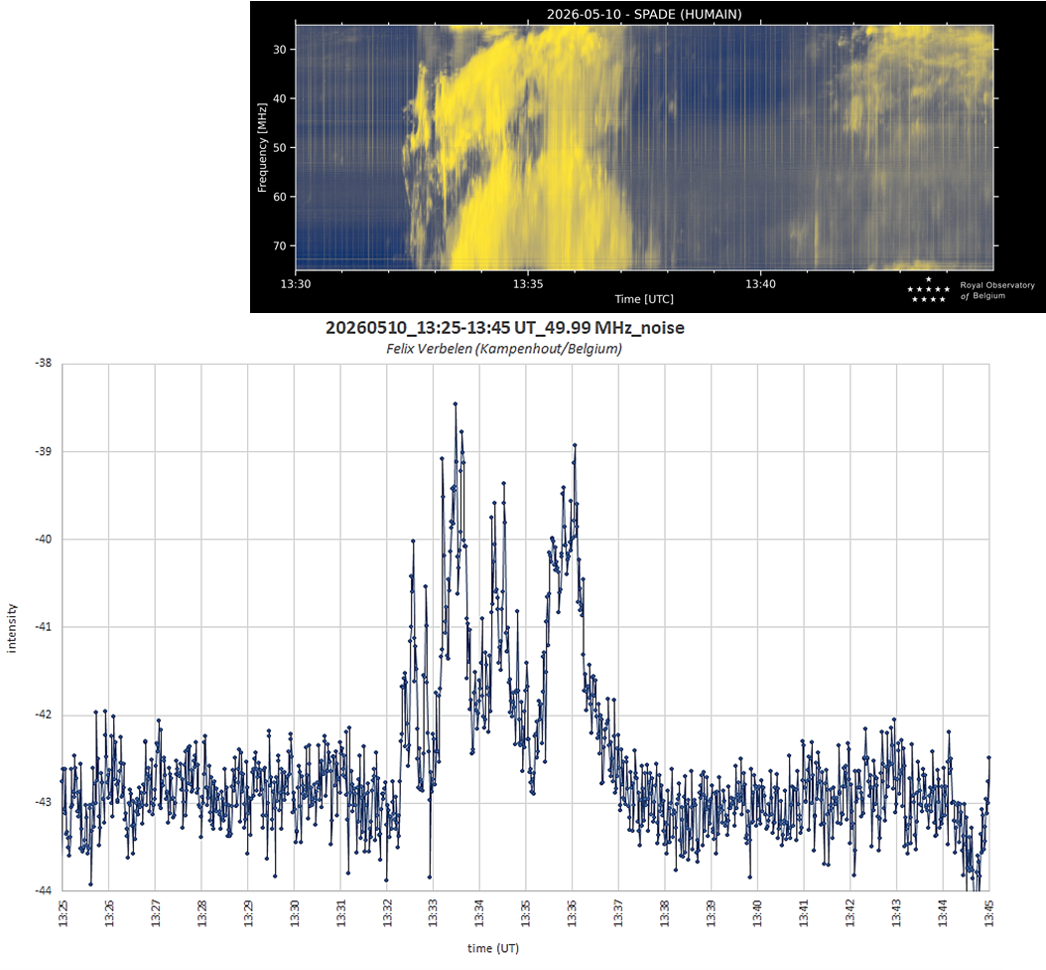
Solar radio bursts were detected by the radio astronomy station at Humain (HuRAS), recording in particular a Type II radio bursts (see the STCE SWx Classification page) for a few minutes on 10 May around 13:35 UTC, i.e. near the peak time of the M5 flare. A zoom on the 25-75 MHz band between 13:30 and 13:45 UTC is provided by the HuRas/SPADE instrument (Small Phased Array DEmonstrator). It is the top image in the compilation below, showing a highly detailed radio spectrogram with the horizontal axis representing time and the vertical axis representing frequency (lowest frequencies on top). It is co-aligned in time with radio observations from the Belgian radio amateurs (VVS ; Felix Verbelen). They use a radio beacon at Ypres with similar frequency and power source as that what BRAMS is using in Dourbes (see the website of the Belgian RAdio Meteor Stations). The correspondence of the observed disturbance between SPADE near 50 MHz and VVS is excellent! The enhancement of the radio noise due to the solar eruption makes it more difficult to observe the faint reflections from the radio meteors.