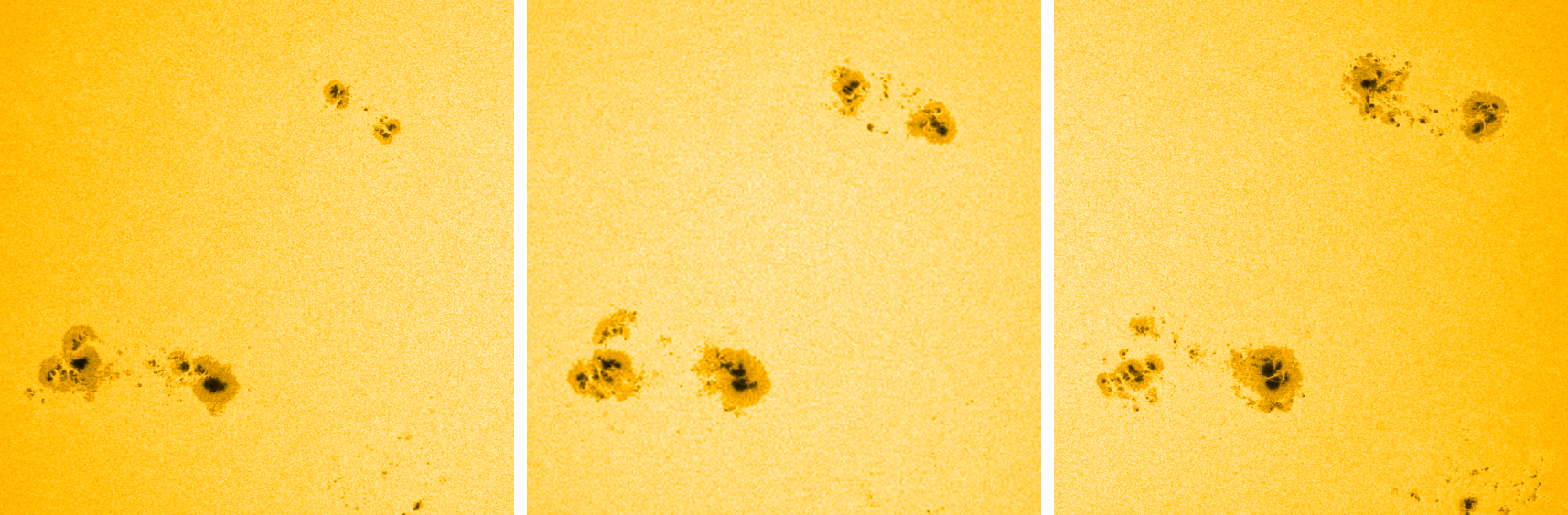
Last week, 2 big sunspot groups dominated the outlook of the solar disk. The largest one was NOAA 4478 (SIDC sunspot group 886) which was located in the southern solar hemisphere, whereas the somewhat smaller NOAA 4479 (SIDC sunspot group 860) was located in the northern solar hemisphere. Both were new groups that started their life resp. on the Sun's farside (STCE newsitem) and on the Earth facing solar hemisphere. Using eclipse glasses, they were easily visible with the naked eye for a few days when they were close to the Sun's central meridian. According to the NOAA statistics, NOAA 4478 reached an area of about 9 times the surface area of the Earth. That's not as large as the big sunspot group of May 2024, but it is -in size- the best of the rest as far as sunspot groups of this solar cycle is concerned. NOAA 4479 had only about half the sunspot area of NOAA 4478. The SDO/HMI images underneath show the development of NOAA 4479 and the decay of NOAA 4478's trailing portion on 28 and 30 June and on 2 July.

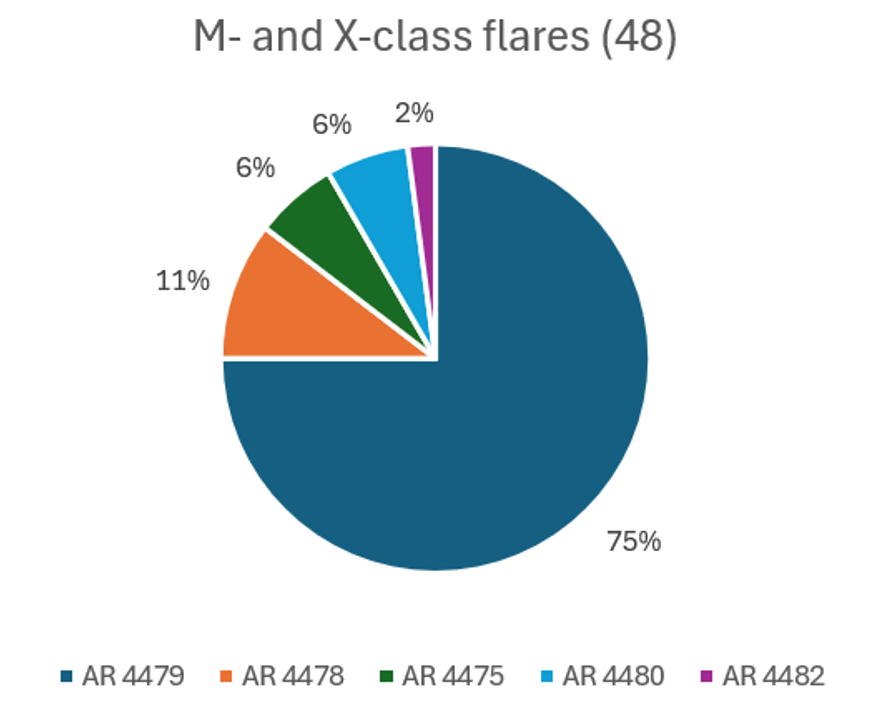
In terms of flare activity, it was NOAA 4479 that had the upper hand. Over the last week, it produced 36 of the 48 M- and X-class flares (unassigned not included). That is much more than any of the other groups (see the pie-diagram underneath). In fact, this number is so high that NOAA 4479 is already in the Top 30 of sunspot groups that produced most of such events during the entire GOES era, i.e. during the last half century (STCE newsitem). Also remarkable is that the region produced more than half of its M-class flares on just 2 days (4-5 July). The strongest flare (X1.1) was produced on 30 June while the region was still developing.
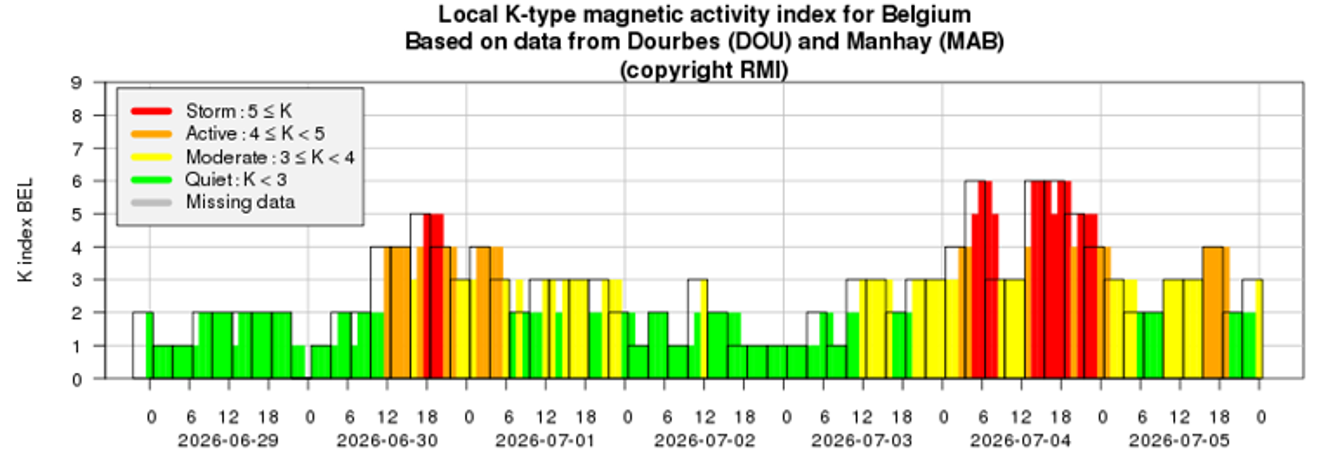
Quite a few of these flares were associated with a coronal mass ejection (CME), some of which had an earth-directed component. The arrival of a few of these CMEs eventually resulted in a strong (Kp = 7 ; Potsdam) geomagnetic storm on 4 July. In Belgium, the local K_BEL index reached only moderate levels (K_BEL = 6 ; see diagram underneath). This was too weak for any polar lights to be visible from Belgium, in particular because the most intense portion of the geomagnetic storm took place during the morning and noon hours on 4 July. In the United States, aurora were seen and photographed as far south as Colorado and California (https://www.spaceweather.com/).