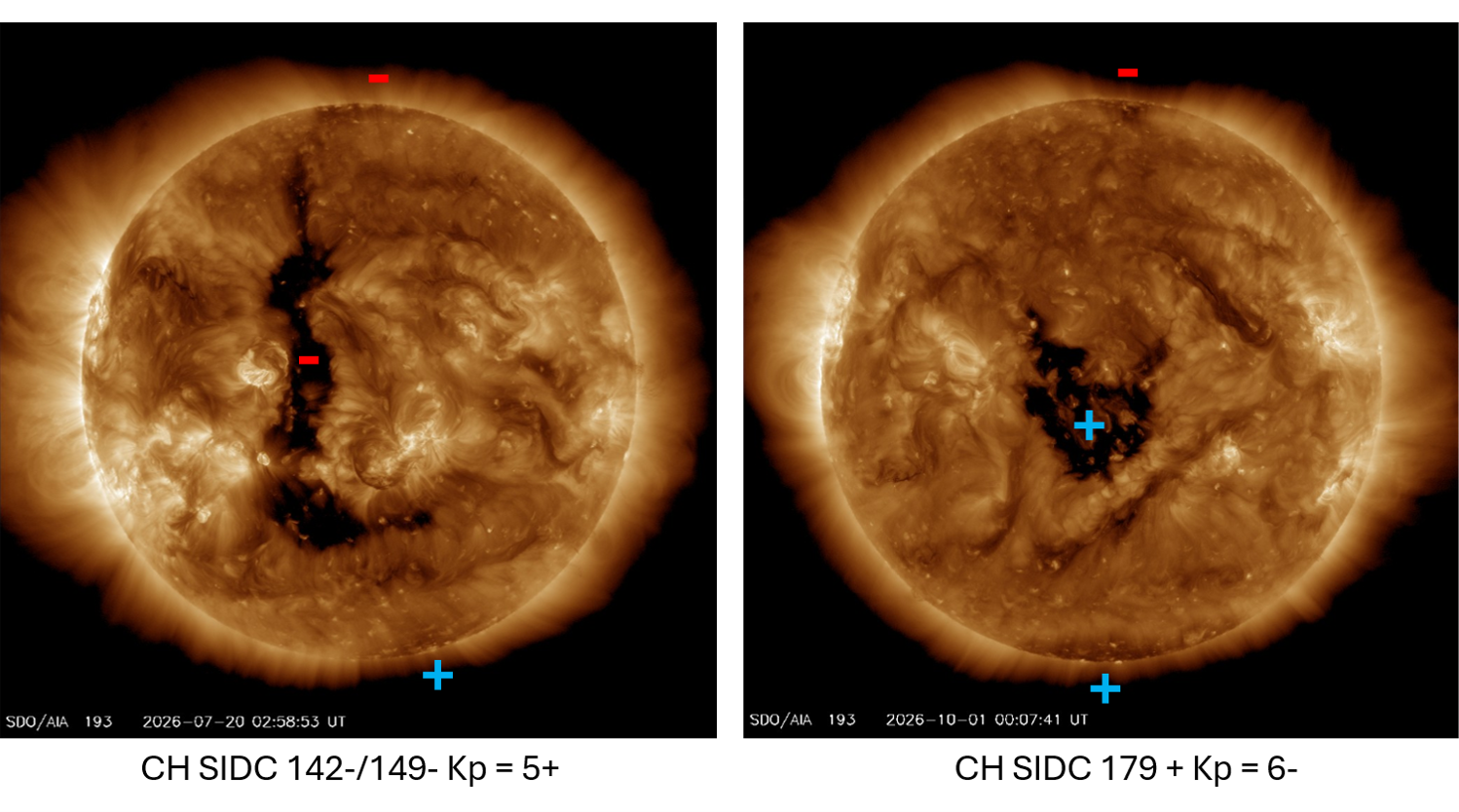
Coronal holes (CHs) are regions in the hot solar atmosphere ("corona") where the plasma density at that temperature is very low compared to its surroundings, and thus they look like dark shapes when viewed in extreme ultraviolet (EUV). Linked to unipolar (i.e. "open") magnetic fields stretching into space, they are the source of the high-speed solar wind which can create geomagnetic disturbances. Space weather forecasters at the SIDC of the Royal Observatory of Belgium assign a number to each CH that appears on the Sun (link). The SDO EUV images underneath show some recent coronal holes of which the associated high-speed solar wind stream was responsible for respectively minor and moderate geomagnetic storming. The CH numbers are as assigned by the SIDC, and the "+" (positive) or "-" (negative) indicate the orientation of the open magnetic field lines, i.e. pointing away from the Sun or towards the Sun.
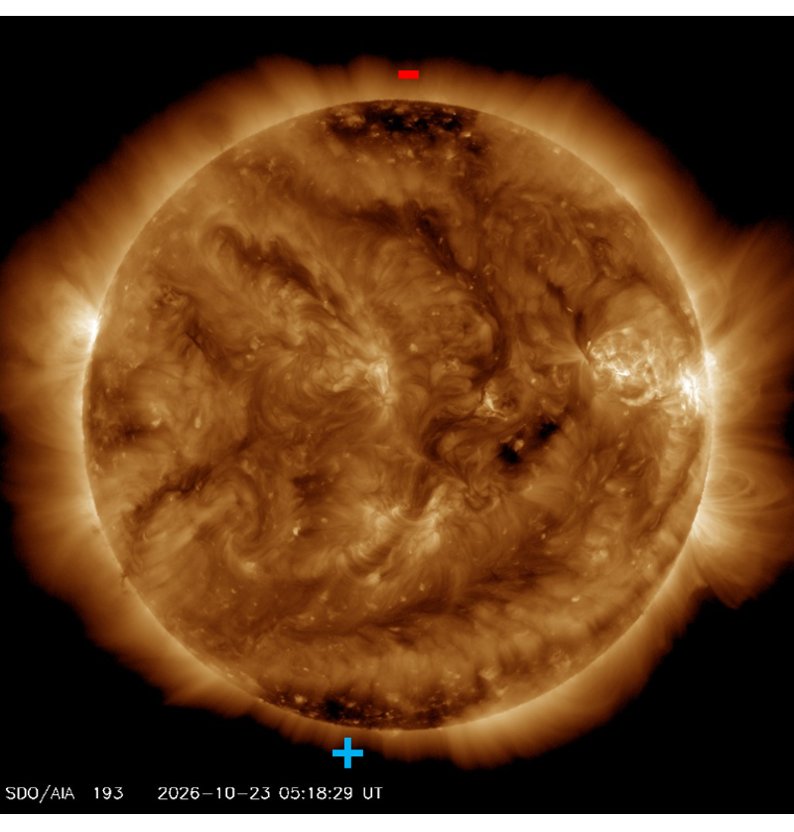
Imagery from the last few weeks seem to indicate that there are coronal holes present at both solar poles. As shown in the annotated SDO image underneath, they are still small but they have been present for several weeks now in contrast to the previous months were they appeared and disappeared within a few days. Note that it is not so easy to establish the exact timings, due to line-of-sight effects, the solar rotation, and the seasonal effect (better view on the Sun's north and south pole resp. in August-October and February-April). If the current situation continues, and these polar coronal holes remain present, then we can say that these polar coronal holes have finally been established. The northern polar coronal hole has a negative magnetic polarity, and the southern one has a positive magnetic polarity. Over the course of the next year, these polar coronal holes are expected to expand a bit and become more prominently visible. Note that these polar coronal holes are not necessarily symmetric around the respective solar pole. In fact, they may be several degrees off this true solar pole (e.g. Riehokainen et al. 2025), and the development, size as well as the evolution of these polar coronal holes may be quite asymmetric (Hess Webber et al. 2014).
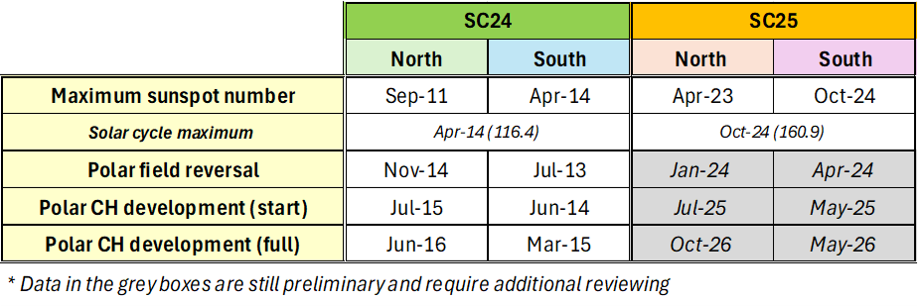
For the ongoing solar cycle (SC25), it seems to have taken quite a while to get the firm establishment of these polar coronal holes. The table underneath compares the current evolution with that from the previous solar cycle (SC24), with a portion of the data for that cycle taken from a paper by Mierla et al. (2020). It gives for each hemisphere the time of maximum sunspot number (SIDC/SILSO), the time of polar field reversal (Wilcox Solar Observatory), and the start and completion of the development of the polar coronal holes (from SDO/AIA 193 imagery). The second line gives the timing and intensity (maximum smoothed monthly sunspot number) for each solar cycle. Except for the sunspot numbers, the other data for SC25 are still preliminary and require a rigourous verification. It seems then when starting the count around the time of each polar field reversal, the polar CH in SC24 took about 20 months to get fully established, while in SC25 this was 29 +/-4 months - considerably longer. However, if one takes the maximum of the solar cycle as a starting point (resp. April 2014 and October 2024), then both solar cycles take about the same time to develop, i.e. about 2 years. Indeed, one of the differences between the two solar cycles is that for SC25, the polar field reversal was basically completed on both poles 6-9 months prior to the solar cycle maximum, whereas in SC24 the northern pole dragged its feet and switched magnetic polarity only 6 to 8 months after solar cycle maximum. A marked difference indeed! Fortunately, we have Solar Orbiter that is gradually changing its orbit to get a better view on what is going on at the solar poles (see e.g. https://www.stce.be/content/first-view-solar-poles-eui ) and how those polar coronal holes further evolve.