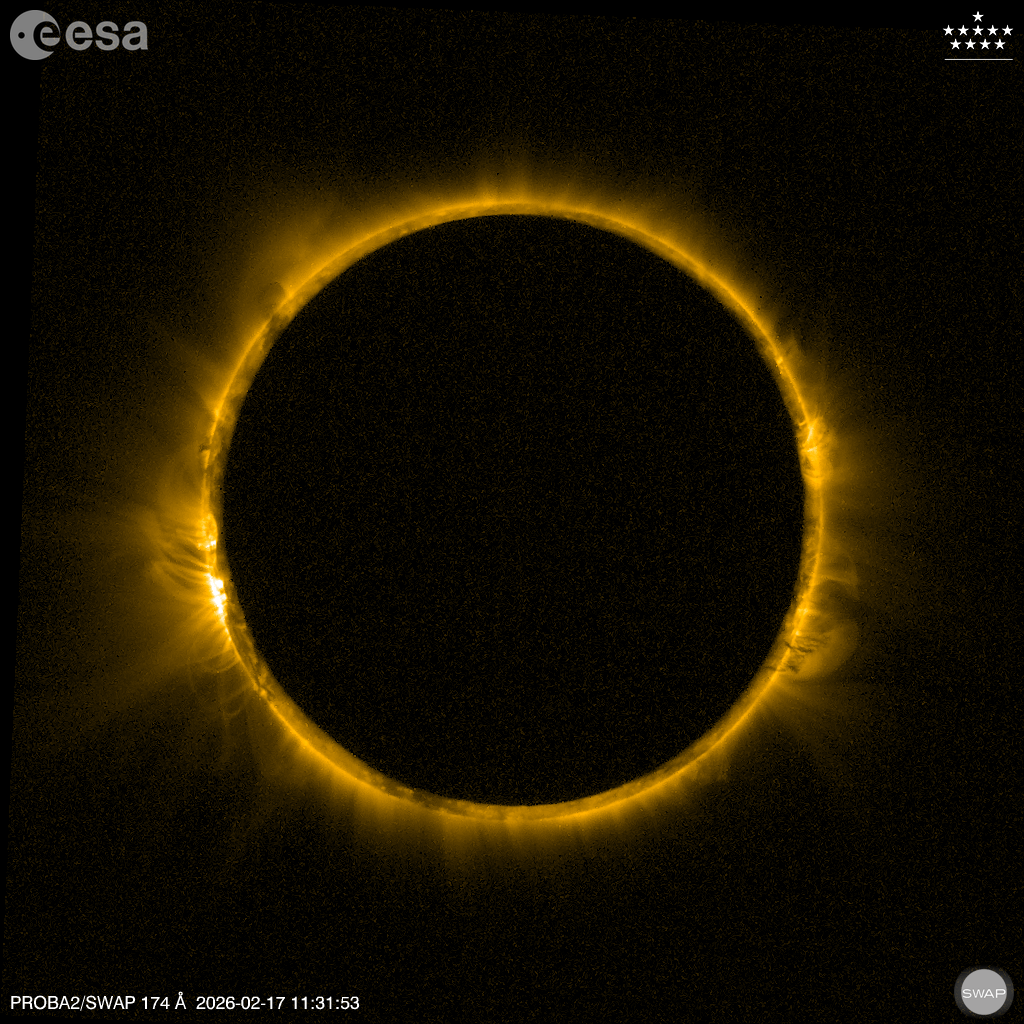
On February 17, an annular eclipse took place. This is an eclipse where the appparent diameter of the occulting Moon is smaller than that of the Sun, making the Sun appear as a ring (annulus in latin). Unfortunately, from Earth, annularity was only visible over Antarctica. Given clear skies, observers in Argentina, Chili and much of Southern Africa were able to see a partial eclipse.
From space, the view was quite different! Thanks to its fast sun-synchronous orbit, the PROBA-2 satellite crosses the eclipse zone multiple times, allowing it to capture several unique perspectives. During its second passage, just over 93% of the solar disk was occulted by the Moon in an annular eclipse, producing the striking “ring of fire” effect. This was followed up by a nearly total eclipse in the third passage. To top it off, PROBA2 observed two small eclipses during the first and the fourth passages.
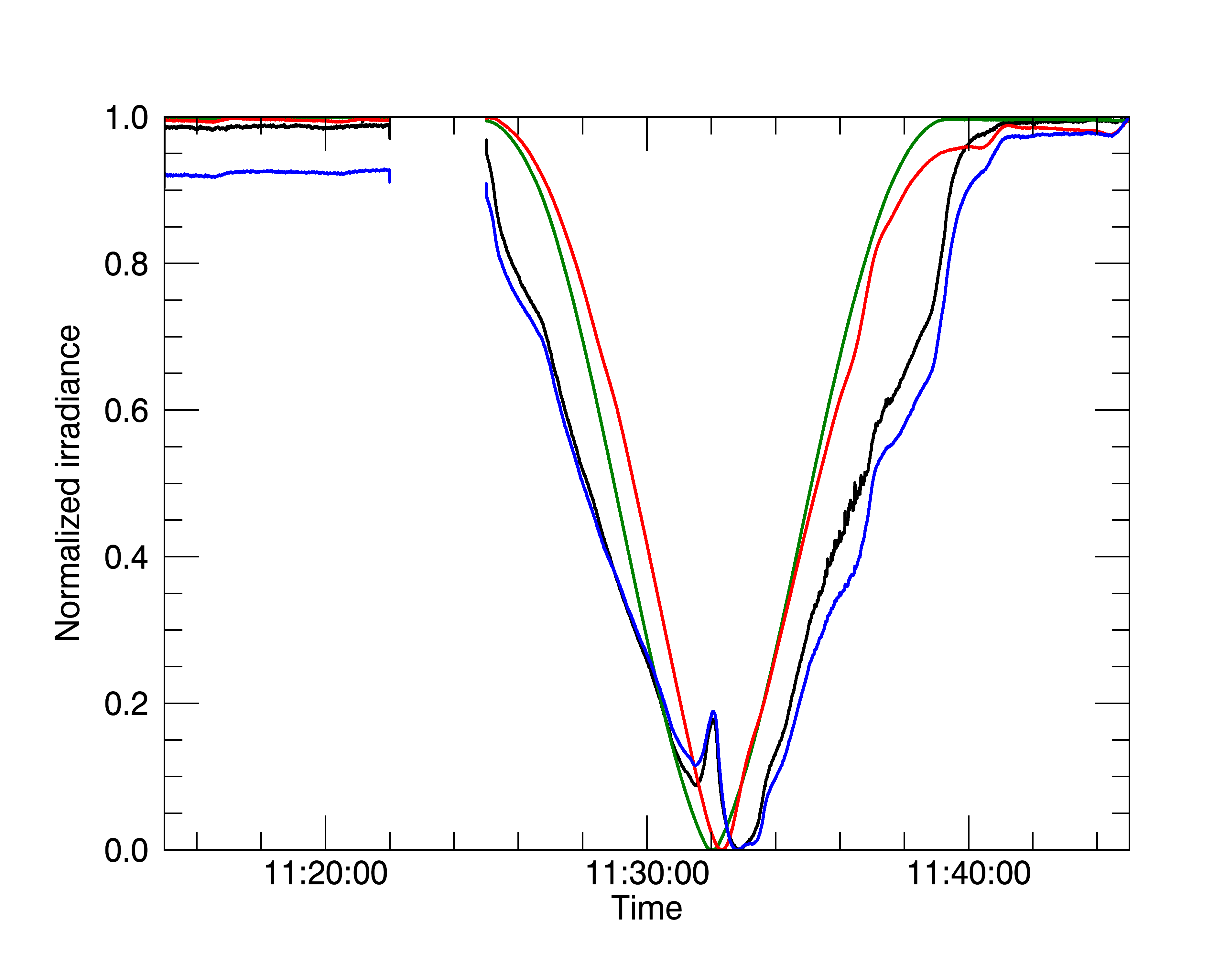
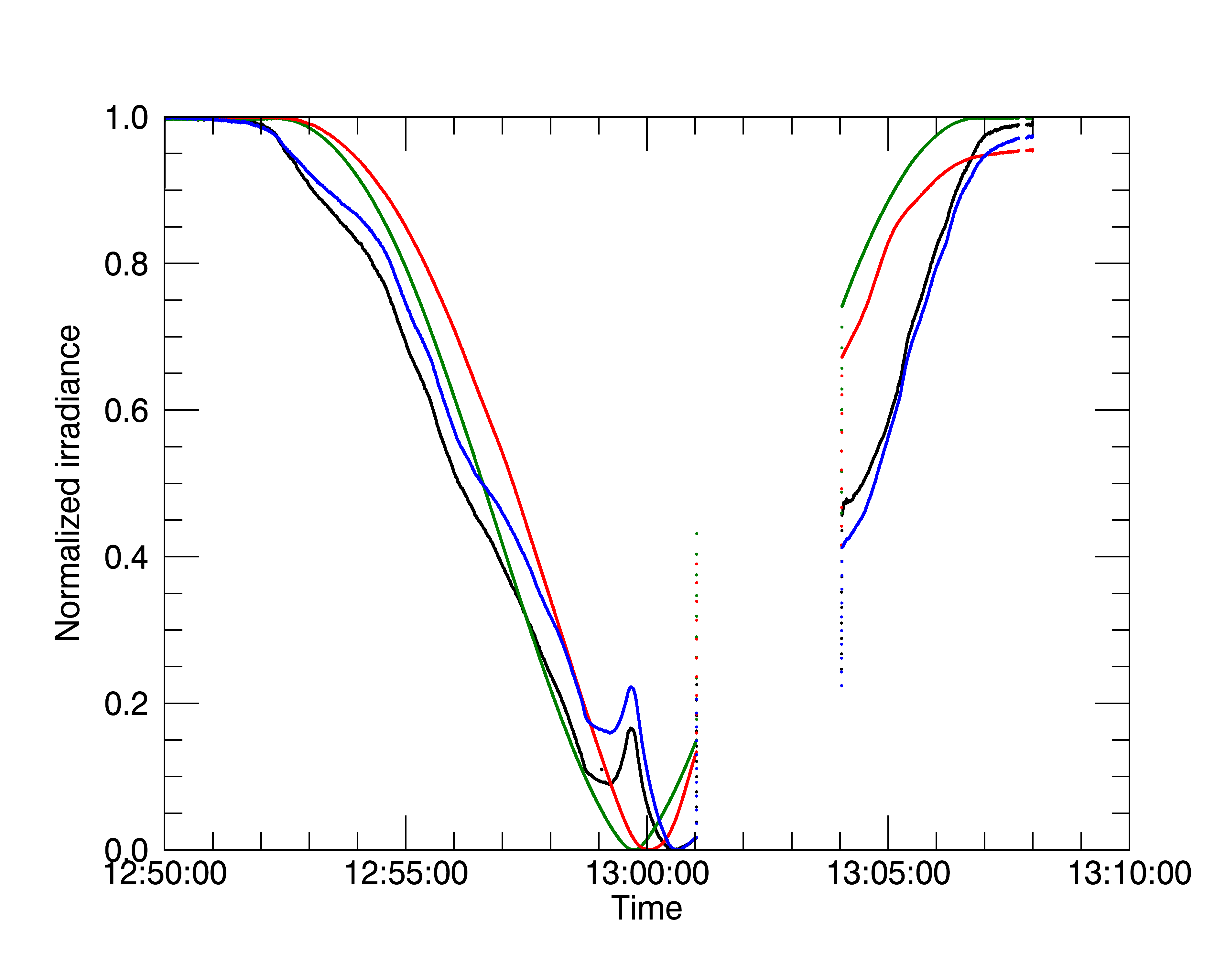
Naturally, high-cadence observations were planned with both SWAP and LYRA instruments and the data was processed as soon as they arrived on the ground. As with earlier eclipses, LYRA conducted a dedicated campaign using one of its backup units to obtain higher-quality measurements. The images below show the dips in the signal measured by the four channels of LYRA when the Moon passes in front of the Sun during the second and third transits through the eclipse zone. Some manoeuvres of the spacecraft were filtered out (corresponding to gaps in the time series).
In these plots, the colours correspond respectively to the zirconium (black — closest to the SWAP passband), aluminium (blue), Lyman-α (red), and Herzberg (green) channels of the instrument. In the two UV channels (red and green), which are relatively insensitive to the presence of active regions on the solar surface, the lunar occultation produces a very smooth, regular profile. In the other two channels, the signal shows additional variations corresponding to the Moon passing in front of regions of differing solar activity.
SWAP operated in high-cadence mode, capturing on average one image every 20 seconds and caught the ring of fire at 11:31 UT. Click on the image to watch a movie with the 4 eclipse passages.