UPDATED - For older posts, please scroll down
UPDATE 4 June 2026 at 16:15UTC - From today's URSIgram issued by the SIDC SWx forecaster: "...Three coronal mass ejections (CMEs) were detected on June 03 with Earth directed components:
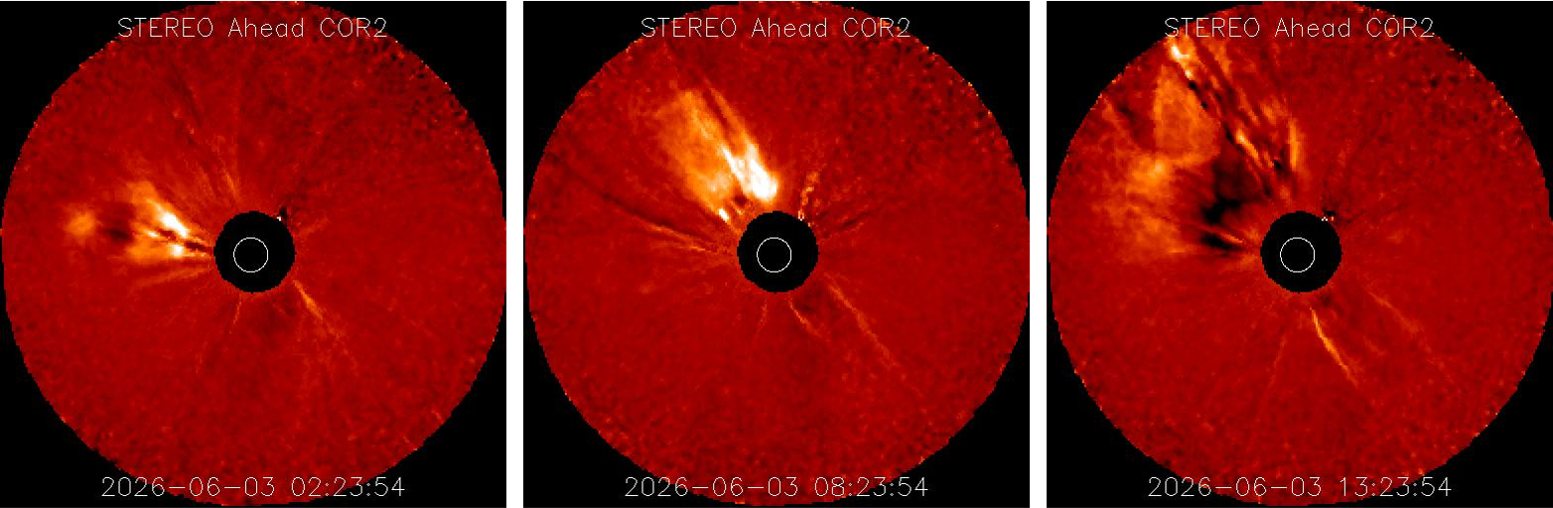
- Firstly, a halo CME, associated with the M9.3 flare ... , seen in SOHO LASCO-C2 and seen STEREO-A COR2 starting at June 03 at 01:53 UTC.
- Secondly, a partial halo CME (directed to the north-west), detected in SOHO LASCO-C2 from 07:58 UTC on June 03, associated with the M7.7 flare ...
- Thirdly, a partial halo CME (directed to the north-west), detected in SOHO LASCO-C2 from 11:48 UTC on June 03, associated with the X1.0 flare ...
These CMEs are expected to impact Earth from late on June 04 and through June 05. ... A large enhancement in the solar wind speed and magnetic field strength is expected on June 04 and June 05, due to the expected arrival of multiple CMEs which left the Sun on June 03. ... Moderate to major storm conditions are expected from late on June 04 with severe storm intervals possible, due to the anticipated combined CME arrivals."
These geomagnetic conditions correspond to a maximum Kp of 8. Depending on the timing and the weather conditions, this means that for Belgium, there's a small chance to see auroras over the northern horizon, with better chances using a recording device. The geomagnetic storm is expected to be considerably weaker than the January storm earlier this year and the extreme storms in 2024.
CMEs related to the 3 main eruptions of 3 June as seen by the STEREO-A/COR2 coronagraph. STEREO-A is located 60° ahead of Earth (to the left in the images).
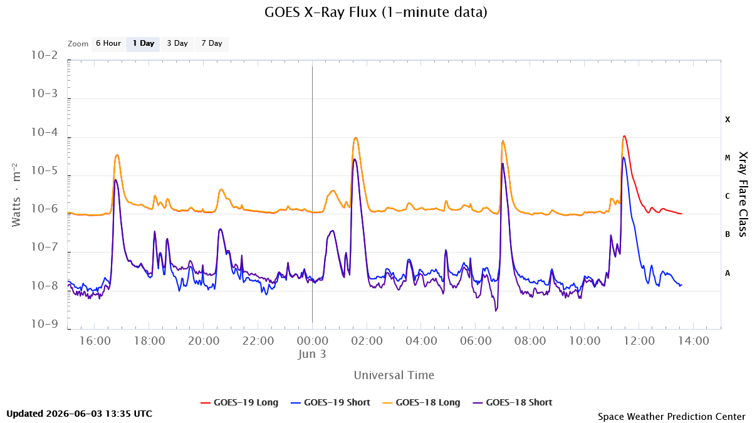
Original 3 June 2026 at 14:45UTC - SIDC Sunspot Group 860 (NOAA Active Region 4455) developed a complex magnetic structure over the last 24 hours. Then early today it started to produce significant flares: an M9.3 at 01:36 UTC, an M7.7 flare at 07:00 UTC, and an X1.0 flare at 11:28 UTC. The graph underneath shows the evolution in soft x-rays as recorded by GOES.
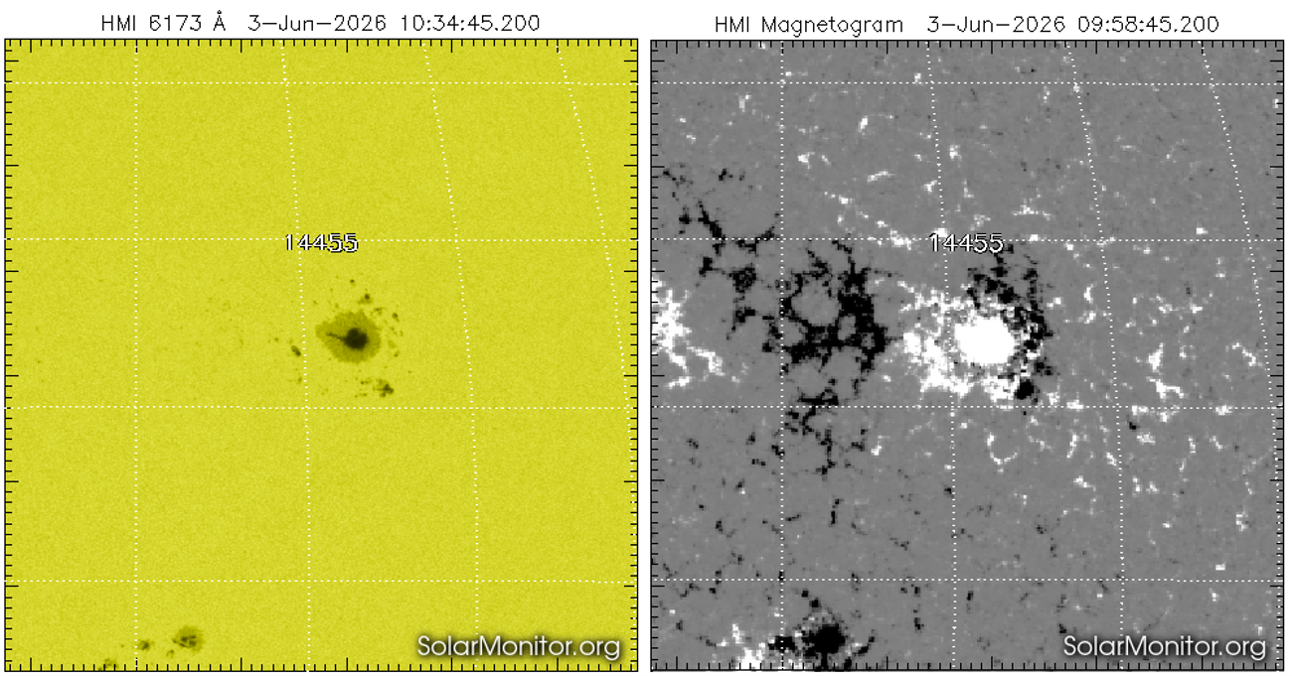
In white light, NOAA 4455 looks all in all deceivingly simply (just a symmetric, big sunspot with some minor spots close-by), but the catch is all in the detail. The few small spots which are partially surrounding the main big spot have an opposite polarity. This can be seen in the SDO imagery underneath, with on the left the white light image and on the right the magnetogram (note the proximity of the "black" satellite sunspots close to the "white" main spot) . This configuration is known for its high flaring potential, which has been dealt with in previous newsitems (e.g. here and here). As long as this magnetic structure exists, further strong flaring remains possible.
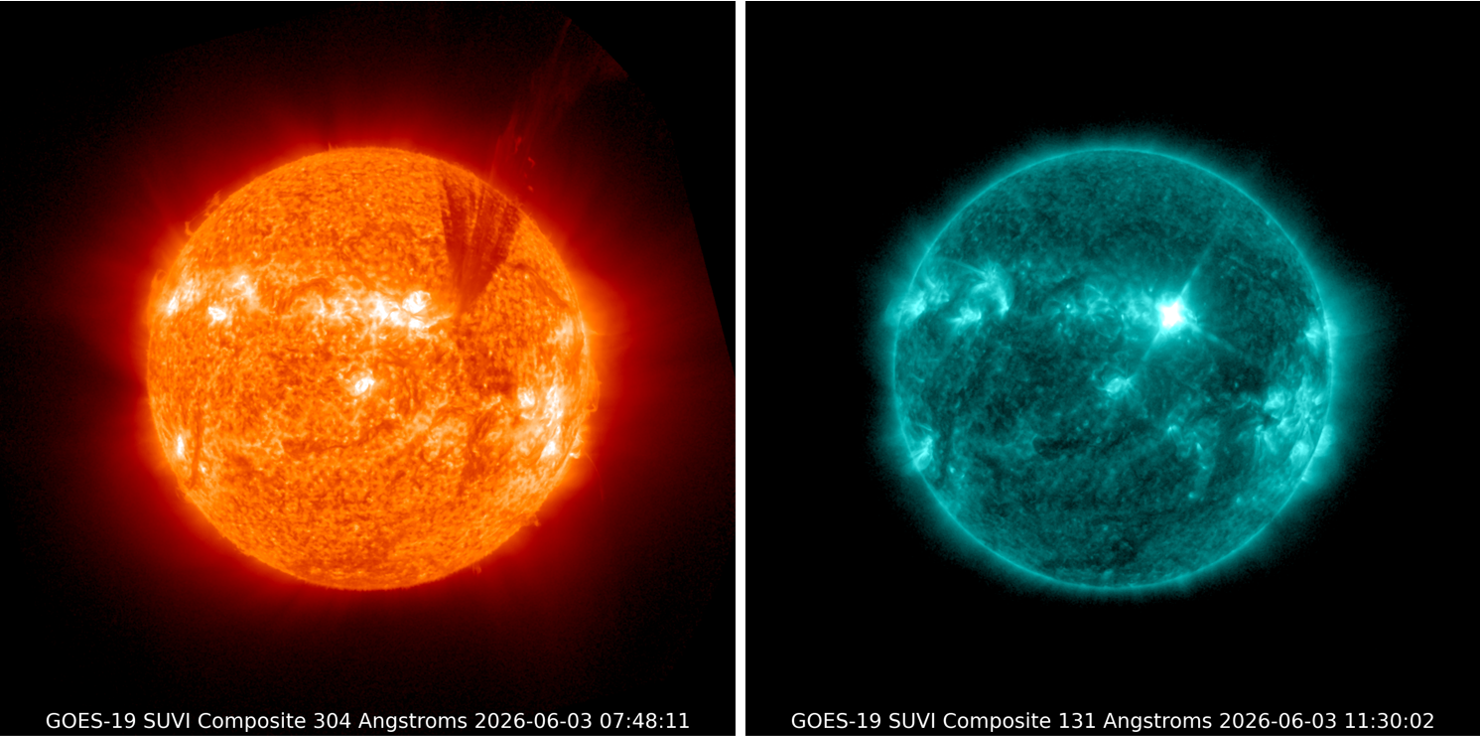
The 3 strong flares of today (so far) differed in the ejection of material into space. The most spectacular was the M7 flare, as shown in the GOES/SUVI 304 image on the left. The image to the right shows the X1 flare in a different wavelength covering much higher temperatures of several million degrees. According to the SIDC spaceweather forecaster, "... A faint halo Coronal Mass Ejection (CME) was detected in SOHO LASCO-C2 and seen STEREO-A COR2 starting at June 03 at 01:53 UTC. This CME was associated with the M9.3 flare (SIDC flare 7838) and a second partial halo CME (directed to the north-west) was detected in SOHO LASCO-C2 from 07:58 UTC on June 03. This CME was associated with the M7.7 flare (SIDC flare 7840), with peak time 07:00 UTC on June 03. Modelling of these events are ongoing but initial estimates indicate possible first arrival from these events on June 05. Any possible CME associated with the X1.0 flare will be analysed when the data becomes available." To be continued (best seats at the SIDC website...).
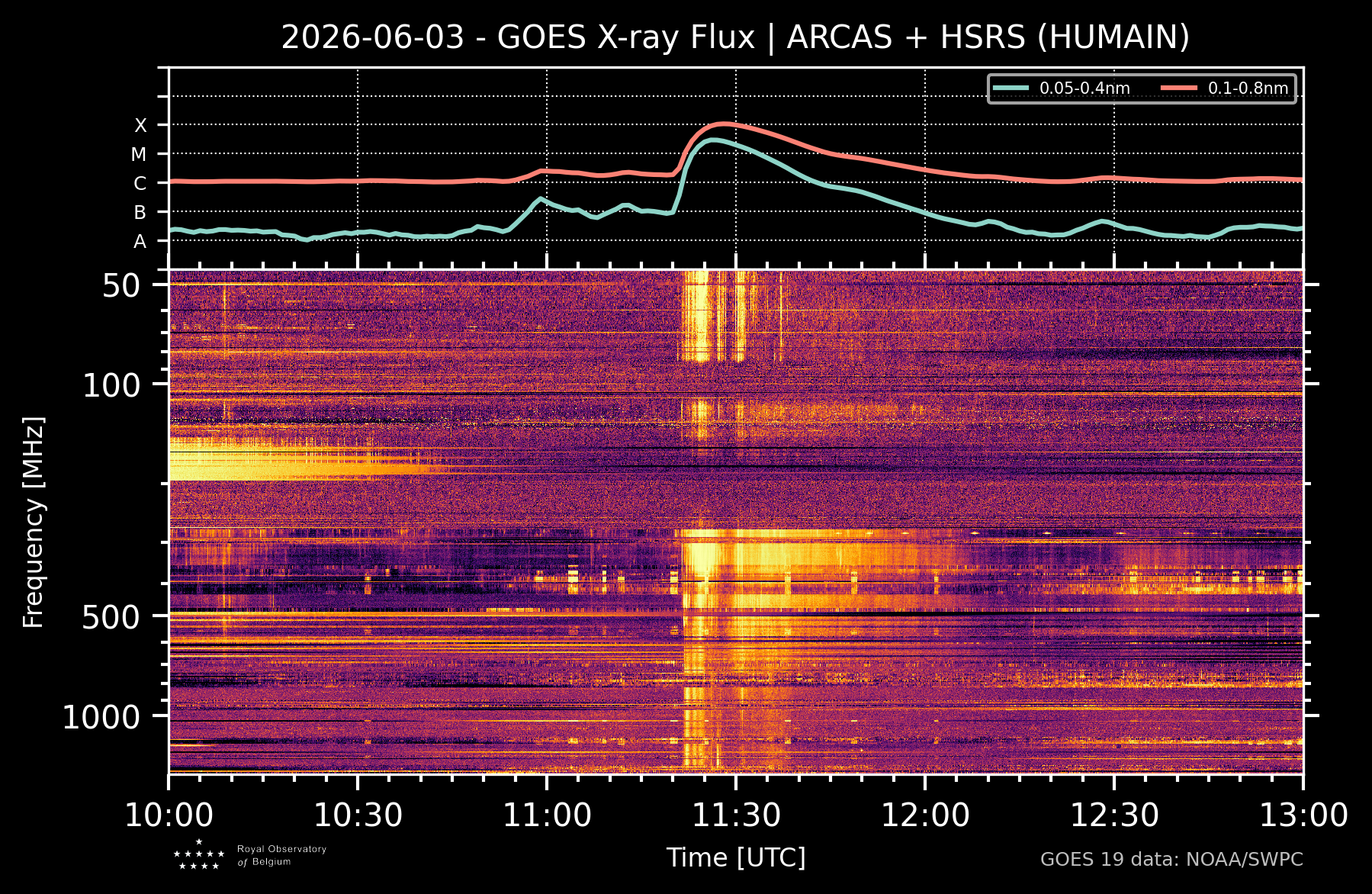
All three eruptions produced significant radio emission at all observed frequencies, but in all cases the frequencies at 1415 MHz (GNSS - Global Navigation Satellite Systems, such as GPS, Galileo,...) and at 2800 MHz (10.7cm solar radio flux) were least affected. The Humain Radioastronomy Station (HuRAS) was able to record the radio emission associated with the X1 flare. Time is on the vertical axis, and frequency on the vertical axis with the lowest on top. Type III radio bursts are the most prominent in this graph (see the STCE SWx classification page for more info).
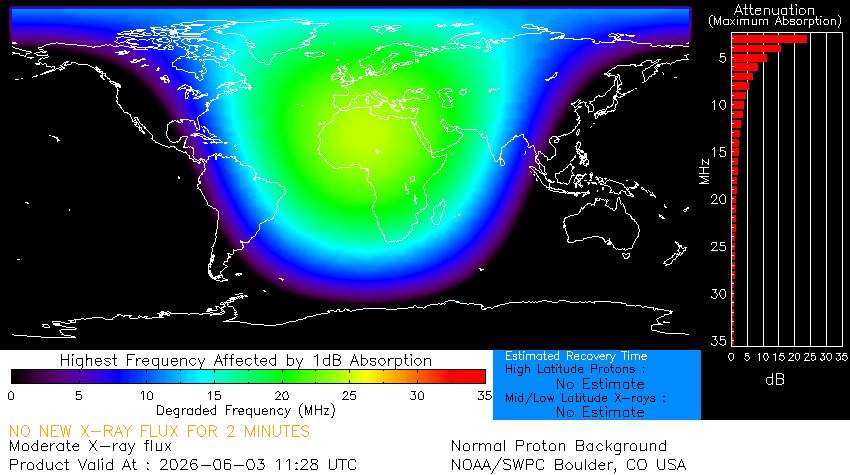
The ionizing radiation of the X-class flare itself affected the lower frequency portion of the High Frequency communication band (HF Com ; 3 - 30 MHz) on the dayside of the Earth. This was mainly over Europe, Africa, Greenland and the North-Atlantic Ocean. The effects of this X-class flare on HF Com can be seen in the D-RAP (NOAA/SWPC) map below. An advisory to civil aviation has been issued (PECASUS).