The USET station -the "Uccle Solar Equatorial Table"- of the Royal Observatory in Uccle (Belgium) monitors solar activity by recording full-disc images of the Sun in three wavelengths. One of its telescopes shows the solar surface in white light, while the other two are equipped with narrow band-pass filters to capture the chromosphere (the Sun's inner atmosphere) in the H-alpha line (656.3 nm) and the Ca II K line (393.3 nm).
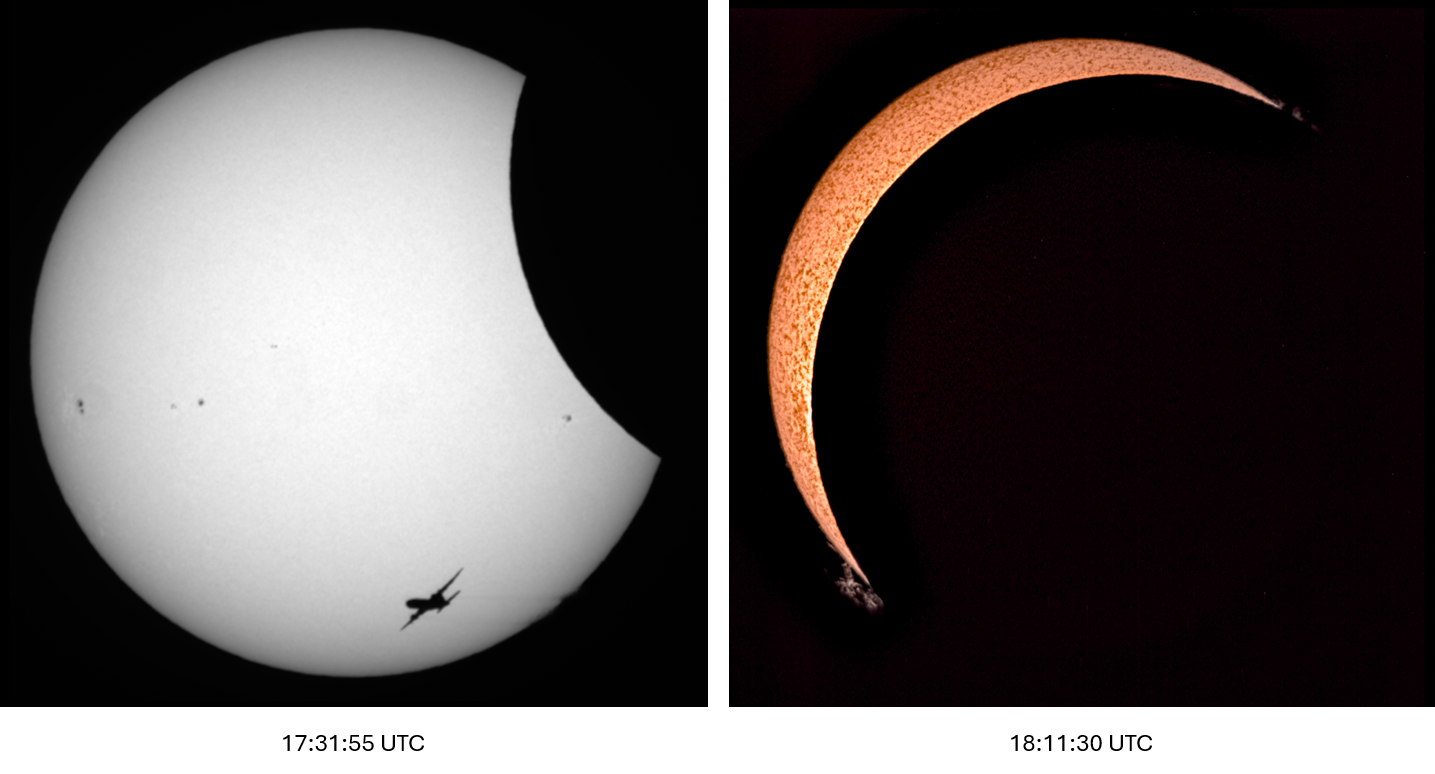
On August 12th, the station captured a partial solar eclipse. It was the largest solar eclipse visible in Belgium since the total solar eclipse of 1999. For Uccle, a maximum of 91.1% of the solar diameter was covered by the Moon, with the full solar diameter taken as 100%. The Moon began to cover the Sun at 17:18:53 UTC, and maximum coverage occurred at 18:13:41 UTC. The eclipse ended after sunset, so the final phase was not observed from Uccle. The last images were taken at 18:24 UTC. Underneath are two videoclips of the eclipse in white light (top) and H-alpha (bottom). Buildings and trees near the observatory are hiding a portion of the solar disc near the end of the videoclips. The stills following the clips show some key moments of the evolution of the eclipse.
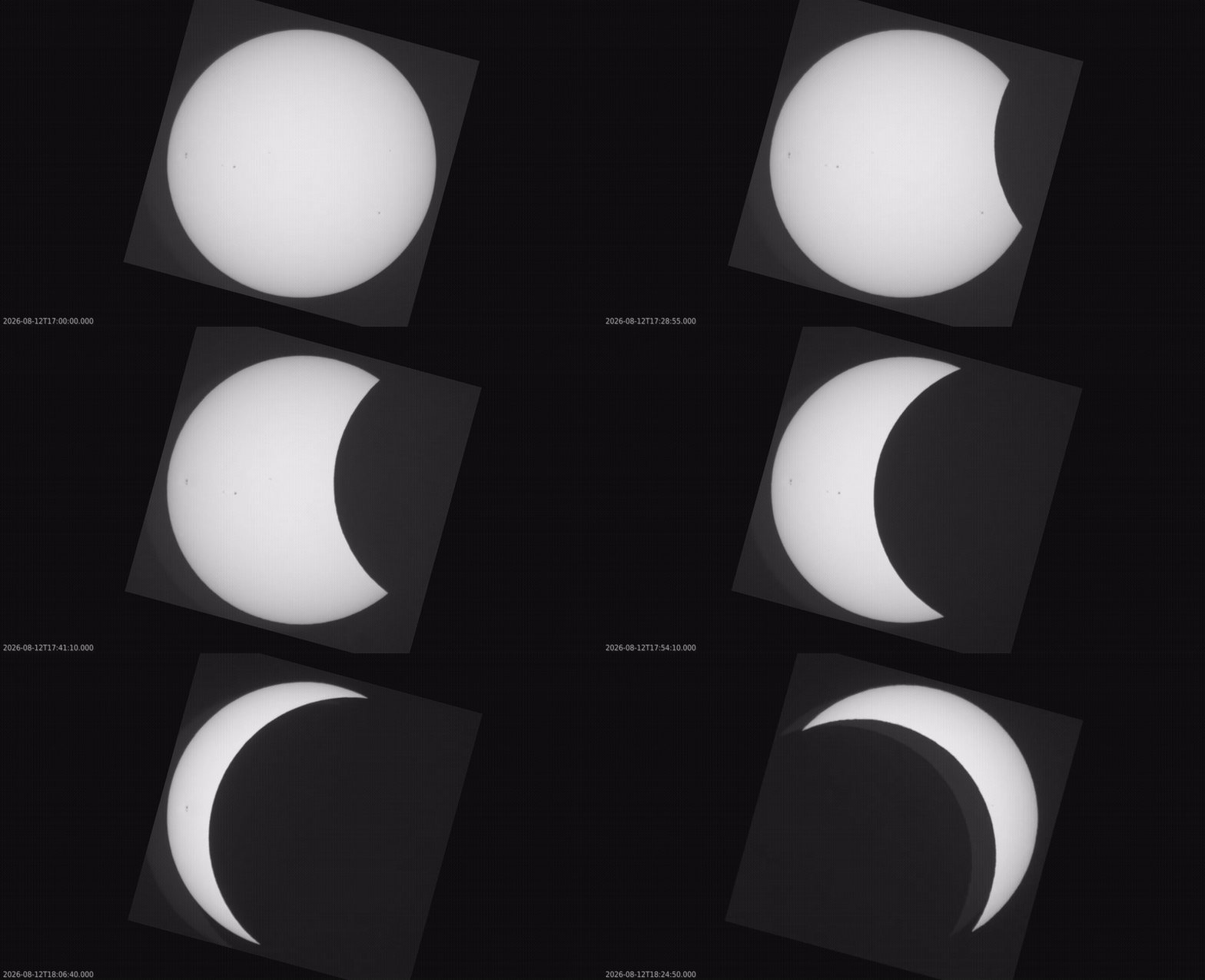
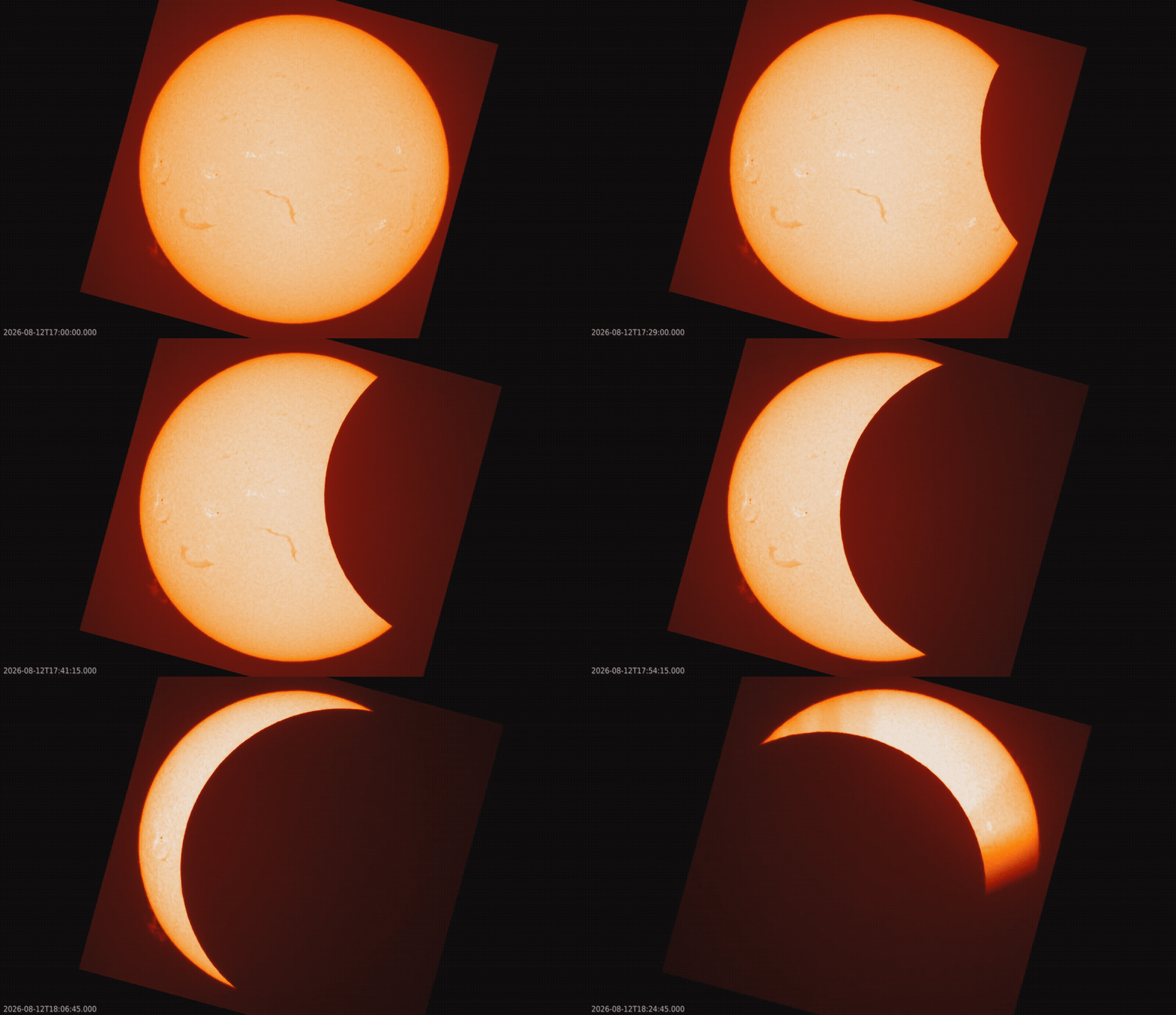
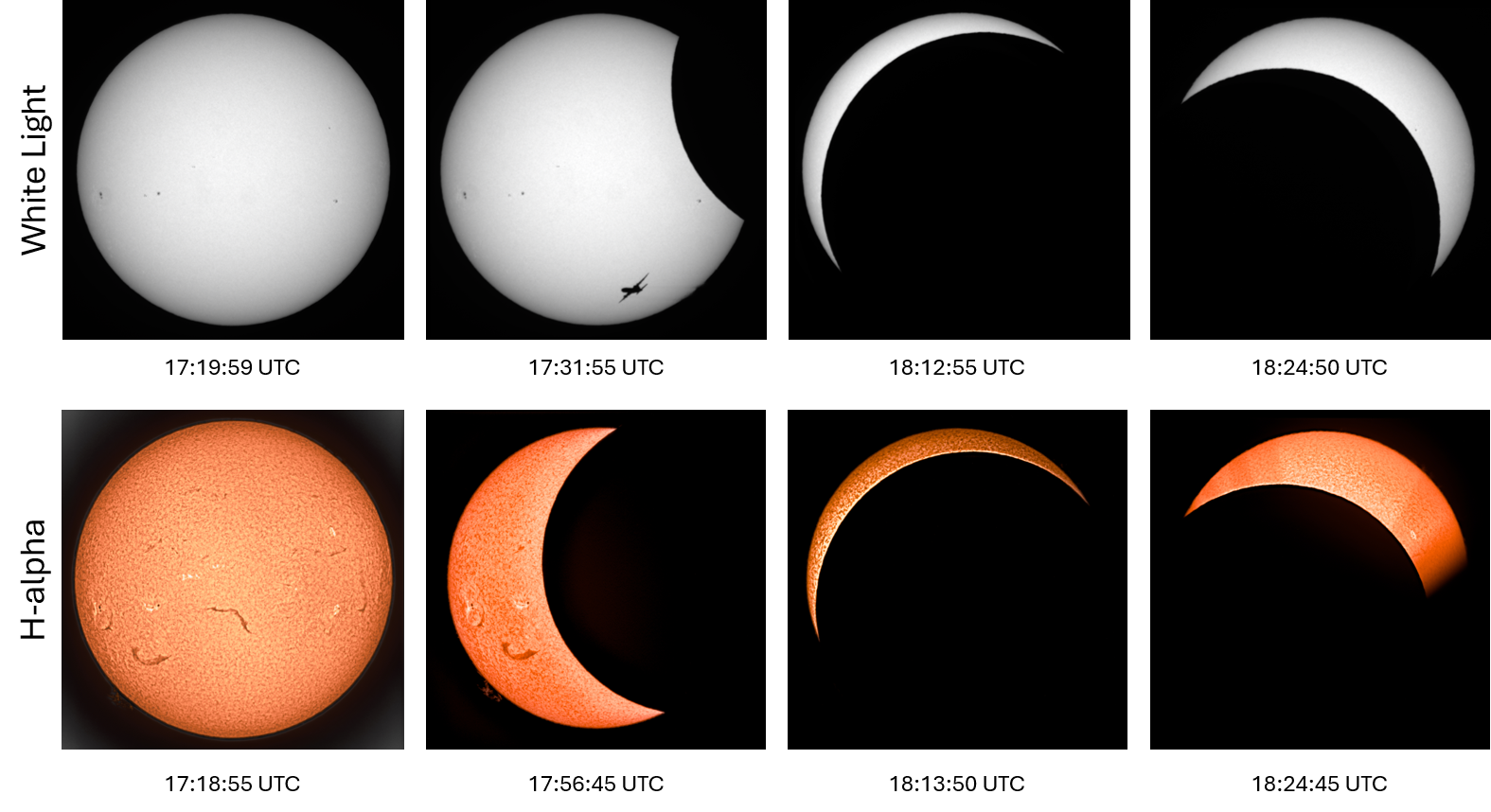
In H-alpha, a beautiful prominence was visible at the east limb (lower left), while in white light an airplane was captured passing in front of the solar disc during the eclipse. These images are highlighted underneath. The dark spots that can be seen in white light are sunspots, local disturbances of the magnetic field at the solar surface. The reddish colour in the H-alpha images reflects better what can be seen in a typical H-alpha telescope. The dark lines that can be seen are filaments (see images above), and over the lower left solar limb a relatively large prominence can be seen. Solar filaments are clouds of charged particles ("plasma") above the solar surface squeezed between magnetic regions of opposite polarity. Being cooler and denser than the plasma underneath and their surroundings, they appear as dark lines when seen on the solar disc and as bright blobs when seen near the solar limb (then they are called "prominences"). Special filters are required to observe these features, and one such a filter is the Hydrogen-alpha (H-alpha) line in the red part of the solar spectrum.
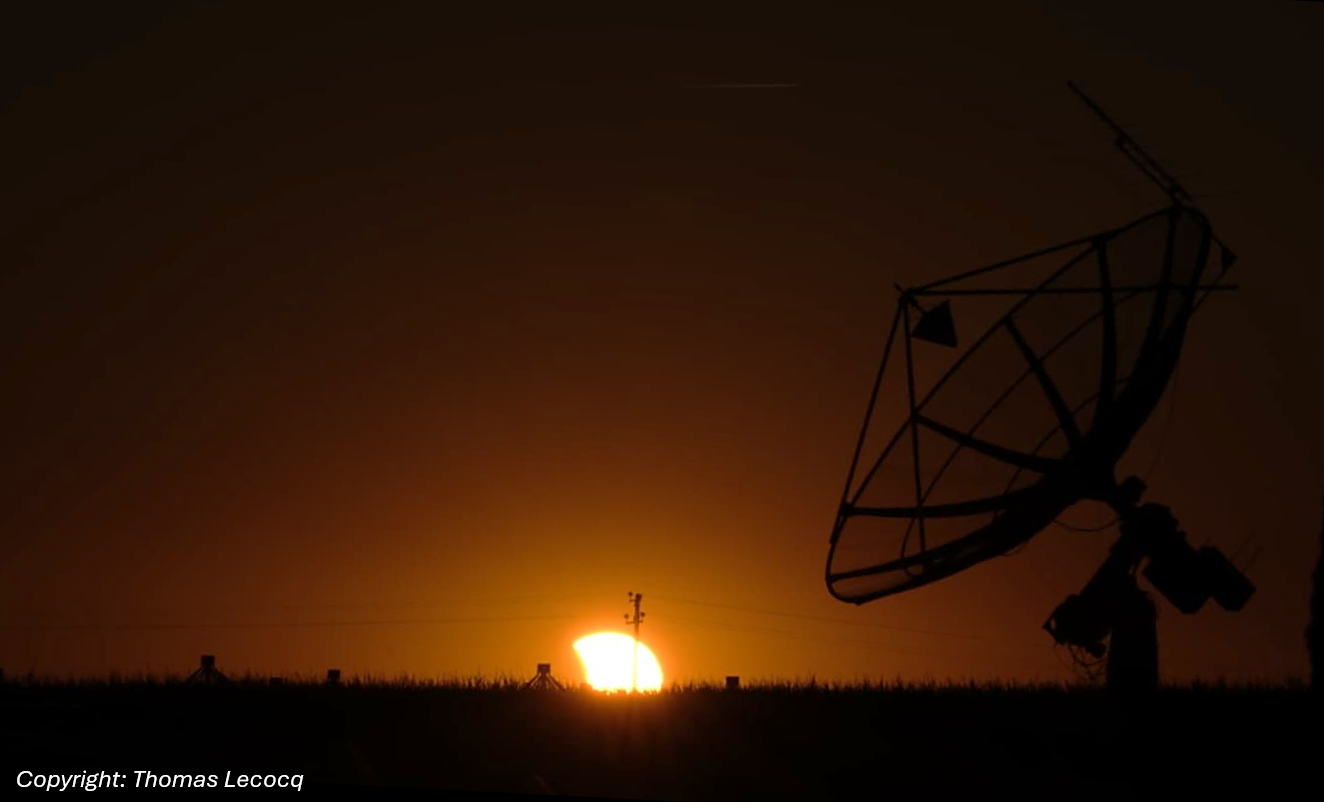
And just to get even more in the "mood", the image underneath was taken by Thomas Lecocq. It shows the setting of the still partially eclipsed Sun as seen from the radioastronomy station in Humain (see this STCE newsitem at and the 14 August STCE Newsletter). One can easily recognize the main big radio telescope (to the right) as well as a few of (the tops of) the smaller SPADE telescopes.
Credits
- The USET eclipse images and videoclips were taken by Joan Vandekerckhove and Olivier Boulvin.
- Sabrina Bechet contributed to the text for this newsitem.
- Thomas Lecocq has the rights on the eclipse image taken from the Humain radioastronomy station.